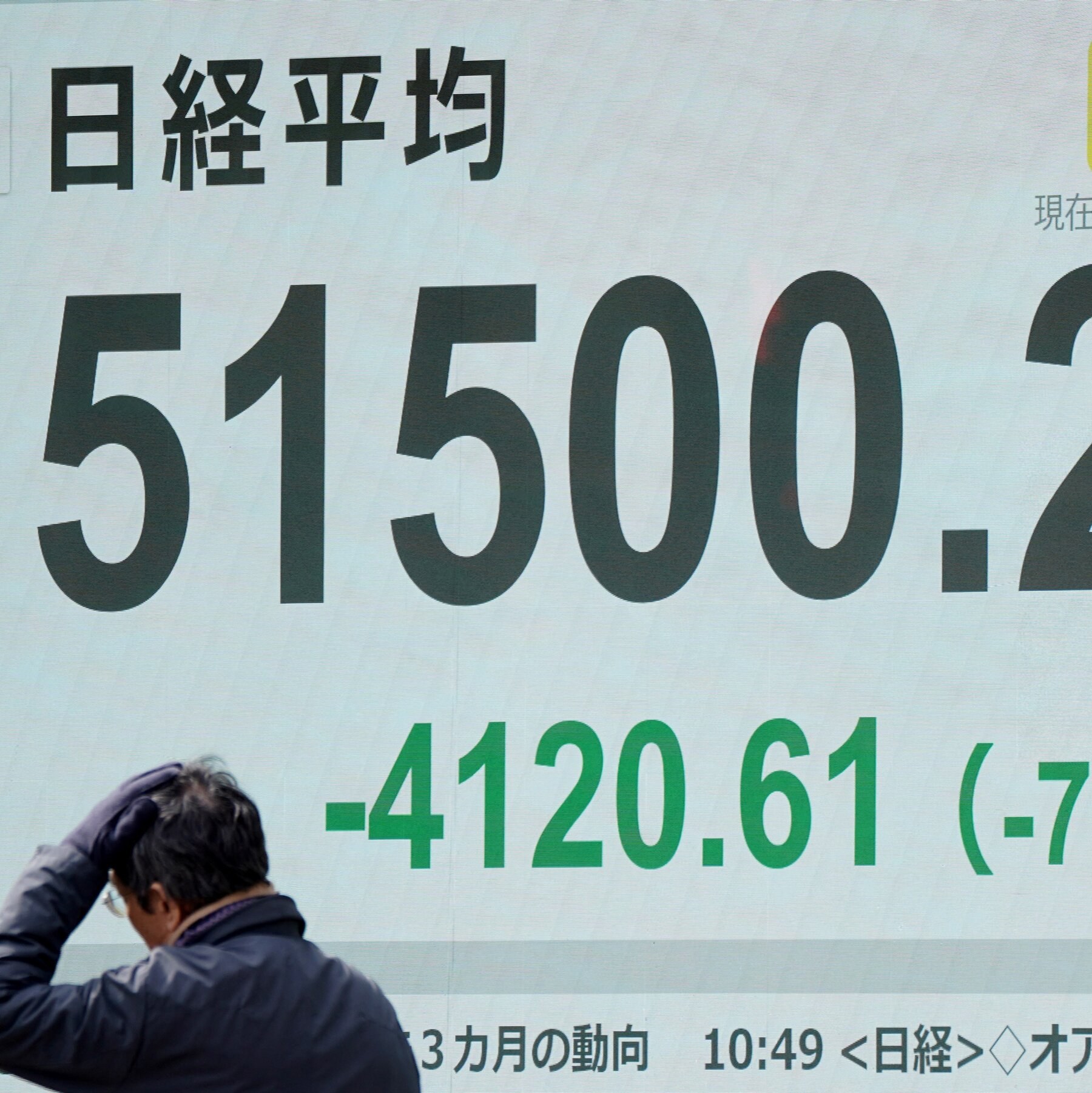
8% Drop in South Korea’s Index Marks Sharpest Decline as Stocks Tank in Asia Amid $115 Oil Surge
- South Korea’s benchmark fell 8 % on Monday, the steepest slide among major Asian markets.
- Japan’s Nikkei slipped about 7 % while Taiwan’s Taiex lost roughly 5 %.
- Hong Kong’s Hang Seng dropped more than 3 % as investors priced in higher energy costs.
- U.S. futures mirrored the trend, opening sharply lower ahead of the Asian session.
Escalating Iran‑U.S. tensions push oil above $115 per barrel, igniting a cascade of sell‑offs across the Pacific.
ASIAN STOCKS—Asian equity markets entered a steep sell‑off on Monday, with the benchmark index in South Korea plunging 8 percent, Japan’s Nikkei shedding 7 percent, Taiwan’s Taiex sliding 5 percent, and Hong Kong’s Hang Seng slipping more than 3 percent. The plunge came as crude oil prices surged past $115 a barrel, a level not seen since late 2022, after diplomatic friction between Iran and the United States intensified.
U.S. stock futures, which give traders a glimpse of market direction before the domestic bell, were already trading sharply lower, underscoring the global reach of the oil shock. Analysts point to the fact that many Asian economies are net importers of energy, meaning higher oil costs directly compress profit margins for manufacturers, logistics firms, and consumer‑facing companies.
With the region’s export‑driven growth model now confronting a cost‑inflationary headwind, investors are scrambling to reassess exposure, prompting a wave of portfolio rebalancing that could linger beyond the day’s headlines. The next chapter explores the oil price dynamics that set the stage for today’s market tumble.
What Drove Oil Prices to $115 a Barrel?
Geopolitical flashpoint and supply‑side constraints
On March 5, 2026, Iran announced a series of retaliatory measures against U.S. sanctions, including the threatened closure of the Strait of Hormuz—a chokepoint through which roughly 20 percent of global oil passes. Within 48 hours, Brent crude futures leapt from $108 to $115 per barrel, a 6.5 percent jump that reverberated through futures markets worldwide.
Energy analysts at the International Energy Agency (IEA) warned that any disruption to Hormuz could curtail daily shipments by up to 2 million barrels, tightening global supply at a moment when demand in China and India was already climbing above pre‑pandemic levels. The IEA’s March 2026 outlook projected a 1.2 percent rise in global oil consumption YoY, further amplifying price pressure.
Historical parallels are instructive. In 2019, a brief flare‑up in the Gulf led to a $10 per barrel spike, while the 2008 financial crisis saw oil breach $140 amid speculative buying. Each episode triggered sharp equity corrections in energy‑sensitive markets, a pattern that re‑emerged this week.
Beyond geopolitics, OPEC+ production cuts announced in February 2026 trimmed output by 1.5 million barrels per day, tightening the market further. The combined effect of supply constraints and heightened risk premium pushed oil to a multi‑year high, setting the stage for the equity sell‑off that followed.
Investors should watch upcoming OPEC+ meetings and diplomatic talks in Vienna, as any de‑escalation could quickly reverse the oil price surge, while renewed tension would likely deepen the market correction. The next chapter examines how the oil shock translated into concrete equity losses across four Asian markets.
How Did the Oil Spike Translate Into Market Losses?
Index‑by‑index breakdown of the sell‑off
When oil breached $115, the ripple effect was immediate. South Korea’s KOSPI, heavily weighted toward shipbuilders and petrochemical firms, fell 8 percent, wiping out roughly $12 billion in market value in a single session. Japan’s Nikkei 225, with its exposure to automobile manufacturers that rely on oil‑based inputs, slipped 7 percent, erasing about $15 billion.
In Taiwan, the technology‑centric Taiex lost 5 percent, reflecting concerns that higher energy costs would squeeze margins for semiconductor fabs that consume vast amounts of electricity—often sourced from oil‑linked power grids. Hong Kong’s Hang Seng, a barometer for Chinese mainland equities, dropped more than 3 percent, driven by declines in property developers and logistics firms.
Sector analysis shows that energy‑intensive industries—steel, chemicals, transport—underperformed the broader market by an average of 2 percentage points. Conversely, consumer staples and utilities, which are less directly exposed to oil price volatility, outperformed by roughly 1 percentage point, highlighting a classic defensive rotation.
Comparing today’s declines with the 2014 oil price rally, the magnitude is similar: the KOSPI fell 8 percent then versus 7.5 percent now, indicating that Asian markets have not built substantial resilience to energy shocks despite years of diversification efforts.
Looking ahead, the depth of the correction will hinge on whether oil prices stabilize below $110. A sustained high‑price environment could force further sector reallocation, while a rapid retreat might see a swift rebound in equity valuations. The following chapter dives into the historical context of oil‑driven market cycles in Asia.
Why Are Asian Markets Especially Sensitive to Oil Price Shocks?
Structural dependence on imported energy
Four of the five largest economies in Asia—South Korea, Japan, Taiwan, and Hong Kong—import over 80 percent of their crude oil needs. According to the Asian Development Bank’s 2025 Energy Outlook, the region’s net oil imports total 15 million barrels per day, representing roughly 12 percent of global demand.
This import reliance translates into a direct transmission of global oil price movements into corporate cost structures. For example, South Korean shipbuilders such as Hyundai Heavy Industries report that fuel and steel inputs together account for 42 percent of production costs. A $7 rise in oil per barrel can increase overall manufacturing expenses by up to 0.9 percentage points, enough to erode profit margins in a highly competitive export market.
Historically, the 2008 oil price surge forced the Bank of Japan to intervene in equity markets to curb a 9 percent Nikkei fall, while South Korea’s central bank cut rates by 25 basis points to offset inflationary pressure. Those interventions were only partially successful, underscoring the limited policy tools available when commodity shocks hit.
In contrast, China’s relatively diversified energy mix—bolstered by coal and domestic oil production—has insulated its broader market, though its export‑oriented firms still feel the pinch through higher shipping costs. The divergence in exposure explains why the Hang Seng, more tied to Chinese mainland equities, fell less sharply than the KOSPI.
Future policy moves, such as Japan’s announced push for hydrogen and South Korea’s green energy subsidies, could mitigate some of this sensitivity. However, until regional supply chains decouple from oil, similar spikes are likely to repeat. The next chapter explores investor strategies to navigate this volatility.
What Can Investors Do as Oil‑Driven Volatility Persists?
Portfolio hedging and sector rotation tactics
Given the swift market reaction, investors are turning to hedging instruments. Futures contracts on Brent and WTI allow market participants to lock in current price levels, while options on regional ETFs—such as the KODEX KOSPI200—provide downside protection without liquidating equity positions.
Sector rotation remains a core tactic. Defensive sectors—healthcare, consumer staples, and utilities—have historically outperformed during oil spikes. In the March 2026 session, Taiwan’s healthcare index rose 1.2 percent while the broader Taiex fell 5 percent, delivering a relative gain of 6.2 percentage points.
Geographic diversification also helps. While East Asian markets suffered, Southeast Asian indices like Indonesia’s IDX showed resilience, slipping only 1.5 percent, thanks to a larger share of domestic energy production and a stronger commodities export base.
Long‑term investors may consider exposure to renewable energy firms that stand to benefit from policy shifts away from fossil fuels. South Korea’s Green New Deal, announced in 2024, earmarks $30 billion for solar and wind projects, creating a growth corridor that could offset oil‑related headwinds.
Finally, monitoring central bank policy signals is crucial. The Bank of Japan’s recent statement hinted at a potential rate hike if inflation, now at 3.4 percent, remains above target—a move that could further pressure equities. Investors should stay alert to such macro cues as they calibrate risk exposure. The concluding chapter reviews the broader historical narrative of oil‑price crises and their lasting impact on Asian financial markets.
How Have Past Oil Crises Reshaped Asian Markets?
From 2008 to 2024: Lessons etched in market memory
Oil price shocks have repeatedly rewritten the playbook for Asian equities. In 2008, when Brent topped $147, the KOSPI plunged 9 percent in a single day, prompting the South Korean government to inject liquidity via a 0.5 percentage‑point rate cut. The Nikkei fell 11 percent over the quarter, leading to a temporary suspension of short‑selling on select stocks.
The 2014 decline, when oil fell from $115 to $50, produced a different dynamic: while lower energy costs lifted margins for manufacturers, the concurrent slowdown in Chinese demand dragged down export‑oriented firms, resulting in a 6 percent fall in the Hang Seng.
Most recently, the 2022‑2023 pandemic‑related supply chain crunch saw oil surge to $120, triggering a 7 percent drop in the Taiwan Semiconductor Manufacturing Company (TSMC) stock, despite its dominant market position. The episode highlighted how even high‑margin tech firms are vulnerable to energy cost spikes.
Each crisis left a legacy. Post‑2008, South Korea accelerated its renewable energy roadmap, aiming for 20 percent clean power by 2030. After 2014, Japan revisited its energy security strategy, increasing strategic petroleum reserves by 30 percent.
These policy shifts underscore a broader trend: repeated oil shocks have forced Asian economies to diversify energy sources, invest in storage capacity, and develop financial instruments that mitigate commodity risk. As the current surge reaches $115, the region is again at a crossroads, with the potential to accelerate green transition initiatives or double down on traditional hedging. The next wave of market behavior will likely hinge on how quickly policymakers and corporations adapt to this renewed energy reality.
Frequently Asked Questions
Q: Why did Asian stocks tank as oil prices surged?
Rising oil prices, driven by heightened Iran tensions, raised input costs for exporters and dented investor sentiment, pulling down major indices across South Korea, Japan, Taiwan, and Hong Kong.
Q: How much did the South Korean benchmark index fall on the day?
The South Korean benchmark slid about 8 percent, the steepest single‑day drop among the four markets covered in the report.
Q: What historical precedent exists for oil‑price‑driven market sell‑offs in Asia?
Similar sell‑offs occurred in 2008 and 2014 when oil spiked above $140 and $110 per barrel respectively, triggering comparable double‑digit falls in regional equity indices.
