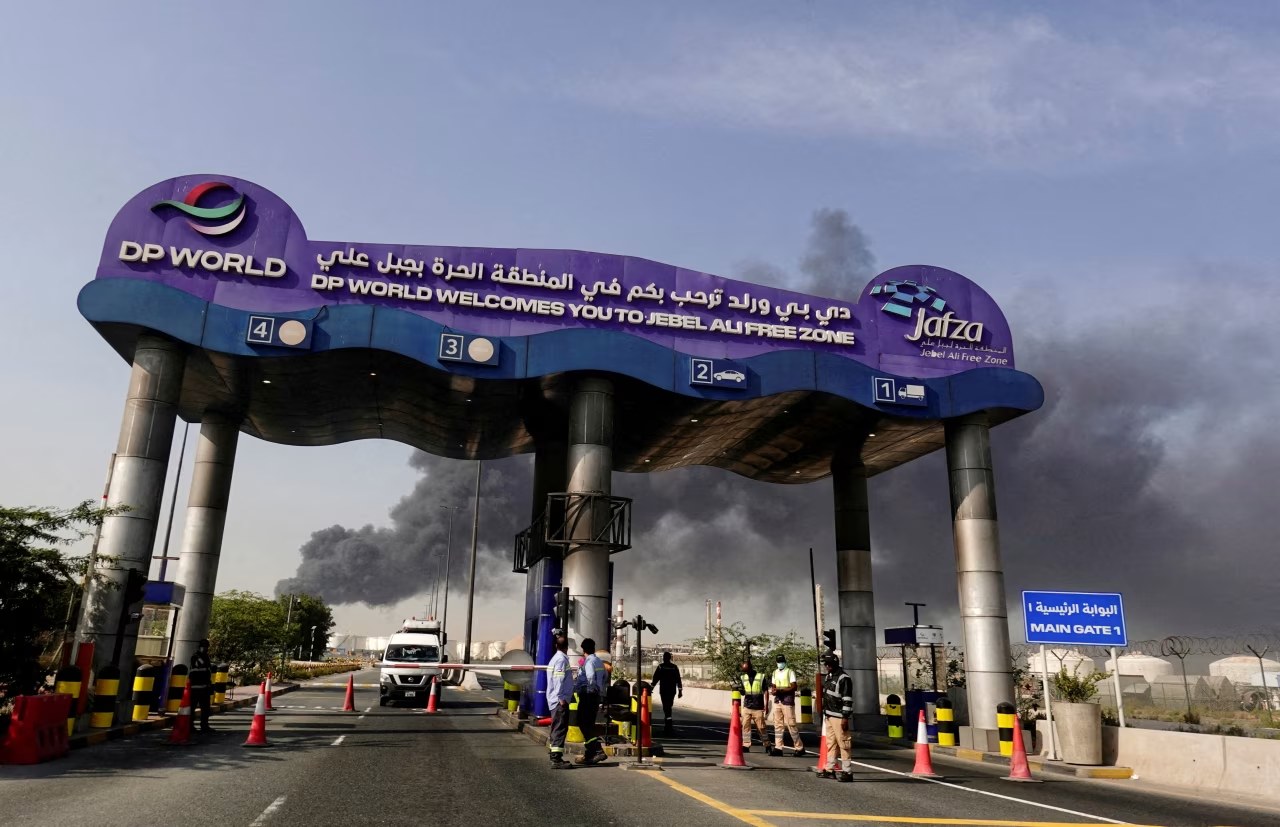
Over 100 Ships Stranded as Strait of Hormuz Closure Doubles Freight Rates
- U.S. and Israeli strikes on Iran triggered the virtual shutdown of the 21-mile Strait of Hormuz, a lane for one-fifth of seaborne oil.
- Grimaldi Group had a Europe-to-Gulf car carrier diverted mid-voyage; delivery dates are now unknown.
- Container spot rates from Asia to Middle-East ports have roughly doubled in two weeks.
- Jebel Ali, Mundra and Colombo hubs report berth congestion as cargoes are rerouted.
From energy to automobiles, the Middle-East conflict is paralysing trade arteries that move $1.2 trillion in annual merchandise.
STRAIT OF HORMUZ—The first sign of trouble for Emanuele Grimaldi, managing director of Italy’s Grimaldi Group, came when his operations centre lost satellite contact with a 5,500-vehicle car carrier transiting the Indian Ocean. Within hours, U.S. and Israeli munitions began striking Iranian soil, and insurers withdrew coverage for any vessel attempting to enter or exit the Persian Gulf. The ship, loaded with roughly 2,000 European cars bound for Dubai and Kuwait, is now steaming toward an undisclosed “safe haven” port while its customers face indefinite delays.
Grimaldi’s plight illustrates a broader paralysis: more than 100 commercial ships—from container giants to very-large-crude-carriers (VLCCs)—are now stuck inside the Gulf, according to Lloyd’s List Intelligence data. The trigger is the effective closure of the Strait of Hormuz, the 21-mile-wide maritime chokepoint that carries 21 million barrels of oil a day and an estimated 12% of global container traffic between Asia, the Middle East and Europe.
Freight markets are responding with the velocity of a commodity squeeze. Shanghai-to-Dubai spot container rates have approximately doubled since the first salvos were reported, while VLCC day-rates on the key Asia-to-Middle East route have vaulted to their loftiest level since the Ukraine war, according to London-based broker Howe Robinson. “The strait is the aorta of world energy trade,” says Esben Poulsson, former chairman of the International Chamber of Shipping. “When it narrows, every downstream vein—from car parts to chemicals—feels the clot.”
The Strategic Physics of the 21-Mile Chokepoint
Geography grants the Strait of Hormuz an outsized role in commerce. At its narrowest, the shipping lane shrinks to two nautical miles—barely 3.7 kilometres—within Omani and Iranian territorial waters. Roughly 20% of all seaborne petroleum and 25% of liquefied natural gas transit this slit each day, according to the U.S. Energy Information Administration. Container lines also use the lane as the fastest path from Shanghai and Ningbo to the booming consumption markets of Dubai, Jeddah and, via the Suez Canal, Europe.
When conflict risk escalates, insurers invoke “additional premium” clauses within hours. The London insurance market has now slapped a war-risk surcharge of up to 5% of hull value on any vessel entering the strait, says Marcus Baker, global head of marine and cargo at broker Marsh McLennan. For a modern 24,000-teu box-ship worth $180 million, that equals a $9 million surcharge for a single passage—enough to erase the entire profit on a round-voyage.
Why a tiny waterway moves a tenth of world trade
The strait’s closure does not require a physical blockade. Satellite imagery analysed by MarineTraffic shows at least 11 Very Large Crude Carriers (VLCCs) drifting off Iran’s Kharg Island terminal, unable to load or discharge. Another 97 bulkers, box-ships and product tankers are anchored outside Gulf ports from Dammam to Sohar, effectively quarantined until underwriters restore cover. “You have a floating warehouse of oil, cars and grain with nowhere to go,” says Ranjith Raja, head of MENA trade flows at Refinitiv.
The knock-on effect is immediate for Europe’s auto giants. BMW, which ships roughly 30,000 vehicles a month via Jebel Ali into Gulf showrooms, has already diverted two roll-on/roll-off (RoRo) vessels to Port Said East in Egypt, adding 12 days to transit time. Volkswagen confirmed it is “evaluating alternative routes,” but rail off-loading points in the Levant are at capacity. Analysts at S&P Global Mobility estimate the delays could subtract 18,000 European car deliveries in the current quarter alone.
Looking ahead, shipping executives warn that even a partial reopening will not unwind the logjam quickly. “Port congestion has memory,” notes Poulsson. “It takes weeks to clear berths once queues form, and schedule reliability is already at historic lows.”
Freight Rates Spike First, Consumer Prices Follow
Rate indices are the earliest thermometer of supply-chain stress. On 17 October, the Shanghai-to-Middle East component of the Shanghai Containerized Freight Index (SCFI) printed $1,940 per teu, up from $970 just fourteen days earlier, according to the Shanghai Shipping Exchange. That 100% surge matches the steepest climb since the 2021 Suez Canal blockage, says Tan Hua Joo, executive consultant at Alphaliner.
Crude-tanker markets exhibit the same whiplash. VLCC day-rates for a benchmark Middle-East-to-Asia run touched WS 185 points, equivalent to $95,000 per day, compared with $38,000 before the strikes. “Shipowners are demanding cash up front because they don’t know if the route will be open next week,” says Anoop Singh, head of tanker analytics at Braemar ACM. The jump adds roughly $1.30 to the landed cost of every barrel of crude—an inflationary pulse that eventually reaches petrol pumps from Mumbai to Melbourne.
How surcharges ripple to supermarket shelves
Consumer-goods importers face the same arithmetic. A single 40-foot container from Shenzhen to Dubai now commands $5,800 versus $2,900 at the start of October, according to Freightos data. That extra $3,000 equals roughly 18 cents per microwave oven or 11 cents per pair of running shoes—costs that big-box retailers typically pass through within 60 days, says Walter Kemmsies, a logistics economist at Jones Lang LaSalle.
Air-cargo markets are tightening in sympathy. Dubai International, a key trans-shipment point for perishables, has seen belly-freight capacity to Europe fall 12% as wide-body jets refuel in Asia rather than the UAE. Kenyan exporters of cut flowers report air-freight rates to Amsterdam up 24% week-on-week, threatening margins on Valentine’s Day forward contracts.
Historical precedent suggests the spike could linger. After the 2019 Abqaiq–Khurais attacks on Saudi oil facilities, VLCC rates stayed 40% above baseline for six weeks even though physical damage was limited. “Markets price the risk premium long before the smoke clears,” Singh notes.
Port Congestion From Jebel Ali to Colombo
Jebel Ali, the largest man-made harbour in the Middle East, typically handles 14.1 million teu annually—about 3,800 containers per hour. Since the conflict escalated, vessel-waiting time has doubled from 0.8 days to 1.6 days, according to Dubai Maritime City Authority data. The port’s container yard is now at 92% utilization, perilously close to the 95% threshold that forces carriers to omit sailings.
Carriers have responded by “blanking”—or cancelling—at least 11 scheduled voyages to the Gulf and Red Sea over the next three weeks, Maersk and Hapag-Lloyd booking advisories show. That equates to roughly 220,000 teu of lost capacity, or 4% of the normal Asia–Middle East trade lane supply, says Niels Madsen, vice-president of Sea-Intelligence.
When vessels skip ports, cargo rolls over
The skipped sailings create a bullwhip effect. Containers already gated into Jebel Ali must await the next available vessel, adding 7–14 days to delivery. European auto-parts supplier Mahle has confirmed that engine components bound for its Abu Dhabi service centre will be “delayed indefinitely,” forcing local dealers to dip into safety stock.
Indian ports are absorbing some overflow. Mundra Port on India’s west coast has seen a 17% week-on-week jump in trans-shipment boxes that would normally move through Dubai. Yet Mundra’s yard density has risen to 85%, and rail connections to Delhi are saturated, says DP World Mundra chief executive Shivam Misra.
Sri Lanka’s Colombo port, another regional hub, is experiencing similar stress. The port authority has extended gate opening hours to 24/7 and waived storage fees for the first five days to prevent gridlock. Still, container dwell time has crept up to 5.2 days from 3.9 days, according to Sri Lanka Ports Authority statistics.
The congestion is compounding global schedule reliability, which had only recently recovered to 65% after pandemic-era dislocations. “We’re going backwards,” says Madsen. “Every skipped sailing ripples to Europe and North America because ships are out of position for their next rotation.”
Is the World Heading Toward a 2021-Style Supply Crunch?
The current turmoil evokes memories of March 2021, when the Ever Given blocked the Suez Canal for six days and cost world trade $9.6 billion daily, according to Allianz Trade calculations. Yet there are key differences. In 2021, demand for physical goods was surging amid Covid stimulus; today, containerised trade volumes are flat and inventory-to-sales ratios in the U.S. and EU are above pre-pandemic levels, says OECD trade economist Przemyslaw Kowalski.
Energy markets, however, are more precarious. Global petroleum inventories sit 56 million barrels below their five-year seasonal average, according to the International Energy Agency. Any prolonged Hormuz shutdown could push Brent crude into triple-digit territory, raising freight fuel surcharges that eventually embed into consumer prices. “Oil inventories are the thinnest they’ve been since Libya’s 2011 civil war,” notes Amrita Sen, director of research at Energy Aspects.
Inventory buffers are thinner this time
Semiconductors, critical for autos and consumer electronics, are another vulnerability. Malaysia’s Penang port, a major chip-packaging hub, relies on Middle-East-bound tankers for the naphtha feedstock used in plastic casings. A 10-day delay in naphtha supply translates into a three-week bottleneck in back-end semiconductor testing, says Ondrej Burkacky, partner at McKinsey’s semiconductor practice. With global chip stockpiles at 38 days of demand—down from 42 days last year—there is little cushion.
Food security is also in focus. India, the world’s biggest rice exporter, moves 35% of its outbound grain through Iranian waters destined for Africa and the Middle East. The Indian government has temporarily relaxed its ban on broken-rice exports to clear ports, but freight costs have added $18 per tonne, eroding razor-thin margins for African importers, says Tejinder Narang, a New-Delhi-based grain economist.
Still, most analysts stop short of predicting a 2021-style systemic crunch. “Back then, we had simultaneous shocks on demand, labour and capacity,” says Kowalski. “Today’s shock is geographic, not systemic. If diplomacy reopens the strait, rates normalise within six weeks.” Whether diplomacy arrives before inventories run dry is the gamble world trade now faces.
What Diplomatic Off-Ramps Could Reopen the Waterway?
Maritime lawyers point to three precedents for safely reopening contested chokepoints: the 1988 Iran–Iraq ceasefire that ended the “Tanker War,” the 2015 Joint Comprehensive Plan of Action (JCPOA) that lifted sanctions on Iranian crude exports, and the 2023 China-brokered Saudi–Iran détente that briefly lowered regional risk premiums.
Each template offers a different lever. A ceasefire could see the U.S. Navy’s Fifth Fleet escort commercial convoys, mirroring the 1987–88 Operation Earnest Will that re-established oil traffic within six months. Sanctions relief, by contrast, would give Tehran an economic incentive to curb militia attacks on shipping, says Ellie Geranmayeh, deputy director of the Middle East programme at the European Council on Foreign Relations. “Iran’s crude exports have already fallen to 700,000 b/d from 1.5 million in August under U.S. pressure; offering partial waivers could buy de-escalation,” she argues.
Convoys, waivers or a new JCPOA—what works fastest?
Regional diplomats say Oman and Qatar are floating a phased plan: an immediate two-week humanitarian truce during which commercial vessels could transit under a flag-neutral naval escort, followed by indirect talks in Muscat. U.S. Secretary of State Antony Blinken held a five-hour meeting with his Omani counterpart last week, though no communique was issued.
China, the world’s largest crude importer, has a vested interest: 42% of its oil transits the strait. Beijing’s foreign ministry has called for “cool-headed restraint” and offered to mediate, repeating playbook language used before the 2023 Saudi–Iran accord. “China’s economic leverage is sizeable, but its naval footprint is limited; expect quiet economic pressure rather than flotilla diplomacy,” says Mathieu Duchâtel, director of the Asia programme at the Institut Montaigne.
Shipping executives privately back the convoy option as the quickest route to lower insurance premiums. “If the U.S., U.K. and France provide naval escorts, war-risk premiums could drop 70% within a fortnight,” estimates Marsh McLennan’s Baker. Yet history cautions that convoys can invite escalation: in 1987, an Iraqi jet mistakenly struck the USS Stark, killing 37 sailors, highlighting the razor-thin margin for miscalculation.
The ultimate off-ramp may be economic exhaustion. Analysts at ClearView Energy Partners estimate that every week of closure costs Iran $450 million in lost crude sales, while Dubai’s Jebel Ali port loses $120 million in trans-shipment revenue. “Pain becomes the diplomat,” says Geranmayeh. “When the cost of closure outweighs the geopolitical gain, the strait quietly reopens—usually at 2 a.m. with the first unescorted tanker testing the waters.”
Frequently Asked Questions
Q: Why is the Strait of Hormuz critical for global trade?
Roughly 20% of the world’s seaborne oil and 25% of its liquefied natural gas pass through this 21-mile-wide chokepoint, making any closure an immediate inflationary shock for energy and containerised goods.
Q: How many ships are affected by the current disruption?
More than 100 vessels—from container ships to tankers—are now idling inside the Persian Gulf, unable to exit or enter through the strait without risking interception or strike.
Q: Which freight routes have seen the biggest rate spikes?
Spot rates for 40-foot containers from Shanghai to Dubai have approximately doubled within a fortnight, while very-large-crude-carrier (VLCC) day-rates from Asia to the Middle East have leapt to their highest level since the 2022 Ukraine war.
