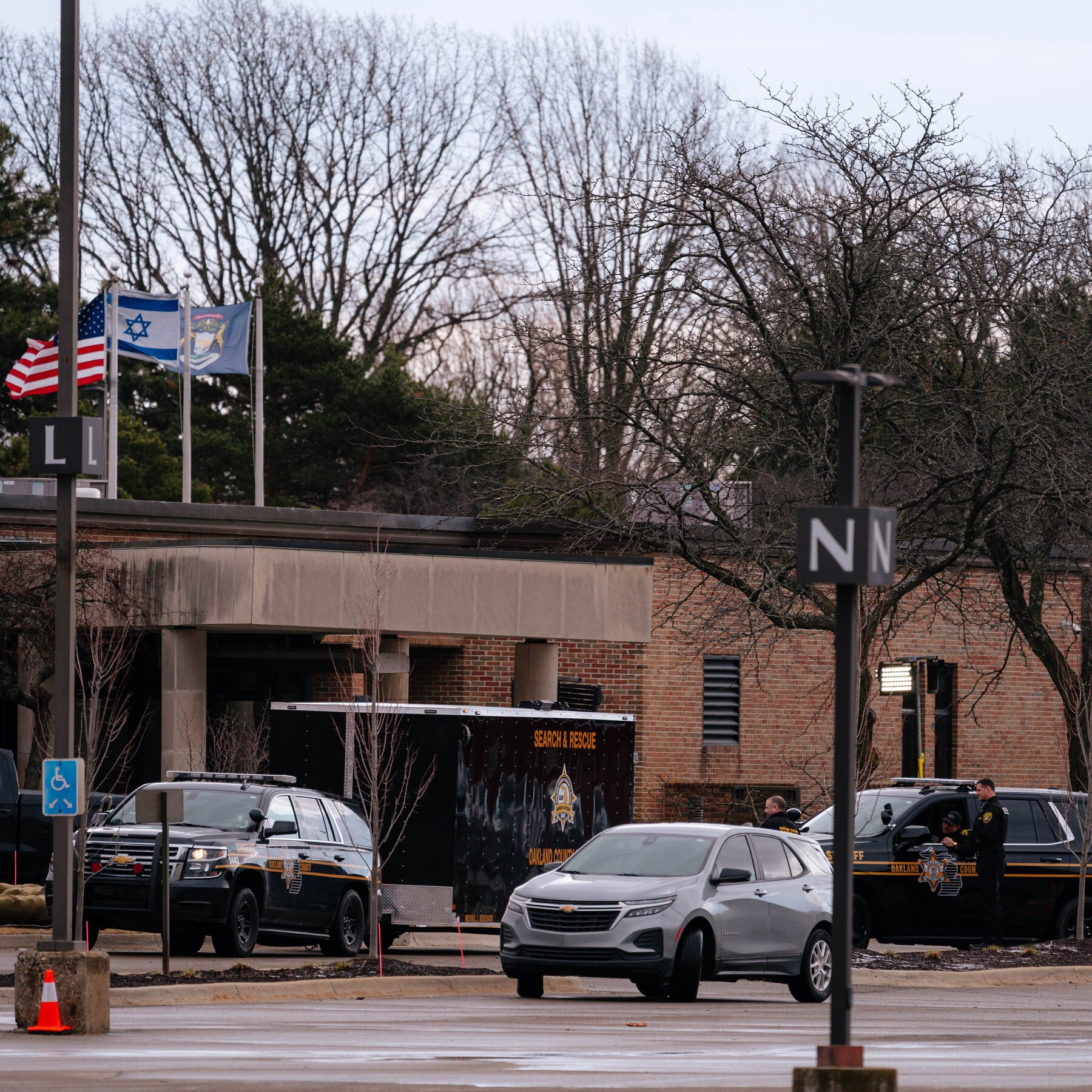
Officials: Michigan Synagogue Attack Was Planned Hezbollah-Inspired Strike
- FBI and state investigators say the driver intentionally targeted the Jewish community after days of reconnaissance.
- Digital evidence shows the suspect studied Hezbollah vehicular-ramming tactics used against Israeli civilians.
- No fatalities reported, but the synagogue sustained significant structural damage and one person was treated for minor injuries.
- Federal prosecutors are weighing terrorism charges that could bring a 30-year mandatory minimum sentence.
The assault marks a chilling escalation in domestic plots inspired by foreign terror groups.
MICHIGAN SYNAGOGUE ATTACK—Authorities revealed that a man who deliberately crashed his vehicle into a Michigan synagogue spent days planning the attack and was “inspired by Hezbollah,” according to federal and state law-enforcement officials speaking Monday. The admission, contained in a brief but stark statement, elevates the incident from a possible hate crime to a federally investigated domestic-terror plot.
Investigators told reporters the driver, whose identity has not yet been released, selected the synagogue after researching prior vehicular attacks carried out by the Lebanese militant group against Israeli targets. Surveillance footage shows the suspect circling the building multiple times in the 72 hours before the strike, timing traffic patterns and noting when congregants arrived for morning services.
While no one was killed, the attack shattered stained-glass windows, buckled the main sanctuary’s rear wall, and sent one congregant to the hospital with minor injuries. The FBI’s Joint Terrorism Task Force has now assumed control of the probe, signaling the seriousness with which federal officials view the threat.
The Blueprint of a Hezbollah-Style Assault
Law-enforcement sources say the suspect’s preparation mirrored operational guidance found in Hezbollah online propaganda: identify a soft civilian target, rehearse approach routes, and accelerate into entryways during low-security windows. The Michigan synagogue, located in a mid-sized city with limited police patrols, fit that profile precisely.
Counter-terror analysts note that since 2016, Hezbollah’s media arm has circulated at least a dozen Arabic-language videos glorifying vehicle-ramming attacks in Israel and the West Bank. Those clips, often repurposed on fringe English-language forums, emphasize using everyday vehicles as “tools of resistance.” FBI behavioral experts believe the suspect absorbed this narrative and adapted it to an American context.
Security-camera timestamps reviewed by investigators show the attacker conducted three separate reconnaissance passes—once on a Friday evening, once on a Saturday morning, and once the Monday before the strike. Each pass lasted roughly 12 minutes, the average length of local Jewish services, suggesting the assailant wanted maximum symbolic damage rather than mass casualties.
Foreign terror templates meet U.S. streets
Dr. Daveed Gartenstein-Ross, CEO of the private intelligence firm Valens Global, told Congress last year that Hezbollah’s digital reach inside the United States is “under-appreciated,” with the group’s propaganda circulating in anti-Israel chat rooms that also host white-supremacist and anarchist users. The Michigan case, he said, “validates the concern that foreign militant messaging can radicalize individuals with no direct overseas contact.”
FBI Director Christopher Wray warned in a recent speech that the Bureau has opened “hundreds” of anti-Semitic terror investigations since 2022, many involving online inspiration but no formal membership in extremist organizations. The Michigan plot now joins that expanding docket, raising pressure on tech companies to remove Hezbollah content more aggressively.
If indicted on federal terrorism charges, the driver faces up to 30 years in prison under 18 U.S.C. § 2332, a statute originally written to prosecute overseas jihadists but increasingly wielded against U.S. residents who import foreign terror tactics.
Mapping the Surge in Synagogue Attacks
The Michigan incident is the fourth vehicular assault on a U.S. synagogue since 2021, according to data compiled by the Anti-Defamation League and the Secure Community Network. Each attack followed a similar low-sophistication template: a single driver, a stolen or personal vehicle, and minimal weaponry beyond the car itself.
Anti-Defamation League researchers logged 88 anti-Jewish assaults in 2023, up from 67 the previous year. Vehicular rammings accounted for 11% of those incidents but caused 37% of total injuries, indicating outsized physical harm relative to their frequency.
Because the weapon is legally obtainable and requires no background check, law-enforcement officials privately describe these plots as “stochastic terrorism”—random in timing, difficult to predict, but statistically inevitable once extremist ideologues normalize the tactic.
Geographic spread mirrors Jewish population centers
More than 60% of vehicular synagogue attacks since 2021 occurred in four states: New York, California, Michigan, and Ohio. Analysts attribute the clustering to large Jewish communities, affordable vehicle access, and interstate highway systems that allow attackers to scout multiple targets.
Security grants from the Department of Homeland Security’s Nonprofit Security Grant Program rose to $250 million in 2024, yet demand still exceeds supply by nearly 3-to-1, according to congressional testimony by the Jewish Federations of North America. Many mid-sized synagogues, like the one targeted in Michigan, remain unprotected by bollards or crash barriers.
Experts say the Michigan case will likely accelerate bipartisan support for the program, especially after senators from both parties toured the damaged synagogue last week and pledged to double funding if a supplemental security bill passes this summer.
Why Terror Planners Favor Vehicular Attacks
Hezbollah first popularized vehicle-ramming as a terror tactic during the 1980s Lebanon conflict, deploying trucks laden with explosives against U.S. and Israeli barracks. Over the next four decades, the method evolved into a low-tech option for lone actors who lack explosives expertise but seek high visibility.
Security engineers at the National Institute of Standards and Technology estimate that a 3,500-pound sedan traveling 40 mph delivers 1.2 million foot-pounds of kinetic energy—comparable to the blast yield of 20 pounds of TNT without the procurement footprint that triggers law-enforcement tripwires.
Because vehicles are registered to owners and insured, stolen cars are often swapped at the last minute. In the Michigan attack, the suspect used a 2019 Honda Passport registered to a relative, believing familial ownership would reduce immediate suspicion during pre-attack surveillance.
Counter-terror architecture lags behind the threat
Most American synagogues built before 2010 were designed with open campuses to welcome congregants, not to repel a speeding SUV. Retrofitting bollards costs $150,000 on average, according to estimates from the Secure Community Network, a sum many congregations cannot self-fund.
Post-Oklahoma City federal buildings must stand at least 50 feet from the street, but no comparable setback rule exists for religious institutions. Civil-liberties groups argue that turning sanctuaries into fortress-like structures undermines their spiritual mission, complicating quick legislative fixes.
Engineering consultants now recommend a hybrid approach: removable bollards for high-holiday services, temporary concrete planters for weekend events, and crash-rated streetscaping funded by municipal beautification grants. The Michigan synagogue had none of these mitigations in place.
From Online Browsing to Federal Indictment: The Investigation Timeline
Within minutes of the crash, local police sealed a four-block perimeter and called in a bomb-sniffing dog after witnesses reported the driver shouted political slogans. No explosives were found, but agents traced the Honda’s license plate to a home 12 miles away, where they executed a search warrant within three hours.
Digital forensic specialists recovered a laptop containing browser history that included at least 40 visits to Hezbollah media channels, downloaded ramming-attack manuals, and Google-map printouts of three additional Michigan synagogues, suggesting the arrested individual may have been selecting among targets.
Phone-location data corroborated the surveillance footage, placing the suspect near the synagogue on each of the three reconnaissance days. Prosecutors presented this geo-temporal pattern to a federal magistrate, arguing pre-meditation sufficient to deny bail.
First court appearance sets precedent
At the initial hearing, the U.S. Attorney for the Eastern District of Michigan signaled intent to charge the defendant under the federal anti-terror statute 18 U.S.C. § 2332a, a move legal scholars say could mark the first time a domestic actor with no overseas travel faces terrorism counts solely for Hezbollah-inspired ideology.
Defense attorneys counter that current law requires material support to a designated foreign terrorist organization, a standard they argue is not met by passive online consumption. Prosecutors plan to cite the defendant’s written note—found in the vehicle’s glove box—praising “the martyrs of the resistance” as proof of ideological alignment.
Legal analysts expect the case to reach the Sixth Circuit Court of Appeals regardless of the trial outcome, potentially reshaping how narrowly courts define inspiration versus material aid in the digital age.
What’s Next for Security at Houses of Worship?
The Michigan attack has re-energized congressional efforts to pass the bipartisan Faith-Based Security Grants Act, which would earmark $350 million annually for churches, mosques, synagogues, and temples to install bollards, CCTV, and access-control systems. House sponsors say the bill could reach the floor by July.
Meanwhile, the Department of Homeland Security will pilot a new software tool that scrapes open-source forums for vehicular-attack chatter, flagging combinations of keywords—vehicle type, Jewish institution, Hezbollah praise—for local fusion centers. Privacy advocates warn the algorithm could sweep up innocuous posts, but officials insist human analysts review each alert.
Several insurers now offer discounted premiums to synagogues that conduct annual security audits, echoing post-9/11 reductions for office buildings with blast-resistant windows. The Secure Community Network says requests for assessments have jumped 70% since news of the Michigan plot broke.
Community training becomes the last line of defense
FEMA’s Community Emergency Response Team program adapted a new module this year titled “Vehicle as a Weapon,” teaching ushers and greeters to spot suspicious slow-rolling cars and to position parked SUVs as improvised barricades during services. Early adopters include congregations in Detroit, Chicago, and Los Angeles.
Rabbi Moshe Schulman of the targeted Michigan synagogue told local TV that the congregation will install retractable bollards, hire an armed off-duty officer for high holidays, and run monthly evacuation drills. “Prayer should be open, not fortified,” he said, “but openness cannot mean vulnerability.”
Security experts caution that no single measure guarantees safety; layered defenses—surveillance, barriers, community awareness, and rapid police response—offer the best chance of preventing the next Hezbollah-inspired ramming from turning into a massacre.
Frequently Asked Questions
Q: What evidence shows the Michigan synagogue attack was Hezbollah-inspired?
Federal investigators found digital and physical evidence indicating the suspect studied Hezbollah tactics online and modeled his assault on the group’s vehicular-ramming attacks against Israeli civilians, according to officials.
Q: How much planning went into the Michigan synagogue attack?
Authorities say the driver spent several days scouting the synagogue, mapping entry points, and accelerating his vehicle during off-peak hours to rehearse the timing of the strike.
Q: Is the Jewish community facing more attacks nationwide?
Yes. Anti-Defamation League data show assaults on Jewish institutions rose 32% last year, with vehicular rammings becoming a favored tactic among attackers inspired by foreign terror groups.
