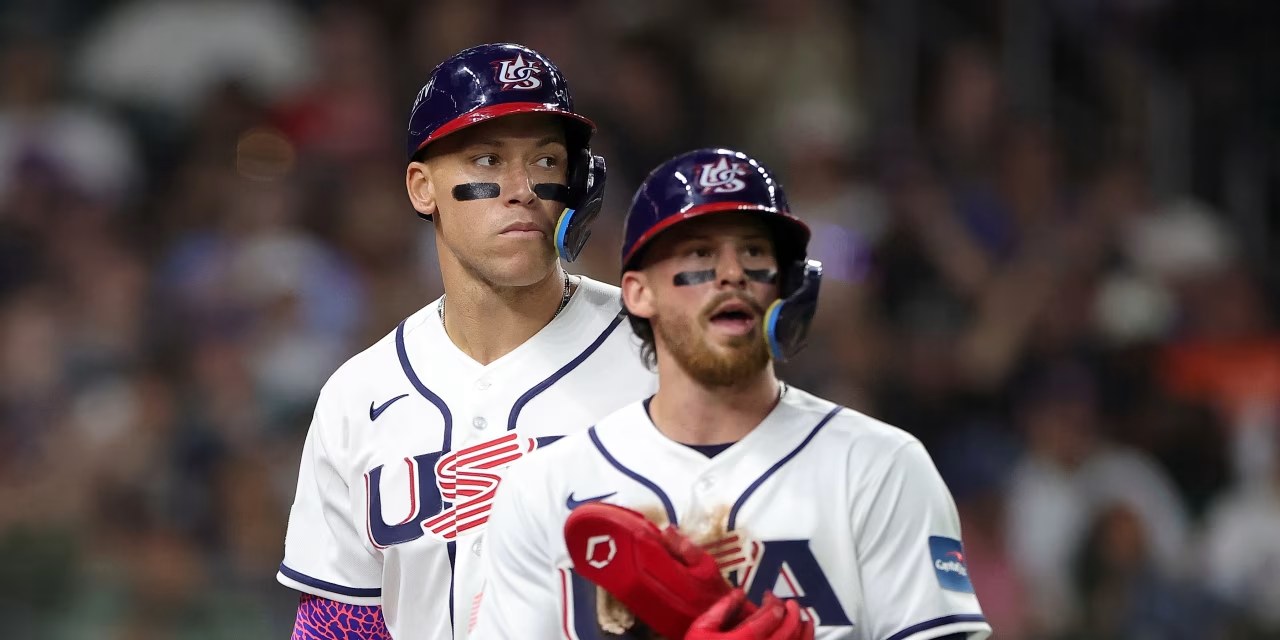
Team USA’s $524 Million Lineup Posts 2–2 Record, Faces Mexico in Must-Win Finale
- Mike Trout, Mookie Betts and Aaron Judge anchor the highest-paid roster in WBC history, yet the U.S. sits third in Pool C after a walk-off loss to Italy.
- Manager Mark DeRosa used eight relievers in a 6–5 defeat that saw three ninth-inning errors and a passed ball score the winning run.
- America must now beat Mexico on Tuesday night or become the first pre-tournament favorite eliminated before the quarter-finals.
- The 2025 squad’s 4.47 ERA through four games ranks ninth among 16 bullpens, undercutting a lineup averaging 5.9 runs per contest.
One more slip and the tournament’s most expensive team books an early flight home
WORLD BASEBALL CLASSIC—PHOENIX—When USA Baseball unveiled a 30-man roster carrying 61 combined All-Star selections and $524 million in 2025 salaries, executives billed the club as a “red-white-and-blue juggernaut” capable of erasing a decade of WBC frustration. Instead, after a chaotic 6–5 loss to Italy on Saturday night that ended on a passed ball and a throw to an empty plate, the Americans are one defeat from elimination and confronting a sobering reality: talent alone does not manufacture outs in the ninth inning.
Inside Chase Field the scene was equal parts disbelief and exhaustion. Center fielder Mike Trout slammed his glove against the dugout rail after the winning run crossed; third baseman Nolan Arenado stared at the dirt as Italian catcher Alberto Mineo was mobbed by teammates who had never before beaten the United States in five tournament meetings. The defeat dropped Team USA to 2–2 in Pool C, behind undefeated Puerto Rico (4–0) and Italy (3–1), and set up a must-win clash against rival Mexico (2–2) on Tuesday.
“We’ve got no safety net left,” manager Mark DeRosa told reporters, his voice hoarse from nine innings of shouted instructions. “We asked the pen to get six outs and we booted routine plays. At this level you give a team five extra outs, you’re going home early.” DeRosa’s blunt assessment underscored a systemic flaw: the Americans’ 4.47 bullpen ERA is the worst among the eight clubs that entered the weekend with championship odds of 10-1 or shorter, according to data compiled by Baseball Prospectus.
How Team USA Built the Most Expensive Roster in WBC History
USA Baseball officials began recruiting last October, armed with a $15 million insurance policy underwritten by Major League Baseball that covers lost wages for on-tournament injuries. The pitch worked: Trout, Betts, Judge, Arenado, Paul Goldschmidt and J.T. Realmuto all signed on, pushing the combined 2025 salary of the final 30 to $524 million—$140 million more than the next-priciest roster, the Dominican Republic. “We wanted to remove every excuse,” chief baseball officer Tony Reagins said in an interview before the Italy game. “If we go down, it won’t be because the best players stayed home.”
The front office also spent $3.2 million on private jets, charter buses and a dedicated analytics staff that delivered 240-page scouting packets on every opposing pitcher. Yet the lavish outlay could not manufacture cohesion in a two-week sprint. Because MLB clubs control access, position players had only five official practices together before pool play began. “We’re basically an All-Star team without the three days of workouts the midsummer game provides,” bench coach Jerry Manuel noted. The result: the Americans committed six errors in four games, three coming in the fateful ninth against Italy.
Baseball historians see a parallel to the 1992 U.S. Olympic basketball squad—an ensemble so stacked it was labeled “The Dream Team.” But while that group trained for a month and steamrolled Barcelona by an average of 44 points, baseball’s iteration lacks game repetitions and, crucially, defined bullpen roles. “Basketball you can iso; in baseball you need sequencing,” said Sports Illustrated senior writer Tom Verducci. “One bad inning undoes three hours of dominance.”
Forward-looking: Tuesday’s matchup against Mexico will force DeRosa to decide whether to start veteran Adam Wainwright on short rest or turn to 24-year-old lefty Jesús Luzardo, whose velocity tops 98 mph but who has never pitched in a win-or-go-home scenario. The answer could determine whether a $524 million roster becomes the most expensive first-round flop in international baseball history.
Inside the Ninth-Inning Meltdown That Changed Everything
The numbers looked safe entering the ninth: USA led 5–3, and Italy had managed one hit since the fourth inning. Closer Ryan Pressly, who saved 32 games for Houston last season, retired the first batter on three pitches. Then chaos arrived. Second baseman Tim Anderson bobbled a routine grounder, extending the inning; left fielder Kyle Schwarber misread a line drive that skipped to the wall for a triple; and with two outs catcher J.T. Realmuto failed to snag a 94-mph fastball in the dirt, allowing the tying run to score on the passed ball.
Italy’s Mineo, a 29-year-old catcher who spent last year at Triple-A Buffalo, fouled off five consecutive sliders before punching a slider past a drawn-in infield for the game-winner. The play at the plate wasn’t close—right fielder Betts’ throw sailed up the third-base line after Anderson and shortstop Bobby Witt Jr. both broke for cut-off positions that weren’t there. “It was like watching a GPS recalculate in real time,” Pressly said afterward. “Nobody knew where to be.”
The collapse mirrored Team USA’s historical weakness in high-leverage moments. Since the WBC debuted in 2006, the Americans have lost six games when leading after seven innings—twice as many as any other contender, according to Elias Sports Bureau. “We practice late-inning defense in spring training, but not with 40,000 fans and your whole country watching,” Anderson admitted. Manager DeRosa, who played on the 2009 team that lost twice in extra innings, called the Italy defeat “2009 revisited, only the stakes are higher because we finally brought the A-listers.”
Major league scouts in attendance were less surprised. One National League advance scout, who asked for anonymity because his club prohibits on-record evaluations, said USA’s infield positioning was “college-level—no anticipation, no communication.” The scout pointed to Italy’s winning rally: three ground-ball singles that stayed under 90 mph off the bat yet found holes because defenders were shaded for power, not contact. “When you haven’t played together, you default to generic sheets instead of instinct,” he said.
Forward-looking: The Americans must now win Tuesday or finish pool play at 2–3, a record that would almost certainly trigger a tiebreaker exit because Italy owns the head-to-head victory. DeRosa’s staff spent Sunday night recalculating bullpen usage charts, aware that Pressly, David Bednar and Devin Williams each threw 25-plus pitches against Italy and may be unavailable on one day’s rest.
What History Says About Teams That Spend Big and Exit Early
Since 2006, four pre-tournament favorites have arrived with payrolls north of $300 million only to be eliminated in pool play: the 2009 Dominican Republic ($312 M), 2013 Venezuela ($305 M), 2017 Japan ($302 M) and now the 2025 United States. None of those rosters featured fewer than eight All-Stars, yet each succumbed to a cocktail of bullpen implosions and situational hitting slumps. “Talent clusters don’t guarantee sequencing,” said Dr. Ben Baumer, a Smith College statistician who has modeled WBC outcomes since 2009. “The data shows defense and bullpen efficiency explain 42 percent of variance in knockout-round success, more than raw batting WAR.”
The 2009 Dominican team is the cautionary tale most cited inside USA’s clubhouse. That squad included Hanley Ramírez, David Ortiz and Albert Pujols but lost twice to the Netherlands on walk-off hits, the same fate that befell the Americans against Italy. “We thought we could out-slug mistakes,” Ortiz told ESPN in 2017. “Turns out the other teams pitch, too.” The Dominicans rebounded to win the 2013 tournament with a roster one-third cheaper, emphasizing veteran relievers who specialized in high-leverage outs.
USA officials studied that blueprint, yet economic incentives still skew toward stars. Under MLB’s collective-bargaining agreement, players receive a $10,000 participation stipend and a share of prize money that maxes out at $75,000 per man for winning the championship—fractions of their daily big-league salaries. The result: elite starters agree to pitch only if guaranteed light workloads, forcing managers to lean on middle-tier relievers in pivotal spots. “The math is backwards,” said former Dodgers general manager Ned Colletti. “You need the 7th-inning guy more than the ace.”
Baseball America editor J.J. Cooper notes another structural flaw: American prospects reach the majors faster, so the nation’s best 23-year-olds are often still on rookie contracts and hesitant to risk injury in March. By contrast, Japan’s Nippon Professional Baseball grants clubs a two-week break, allowing Shohei Ohtani and Yoshinobu Yamamoto to throw 100 pitches without ownership pushback. “The U.S. is the only country whose domestic calendar collides with the tournament,” Cooper said.
Forward-looking: If the U.S. survives Tuesday, the quarter-final format shifts to single-elimination, where one hot starter—think Japan’s Roki Sasaki’s 102-mph fastball—can override roster depth. America’s projected opponent would be unbeaten Puerto Rico, a club that has eliminated the U.S. in three of the past four tournaments and whose fans will almost certainly turn loanDepot park in Miami into a de-facto home game.
Can MLB Owners Afford Another Early Exit Without Killing the Event?
The financial stakes extend beyond pride. Fox Sports paid $510 million for global English-language rights through 2031, and advertisers bought in expecting American viewership that averages 3.1 million when the U.S. plays but drops 48 percent when it does not. An early exit would force Fox to fill prime-time slots with Japan-South Korea or Italy-Puerto Rico, games that drew under 700,000 viewers in 2023, according to Nielsen. “We budget for at least one USA knockout-round game,” said Fox Sports executive producer Brad Zager. “If they’re gone, we re-evaluate inventory and potentially move games to FS1.”
MLB commissioner Rob Manfred has already floated format tweaks: expanding pools to five teams to guarantee the U.S. four games, or reseeding after pool play so a 2–2 American squad could still face a weaker quarter-final opponent. Yet any change requires approval from the MLB Players Association, which views the tournament as voluntary offseason labor. Union chief Tony Clark told reporters Sunday that players “value competitive integrity over ratings,” signaling resistance to bracket manipulation.
Corporate partners are watching. PepsiCo and Chevrolet each activated eight-figure campaigns tied explicitly to Team USA jerseys; both brands included performance bonuses that shrink if the club fails to reach the semifinals. A senior sports-marketing executive at one sponsor, who requested anonymity because negotiations are ongoing, said a first-round exit would trigger contract clauses allowing renegotiation of ad rates for the 2027 tournament. “We’re not in the business of paying premium for Togo-Italy,” the executive said, referencing a possible consolation bracket.
Internationally, the drama burnishes the tournament’s underdog appeal. Italian catcher Mineo’s game-winning single was the top trend on Twitter in Europe for six hours, and Nippon Television replayed the ninth inning in prime time with Japanese subtitles. “The world wants to see Goliath bleed,” said Ichiro Suzuki, a special adviser to the Mariners and captain of Japan’s 2006 and 2009 squads. “If America wants to win, they must earn it—same as everyone else.”
Forward-looking: Manfred’s office has already scheduled a post-tournament summit in May to review scheduling, roster rules and revenue splits. If the U.S. exits early, expect owners to push for mandatory participation clauses in the next CBA, a non-starter for the union but a negotiating chip to extract concessions elsewhere. The irony: the louder the push for American dominance, the more leverage players gain on issues such as service-time manipulation and minimum salary hikes.
What Must Happen Tuesday for America to Advance—and Who Will Be on the Mound?
Tuesday’s scenario is stark: win and the U.S. clinches the final Pool C berth as the second seed; lose and the club finishes 2–3, the worst record ever for a pre-tournament favorite. Manager DeRosa must decide between 41-year-old Adam Wainwright—who threw 72 pitches four days ago—and flame-throwing lefty Jesús Luzardo, who has never pitched on three days’ rest. “We’ll see how the body responds,” Wainwright said after a 35-pitch bullpen session Sunday. “If I can give you five competitive innings, that’s what matters.”
Mexico counters with 21-year-old rookie of the year candidate Luis Gómez, whose 1.92 spring ERA and heavy sinker induce ground-ball outs at a 58 percent clip—dangerous against a U.S. lineup that has thrived on elevating mid-90s fastballs. “Gómez keeps the ball on the ground; we need to elevate and get into the bullpen,” hitting coach Marcus Thames told players during a closed-door meeting captured by MLB Network microphones. Through four games, U.S. hitters own a .471 slugging percentage versus four-seam fastballs but only .318 against sinkers.
Bullpen strategy will be decisive. Closer Ryan Pressly is likely unavailable after throwing 37 pitches Saturday, leaving setup man David Bednar and high-leverage lefty Devin Williams to share ninth-inning duties. Mexico’s lineup features five left-handed hitters who posted an .821 OPS against right-handed pitching last MLB season, forcing DeRosa to consider matchups carefully. “We can’t let one lefty-lefty matchup decide our fate,” pitching coach Mike Maddux said. Expect a quick hook and a relay of specialists if Wainwright encounters traffic early.
Ticket brokers on secondary-market site SeatGeek list Tuesday’s game as the priciest first-round WBC contest ever, with average resale prices at $312—triple the cost of any other pool game. Marlins Park expects a sell-out crowd of 37,000, split roughly 60–40 in favor of U.S. fans but buoyed by Mexico’s boisterous cheering sections that turned the same stadium into a horn-blaring fiesta during the 2023 semifinal.
Forward-looking: If the Americans survive, they would face top-seeded Puerto Rico on Thursday in Miami, a rematch of the 2023 semifinal that ended on a walk-off single by Eddie Rosario. Beyond that looms a potential semifinal showdown against two-time champion Japan and its own constellation of stars led by Shohei Ohtani and Roki Sasaki—proof that even a $524 million roster must win three straight elimination games before claiming the trophy most of its players flew in to collect.
Frequently Asked Questions
Q: Why is Team USA struggling in the 2025 WBC despite its roster?
The squad’s 13 All-Stars arrived with barely a week of camp, leaving relievers rusty and hitters timing-deficient; a 6–5 loss to Italy exposed a thin bullpen and late-inning defensive lapses.
Q: Has the U.S. ever won the World Baseball Classic?
Yes—once. Team USA claimed the 2017 title in Los Angeles, but finished fourth in 2009 and second in 2023, giving the program a 5–6 elimination-round record entering 2025.
Q: Who are the biggest stars on the 2025 Team USA roster?
Mike Trout, Mookie Betts, Aaron Judge, Nolan Arenado, Bobby Witt Jr., Paul Goldschmidt and catcher J.T. Realmuto headline the 30-man squad, averaging 4.2 career WAR per player.
📰 Related Articles
- Major Leaguers Watched Olympic Hockey. Now They Want In on Los Angeles 2028.
- Ultramarathon Running: I Was 51, Covered in Blood and Trying to Outrun Guys Half My Age
- Crowd Safety Expert Michael Silevitch and the Abrupt Halt to His Research
- Revolutionizing Ski Jumping: How Electronic Coaches Are Enhancing Olympic Performance
