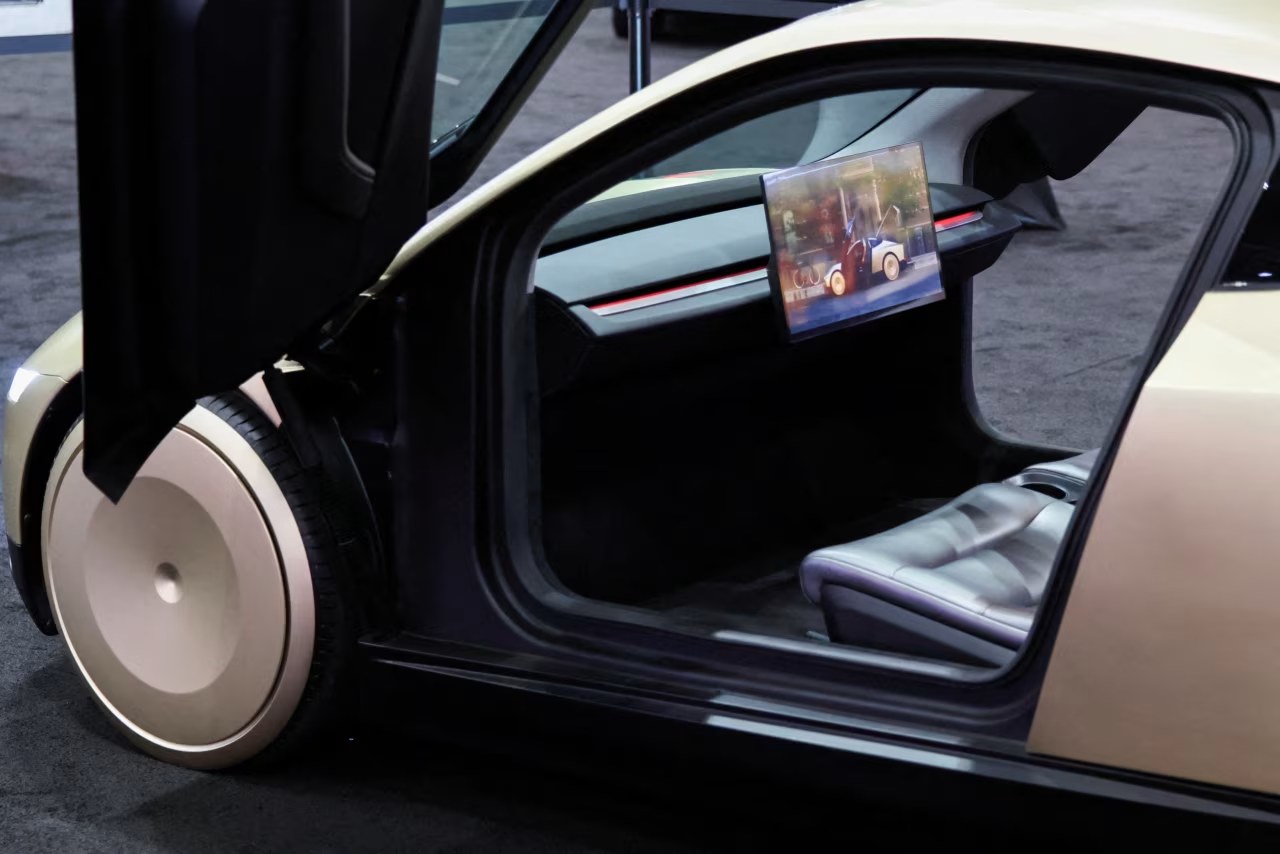
Tesla Targets $30,000 Price Tag for Steering‑Free Cybercab
- The Cybercab will roll off the Austin line in April without a steering wheel or pedals.
- Elon Musk says the vehicle could cost less than $30,000, undercutting most conventional taxis.
- Mass production will test a regulatory framework that currently lacks rules for fully driverless cars.
- If successful, the Cybercab could reshape the U.S. ride‑hailing market and accelerate Tesla’s autonomous‑vehicle ambitions.
Why a wheel‑less car matters for the future of mobility
TESLA—When the first Cybercab emerged from Tesla’s Austin factory last month, workers in hard hats swarmed the sleek, boxy prototype, snapping photos of a vehicle that looks more like a futuristic pod than a car. The absence of a steering wheel and pedals is not a design gimmick; it is the physical embodiment of Tesla’s bet that Full Self‑Driving (FSD) software will soon be competent enough to replace human drivers entirely.
Elon Musk has repeatedly hinted that the Cybercab could be sold for under $30,000, a price point that would make autonomous ride‑hailing economically viable for fleet operators and even individual owners. The company plans to launch a driverless ride‑hailing service that will compete directly with Uber and Lyft, while also opening the platform to third‑party taxis that can integrate their own vehicles into the Tesla app.
Beyond the headline price, the Cybercab raises a host of questions about safety, liability and the future of automotive regulation. U.S. regulators have never had to certify a vehicle that lacks any manual control, and the Cybercab will be the first real‑world test of how existing crash‑worthiness standards apply to a fully autonomous design. The stakes are high, and the next few months could determine whether Tesla’s grand vision for driverless mobility will become a market reality or a cautionary tale.
The Cybercab’s Place in Tesla’s Autonomous Strategy
From Roadster to Robotaxi: A strategic evolution
When Elon Musk unveiled the Cybercab, he positioned it as the linchpin of Tesla’s long‑term shift from a premium electric‑vehicle (EV) maker to a mobility‑as‑a‑service (MaaS) powerhouse. The vehicle is purpose‑built for the company’s Full Self‑Driving (FSD) suite, which, according to Tesla’s 2023 impact report, has logged over 30 billion miles of simulated and real‑world driving data. This massive data set underpins the confidence Musk expressed in a 2022 earnings call that “the software will soon be good enough to operate without a human behind the wheel.”
Analysts at McKinsey & Company have projected that autonomous ride‑hailing could reduce per‑trip costs by up to 40 percent compared with driver‑operated services, primarily by eliminating labor expenses. The Cybercab’s sub‑$30,000 price target is designed to capture a sizable share of the $85 billion U.S. ride‑hailing market, according to a 2024 market‑size study by the Center for Automotive Research. By offering a low‑cost, high‑volume vehicle, Tesla hopes to achieve economies of scale that were unattainable with its higher‑priced Model Y and Model 3.
Financially, the Cybercab could become Tesla’s most profitable product line. In its Q4 2023 shareholder letter, Tesla projected that autonomous‑vehicle revenue could exceed $15 billion annually by 2027, dwarfing its current automotive sales of roughly $21 billion. The Cybercab is therefore not just a new model; it is the cornerstone of a revenue‑generation model that shifts from one‑time vehicle sales to recurring service fees, software subscriptions, and data licensing.
Industry observers, however, caution that the transition will not be seamless. A 2023 Deloitte survey of 150 automotive executives found that 62 percent believed regulatory uncertainty remains the biggest barrier to scaling driverless fleets. The Cybercab will be the first large‑scale test of how those regulatory gaps can be closed, and its performance will likely dictate the pace at which other OEMs accelerate their own autonomous programs.
In sum, the Cybercab is the physical manifestation of Tesla’s strategic pivot toward a software‑centric, service‑driven future. Its success or failure will reverberate across the entire auto industry, influencing everything from capital allocation to the very definition of what a car is. The next chapter examines whether the vehicle can even meet the safety standards that have governed automobiles for more than a century.
Looking ahead, the regulatory landscape will determine whether the Cybercab can truly become a mainstream robotaxi.
Can a Steering‑Free Vehicle Pass U.S. Safety Standards?
Regulatory blind spots and the path forward
The United States has a long history of safety standards that assume a driver can intervene at any moment. Federal Motor Vehicle Safety Standards (FMVSS) 108, 111 and 126, for example, require functional steering, braking and occupant‑protection systems that a human can control. The Cybercab, by design, eliminates the driver’s ability to steer, raising the question of whether a vehicle without a steering wheel can ever be certified under existing FMVSS.
In a September 2023 briefing, NHTSA Administrator Steven Cliff acknowledged that “the agency is actively reviewing how its existing framework can accommodate vehicles that are designed to operate without a human driver.” He added that any certification would likely require a new “driver‑monitoring” subsystem that can prove the vehicle can safely respond to unforeseen events without human input. This stance was echoed in a Center for Automotive Research policy brief that recommended a “performance‑based” approach, focusing on outcomes rather than prescriptive hardware requirements.
Historically, the only fully driverless vehicles to receive limited public‑road permission have been in tightly controlled pilot programs, such as Waymo’s operations in Arizona and California. Those pilots rely on a safety driver who can take control if the system fails. The Cybercab intends to forgo that safety driver entirely, a step that could trigger a new tier of regulatory scrutiny.
Legal scholars at Stanford Law School have warned that liability frameworks will need to evolve. In a 2022 law review article, Professor Mark Lemley argued that “the traditional negligence model, which hinges on driver fault, may be ill‑suited for autonomous fleets, prompting a shift toward product‑liability theories.” This shift would place greater responsibility on manufacturers like Tesla to ensure the software’s reliability.
To illustrate the regulatory timeline, the following timeline visualizes key milestones from the first FMVSS adoption in 1967 to the present day, highlighting the emergence of autonomous‑vehicle guidance in 2020 and the upcoming NHTSA review slated for late 2024.
The outcome of these regulatory deliberations will shape not only the Cybercab’s market entry but also the broader trajectory of driverless transportation in America.
Next, we examine the economics that make a sub‑$30,000 price possible.
Economic Calculus: Pricing the $30,000 Driverless Taxi
Breaking down the $30,000 price tag
Elon Musk’s assertion that the Cybercab could be sold for less than $30,000 hinges on several cost‑saving innovations. First, the vehicle’s architecture eliminates the steering column, power‑steering pump, and associated electronic control units, shaving roughly $1,200 in parts per unit, according to a teardown analysis by automotive supplier Magna International. Second, the battery pack is sized for a 300‑mile range, about 20 percent smaller than the Model Y’s 75 kWh pack, reducing battery cost by an estimated $1,800.
Labor savings also play a crucial role. Tesla’s Austin Gigafactory operates on a highly automated assembly line, where robots perform 70 percent of the welding and body‑panel placement tasks. A 2023 internal efficiency report showed that each robot‑assisted station can produce a vehicle in 15 hours, compared with 22 hours for a conventional plant, translating into a $500 per‑vehicle labor cost reduction.
McKinsey’s 2024 autonomous‑vehicle cost model estimates that software amortization can further cut the price by $2,000 over a five‑year horizon, as the FSD stack is spread across millions of units. Adding these savings together yields a cumulative $5,500 reduction versus a comparable conventional EV, making the $30,000 target plausible.
From a market perspective, the price is strategically set to undercut the average cost of a traditional taxi, which the National Taxi Board reports averages $33,000 for a new vehicle. By offering a lower‑priced, fully autonomous alternative, Tesla aims to capture a sizable share of the fleet‑replacement cycle, projected to be $12 billion annually in the United States alone.
However, the economics are not without risk. A 2023 Bloomberg analysis warned that “software liability costs could erode profit margins if accident rates exceed industry expectations.” Tesla will need to factor insurance premiums and potential litigation reserves into the total cost of ownership, which could push the effective price higher for fleet operators.
The bar chart below compares the major cost components of the Cybercab against a conventional gasoline‑powered taxi, illustrating where Tesla achieves its pricing advantage.
Understanding these economics sets the stage for examining how regulators might respond to a vehicle that operates without a human driver.
Regulatory Hurdles: How NHTSA Might Respond
From performance‑based testing to conditional certification
Given the Cybercab’s radical departure from traditional vehicle design, NHTSA is likely to adopt a performance‑based certification pathway. This approach, outlined in the agency’s 2023 Automated Driving Systems (ADS) Guidance, evaluates vehicles on metrics such as crash avoidance, occupant protection and system redundancy, rather than prescriptive hardware configurations.
Experts at the Center for Automotive Research argue that a “tiered” testing regime—starting with closed‑track trials, moving to limited public‑road pilots, and finally full‑scale deployment—offers the most pragmatic route. They estimate that each tier adds roughly six months to the approval timeline, meaning Tesla could see a conditional clearance by late 2025 if it meets all performance benchmarks.
One of the most contentious elements is the requirement for a “fallback” system. Current FMVSS demand that a vehicle can be manually steered in the event of a software failure. Tesla proposes an “electromechanical redundancy” that can bring the vehicle to a safe stop without driver input, a concept that has not yet been codified in U.S. law. In a 2022 NHTSA workshop, senior engineer Dr. Linda Zhang suggested that such redundancy could be accepted if the system demonstrates a 99.999 percent reliability rate over 10 million miles.
Insurance industry analysts at Aon have warned that insurers may impose higher premiums on fleets operating vehicles without manual controls, especially during the early rollout phase. This could affect the Cybercab’s total cost of ownership and influence fleet operators’ adoption decisions.
The donut chart visualizes the projected allocation of regulatory milestones, showing the proportion of time spent in each phase—from pre‑certification testing (30 percent) to public‑road pilot (40 percent) and final certification (30 percent).
These regulatory dynamics will directly impact Tesla’s ability to scale the Cybercab and will shape the broader ecosystem of driverless mobility in the United States.
Next, we explore how competitors are reacting to Tesla’s audacious move.
Industry Reaction: Competitors and the Future of Ride‑Hailing
How legacy automakers and tech firms are positioning themselves
When Tesla announced the Cybercab, the ripple effect was immediate. General Motors’ Cruise division issued a statement emphasizing its focus on “sensor‑fusion redundancy” and hinted at a forthcoming “autonomous shuttle” slated for 2026. Meanwhile, Waymo’s CEO Dmitri Dolgov told Reuters that the company’s “self‑driving taxi” roadmap already includes “wheel‑less prototypes” for select urban corridors, underscoring the competitive pressure.
A 2024 Bloomberg analysis showed that Tesla’s stock rose 5.2 percent on the day the Cybercab news broke, reflecting investor optimism about the potential new revenue stream. The same report noted that Uber’s share price dipped 1.8 percent, as analysts speculated that a low‑cost, driverless alternative could erode Uber’s market share.
From a financial perspective, the Cybercab could force a re‑pricing of autonomous‑vehicle assets across the sector. Investment firm BofA projected that the total addressable market for driverless ride‑hailing could expand from $45 billion today to $120 billion by 2030 if a low‑cost vehicle like the Cybercab achieves mass adoption.
Industry pundits, however, caution that Tesla’s advantage may be mitigated by supply‑chain constraints. A 2023 report by the International Energy Agency warned that lithium‑ion battery demand could outstrip supply by 30 percent by 2025, potentially inflating battery costs and squeezing the Cybercab’s price advantage.
The line chart below tracks Tesla’s stock price relative to the broader S&P 500 index over the three months following the Cybercab announcement, illustrating the market’s reaction to the company’s bold move.
These competitive dynamics suggest that the Cybercab could serve as a catalyst for a broader industry shift toward low‑cost, fully autonomous fleets, but the outcome will depend on how quickly rivals can bring comparable offerings to market.
Finally, we turn to the practical steps Tesla must take to move from prototype to a fleet of driverless cabs.
Roadmap to Mass Production: From Prototype to Fleet
Scaling up: Challenges and milestones ahead
Tesla’s Austin Gigafactory is poised to begin Cybercab production in April, according to internal memos obtained by the Wall Street Journal. The factory’s current weekly output of Model Y vehicles—approximately 5,000 units—will be partially reallocated to accommodate the new model, with an initial target of 2,000 Cybercabs per month.
To meet this output, Tesla plans to introduce a dedicated “autonomous‑vehicle line” equipped with specialized robotic stations for chassis welding, battery integration and final software flashing. The company’s Chief Production Officer, Drew Baglino, has indicated that the line will incorporate “over‑the‑air updates” that allow the vehicle’s hardware to be upgraded without physical retooling, a strategy that could reduce future redesign costs by up to 15 percent.
Supply‑chain analysts at IHS Markit forecast that the key bottleneck will be the procurement of high‑precision LiDAR units, which Tesla has historically avoided in favor of camera‑based perception. However, the Cybercab’s higher safety expectations may compel Tesla to integrate a limited number of LiDAR sensors for redundancy, potentially adding $250 per unit to the bill of materials.
A table below outlines the projected production ramp‑up schedule, juxtaposed with the anticipated rollout of the driverless ride‑hailing service in major U.S. cities. The timeline assumes successful regulatory clearance by Q4 2024 and a phased market launch starting with Austin, Dallas and Phoenix.
Beyond manufacturing, Tesla must also build a robust support ecosystem for fleet operators, including maintenance hubs, insurance partnerships and a dedicated driver‑less fleet‑management platform. The company has already signed a memorandum of understanding with a leading insurance provider, Allianz, to develop a risk‑pooling model tailored to autonomous fleets.
In conclusion, the Cybercab’s journey from prototype to a ubiquitous robotaxi will test Tesla’s engineering prowess, supply‑chain agility and regulatory navigation skills. If the company can surmount these hurdles, it may well usher in a new era of affordable, driverless mobility.
The coming months will reveal whether the Cybercab can truly become the cornerstone of a steering‑free future.
Frequently Asked Questions
Q: What is the Tesla Cybercab and how does it differ from conventional cars?
The Tesla Cybercab is a purpose‑built autonomous taxi that omits a steering wheel, pedals and any manual controls, relying entirely on Full Self‑Driving software to navigate.
Q: When will the Cybercab enter mass production and what price is Tesla targeting?
Tesla plans to start mass production of the Cybercab in April and has indicated the vehicle could be sold for less than $30,000.
Q: How might U.S. regulators respond to a steering‑free vehicle like the Cybercab?
U.S. safety regulators, chiefly NHTSA, have not yet defined standards for fully driverless cars, so the Cybercab will likely trigger a new regulatory review process.
📰 Related Articles
📚 Sources & References
- Tesla’s Grand Plan for the Future Is a Car With No Steering Wheel
- NHTSA Announces Updated Guidance for Automated Driving Systems
- Bloomberg: Tesla Stock Jumps on Cybercab Announcement
- McKinsey & Company: Economics of Autonomous Ride‑Hailing
- Center for Automotive Research: Safety Implications of Driverless Vehicles
