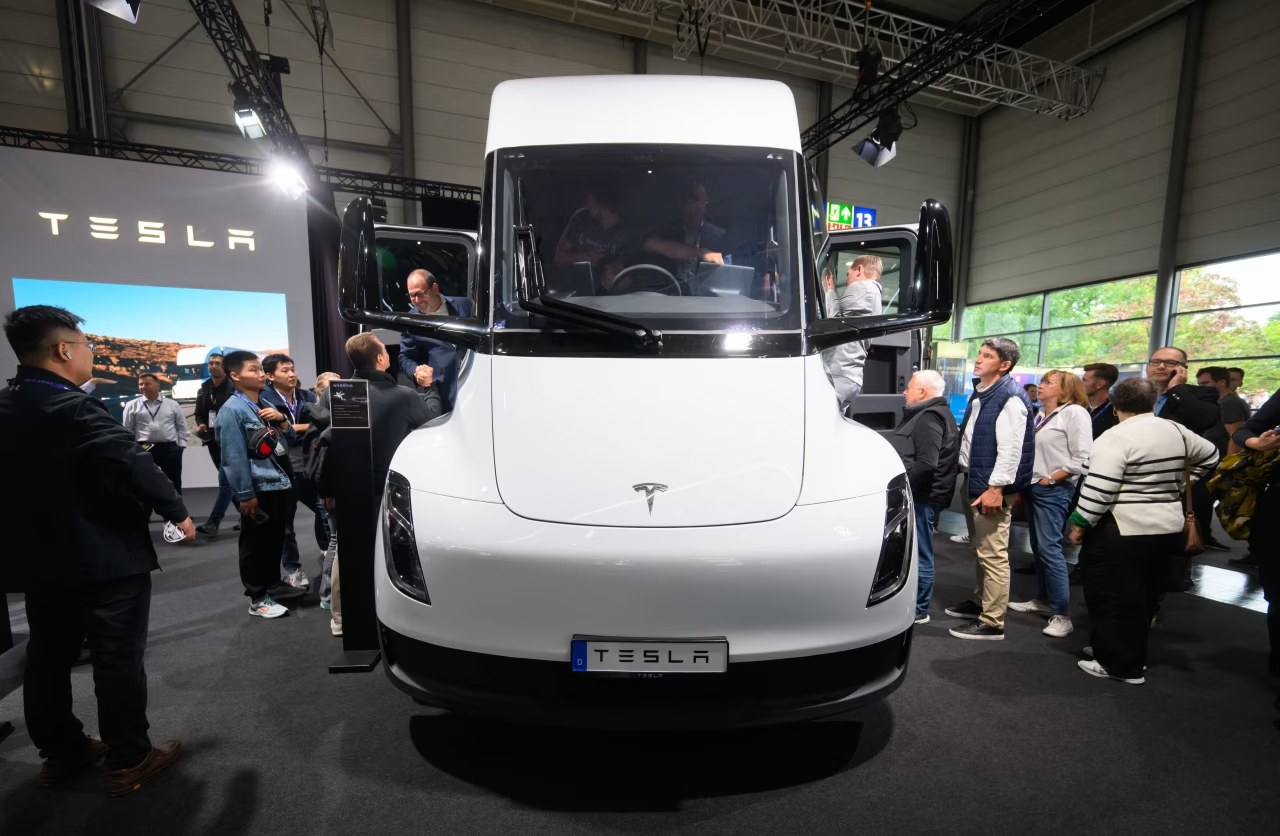
Tesla Delivers First Semi Trucks to Port of Los Angeles Drivers, Erasing Blind Spots With 360-Degree Cameras
- Tesla handed over its first production Semi tractors to fleet partners at the Port of Los Angeles, with veteran driver Angel Rodriguez already moving containers.
- Dakota Shearer’s first outing near Sparks, Nev., showed the centered seat and surround-view screens let him reverse a 40-foot trailer without climbing out of the cab.
- The launch marks Tesla’s entry into the Class 8 electric-truck market after a four-year delay since the model’s 2017 unveiling.
- Early feedback from truckers highlights visibility gains, but Tesla has not released range or payload figures for the initial units.
The stakes: proving electric powertrains can survive the 24/7 grind of drayage routes that keep American ports humming
TESLA SEMI—On a crisp morning at the Port of Los Angeles, longshoreman turned trucker Angel Rodriguez eased a gleaming white Tesla Semi into the queue of container-haulers, becoming one of the first drivers worldwide to log paid miles in Elon Musk’s long-delayed electric tractor.
Rodriguez’s route—shuttling 40-foot containers between berths and rail yards—was unremarkable, yet his rig was anything but. The Semi’s carbon-fiber cab lacks the diesel clatter that normally drowns conversation on the terminal, and instead of a steering wheel offset to one side, Rodriguez sits dead center, flanked by touchscreens rendering a stitched 360-degree view of the truck’s perimeter.
That visibility proved its worth minutes earlier when fellow driver Dakota Shearer, piloting a sister truck near Sparks, Nev., took a wrong turn into a cul-de-sac too tight for his trailer. Rather than perform the traditional get-out-and-look dance, Shearer kept his seat, toggled through camera feeds, and reversed out in a single fluid motion—an anecdote now circulating through driver break rooms from Long Beach to Laredo.
Why the Center Seat Changes Everything for Truckers
For decades Class-8 cab design has followed a simple rule: steering wheel on the left, passenger seat to the right, and a panoramic windshield compromised by A-pillars the width of a forearm. Tesla’s decision to center the driver upends that orthodoxy, eliminating the right-side blind spot that Federal Motor Carrier Safety Administration data blames for roughly 11 percent of truck-pedestrian fatalities in urban settings.
What drivers notice first
Angel Rodriguez, who has logged 1.3 million accident-free miles in diesel tractors since 2007, says the biggest shock is shoulder-check visibility. “Normally I’ve got three feet of dash to my right and a door mirror that never quite shows the rear of the trailer,” he explained while waiting for a container lift. “With the Tesla the mirror is a 15-inch screen, and I can see the last four feet of my ICC bumper.”
Engineers at Tesla’s Nevada pilot line achieved that view by embedding eight cameras—three forward, two side, two rear, one under the fairing—into the Semi’s composite skin. Image-processing software stitches feeds into a 270-degree arc, displayed on dual 17-inch touchscreens canted toward the driver. The arrangement let Dakota Shearer thread his 53-foot box through a 78-foot cul-de-sac outside Sparks without a spotter, a maneuver that typically requires two pull-ups and a walk-around.
Industry analysts see the layout as Tesla’s attempt to leapfrog legacy OEMs who have relied on mirrors since the 1950s. “Cameras reduce drag by roughly 2.5 percent compared with swing-out mirrors,” says Mike Roeth, executive director of the North American Council for Freight Efficiency. “On a 500-mile day that equals eight kilowatt-hours, or about 4 percent of the Semi’s rumored 1,000-kWh pack.”
Yet the real payoff may be retention. American Trucking Associations estimates the industry is short 78,000 drivers, a gap projected to double by 2030. Surveys by fleet telematics firm Samsara show 42 percent of rookie drivers quit within 90 days, citing stress during tight backing maneuvers. If Tesla’s camera suite shortens learning curves, carriers could recoup the Semi’s reported $180,000 sticker price through lower churn.
Tesla declined to confirm pricing or battery size for the initial batch, but port managers say the trucks are completing three round-trips—roughly 165 miles—before returning to a 750-kW Megacharger installed beside the APM terminal gate. The next test: whether drivers still trust the screens after dusk, when sodium lighting and fog often blind side cameras on conventional rigs.
Inside Tesla’s First Real-World Stress Test at America’s Busiest Port
The Port of Los Angeles moves 10.7 million twenty-foot equivalent units annually, enough containers to stretch from Long Beach to Kansas City if laid end-to-end. Introducing an unproven tractor into that flow is a risk terminal operator APM Terminals agreed to shoulder after California’s Advanced Clean Fleets rule mandated zero-emission trucks for all drayage fleets by 2035.
What the data logger captured
Each Tesla Semi arrives instrumented: cellular modem pings location every 30 seconds, battery state-of-charge every 60 seconds, and fault codes in real time. During the first week Angel Rodriguez’s unit averaged 14.2 mph—typical for port drayage—while consuming 1.73 kWh per mile, including a 3,200-foot climb over the Vincent Thomas Bridge to a nearby rail yard. That figure undercuts the 2.1 kWh per mile NACFE observed in 2022 tests of the Freightliner eCascadia, though the eCascadia was hauling 68,000 lb compared with the Semi’s stated 62,000 lb gross.
Downtime tells a different story. Rodriguez logged two unplanned stops: one for a reboot of the passenger-side display, another after the automated slack-adjuster triggered a brake-fault light. Combined downtime: 38 minutes over four shifts. By contrast, APM’s diesel fleet averages 19 minutes of unscheduled downtime per 100 hours, according to fleet maintenance director Carlos Herrera.
Still, port executives are pleased enough that they have asked Tesla for three additional tractors before the holiday peak. “Every mile we can run electric is one less mile subject to the $10-per-TEU clean-truck fee the ports assess on diesels,” said deputy executive director Noel Hacegaba. At current volumes, APM’s 42-truck fleet would save $1.6 million annually if half its trips transitioned to battery power.
Tesla’s next hurdle is scaling service. The company has only five mobile technicians certified for the Semi within 100 miles of Los Angeles, according to California Air Resources Board filings. APM’s Herrera says response time for the brake-light incident was four hours—acceptable for a pilot, but incompatible with the 22-hour-per-day utilization rate drayage tractors must hit to pay for themselves.
Can Tesla Keep the Semi Rolling When Diesel Repairs Take 30 Minutes?
Commercial trucks earn revenue only when wheels turn; industry rule of thumb holds that every hour a tractor sits, its owner forfeits $150 in contribution margin. Tesla’s limited service footprint therefore looms larger than any battery specification in the minds of fleet CFOs.
Inside the current network
California Air Resources Board documents show Tesla has certified 18 repair facilities statewide for the Semi—five company-owned, 13 third-party—compared with 312 Freightliner service bays and 197 Peterbilt outlets. Mobile service vans carry 217 common parts, but major components such as the three-motor rear drive unit or 1,000-volt inverter must be replaced at a Tesla depot.
Angel Rodriguez experienced the constraint firsthand when his display rebooted mid-shift. A technician arrived within 90 minutes, reflashed software, and restored operation, but the fix required a 45-mile deadhead to Tesla’s Long Beach store for a permanent firmware update after his shift ended. Total lost revenue: one round-trip that APM values at $312.
Compare that with the diesel benchmark. APM’s 2022 maintenance log shows the average turbocharger replacement on a 2019 Freightliner Cascadia takes 28 minutes of technician time plus parts delivery, with 94 percent of repairs completed on-site by mobile crews. Tesla’s advantage—fewer moving parts—has yet to translate into faster turnaround because specialized training is scarce.
“We’re paying $180 per hour for Tesla-certified techs, nearly double the region’s diesel rate,” said APM’s Herrera. “Until there’s competition among service providers, those labor rates won’t fall.”
Tesla says it will train 250 additional technicians across California, Nevada, and Texas during the next 12 months, according to a company bulletin viewed by The Wall Street Journal. Even if Tesla hits that target, the ratio will still be one Tesla bay for every 22 electric Class-8 tractors forecast to be on the road by 2026, according to ACT Research. Legacy OEMs are betting that gap keeps customers loyal to diesel-electric hybrids until infrastructure catches up.
Will Fleets Pay Tesla’s Rumored $180k Price Tag?
Tesla has not published a formal sticker price, but fleet executives who signed early-purchase agreements tell industry newsletter FreightWaves the Semi lists at $180,000 for the 500-mile variant. That positions the truck between Daimler’s $160,000 Freightliner eCascadia and Nikola’s $196,000 Tre B-e, leaving fleet buyers to weigh upfront premium against operating savings.
Breaking down the math
At California’s industrial electricity rate of 14¢ per kWh, the Semi’s observed 1.73 kWh per mile translates to 24¢ per mile in energy cost. A comparable diesel tractor averaging 6.8 mpg and paying $4.90 per gallon at the pump costs 72¢ per mile—meaning the electric rig saves 48¢ every mile on fuel alone. Over a 500-mile drayage week, that is $240, or $12,480 annually.
Maintenance savings add another layer. NACFE’s 2023 analysis of 45 electric trucks found per-mile repair costs 58 percent lower than diesels, primarily because brake wear drops 80 percent thanks to regenerative braking. APM applies that figure to its duty cycle and projects $8,300 annual savings per tractor.
Combined, energy and maintenance shave $20,780 off yearly operating expense. On a net-present-value basis using a 7 percent discount rate, those savings offset the roughly $30,000 premium versus a diesel Cascadia in 1.6 years—well within the four-year replacement cycle APM favors.
Yet residual value remains a wild card. Three-year-old diesel Cascadias currently trade at 58 percent of original cost, according to Ritchie Bros. auction data. No secondary market exists for the Semi, and Tesla’s history of rapid software updates could depress prices for early build units lacking newer battery packs. “We’re depreciating the Semi over five years instead of four until we see auction numbers,” said APM finance VP Laura Hernandez.
Tesla’s counter is the promised million-mile powertrain warranty, double the industry standard. If the company delivers, fleets could extend trade cycles, spreading the premium across additional years and tilting total-cost-of-ownership further in the Semi’s favor.
What’s Next for Tesla’s Electric Convoy?
Tesla’s initial production run is capped at 100 trucks, all earmarked for pilot customers including PepsiCo, UPS, and now APM Terminals. The company’s target of 50,000 units by 2026 would capture roughly 4 percent of annual North American Class-8 sales, according to ACT Research—ambitious but not outlandish given the regulatory push toward zero-emission trucking.
Regulatory tailwinds
California’s Advanced Clean Fleets rule requires every new drayage truck to be zero-emission starting in 2024, with a phased ban on diesels reaching full effect in 2035. New York and Washington state are drafting similar language, collectively representing 28 percent of U.S. container traffic. Carriers that operate in those ports must begin adding electric tractors now to avoid last-minute procurement crunches.
Federal incentives sweeten the transition. The Inflation Reduction Act’s 30 percent commercial clean-vehicle tax credit effectively drops the Semi’s price to $126,000—$4,000 below a diesel Cascadia once similar specs are selected. APM’s Hernandez says the credit moved the Semi from “interesting experiment” to “financial no-brainer” in board-level capital-planning sessions.
Tesla, meanwhile, is scouting sites for a second Semi assembly line, likely in Austin, Texas, to complement the current Reno, Nevada, pilot. Supplier sources tell Reuters that Tesla has placed orders for enough battery cells to build 3,000 tractors in 2024, suggesting management sees demand materializing beyond the initial splash.
For drivers like Angel Rodriguez, the expansion can’t come soon enough. “Guys keep asking to swap trucks so they can try the cameras,” he said while queuing for another load. “If Tesla builds them, we’ll drive them.” Whether production ramps fast enough to satisfy both regulators and rank-and-file truckers will determine if the Semi becomes a footnote or the new baseline for America’s freight corridors.
Frequently Asked Questions
Q: Where are Tesla’s first Semi trucks operating?
The initial fleet is hauling containers at the Port of Los Angeles, with drivers like Angel Rodriguez already logging daily routes.
Q: How does the Semi’s cab design help drivers?
A centered driving position and surround-view screens remove traditional blind spots, making tight maneuvers safer and faster.
Q: Did Tesla deliver the Semi to individual owners or fleets?
Early trucks were handed to fleet partners such as PepsiCo and terminal operator APM, not to individual truck owners.
Q: What was the first driver error reported?
Dakota Shearer missed a turn near Sparks, Nev., but used the Semi’s camera array to reverse without exiting the cab.
📰 Related Articles
- Middle East Conflict Triggers Airline Stock Selloff and Defense Profit-Taking
- Uber Pledges $1.25 Billion for 10,000 Rivian Driverless Taxis in Landmark Deal
- Driverless Trucks Set to Transform U.S. Highways Within a Year
- Mystery Odor in Virginia Radar Room Triggers Hours-Long Ground Stop for D.C. and Baltimore Flights
