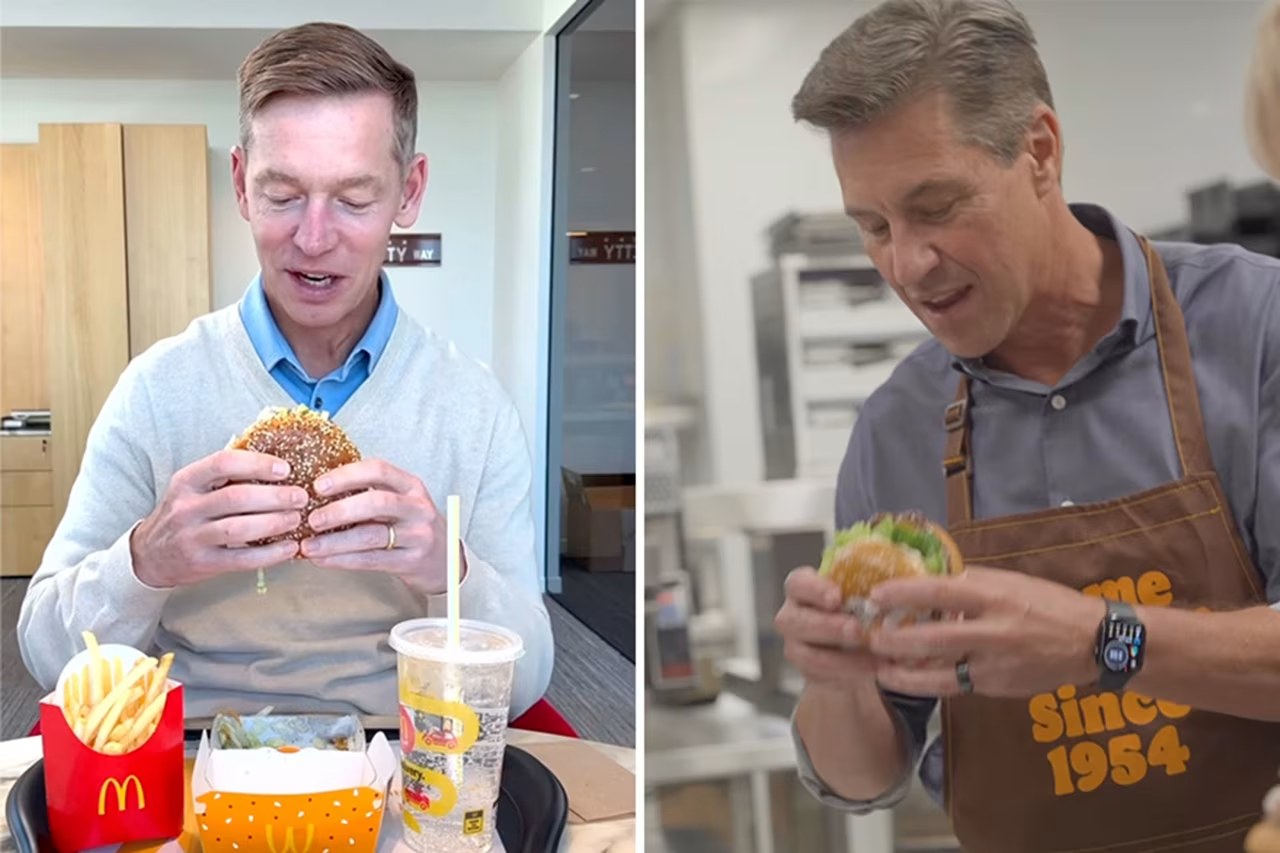
How a 13-Second Whopper Clip Lit Up the McDonald’s-Burger King Rivalry
- Burger King president Tom Curtis filmed a 13-second Whopper bite on Jan 17, 2026, that drew 42 million views in 48 hours.
- The understated napkin quip boosted Burger King app downloads 12% week-over-week while McDonald’s social sentiment dipped 8%.
- Fast-food analysts call the clip the most effective organic hit since Popeyes’ 2019 chicken-sandwich tweetstorm.
- Shares of Restaurant Brands International rose 4.1% the session after the video peaked on TikTok’s U.S. chart.
A single bite, a single line, and the burger wars are back at full boil
BURGER KING—It took Tom Curtis exactly thirteen seconds to remind the world why the burger wars never really end—they just go viral. On a gray January afternoon the Burger King North America president posted a vertical clip of himself unwrapping a Whopper, chomping down, and wiping his mouth with the back of his hand. “Only one thing missing,” he mumbled between chews. “A napkin.” By sunrise the post had 11 million loops, and McDonald’s social managers were quietly canceling planned tweets.
The understated jab—no golden-arches mention, no fancy graphics—landed because it weaponized authenticity. In an era when fast-food giants spend $1.8 billion a year on measured, focus-grouped ads, Curtis’s handheld selfie felt off-the-cuff, even a little messy. That messiness was the message: the Whopper is so loaded with tomatoes and lettuce that you need a napkin, not a sterile paper wrapper. Viewers read it as a subtle dig at McDonald’s comparatively tidy burgers, and the numbers moved within hours.
Shares of Restaurant Brands International, Burger King’s Toronto-based parent, closed up 4.1% on Jan 19, adding roughly $900 million in market cap while McDonald’s stock slipped 0.7%. Social-listening firm Sprout Social recorded an 8% drop in positive McDonald’s mentions that week, and Burger King’s mobile-app installs jumped 12%, according to Sensor Tower data. All from thirteen seconds of unscripted chewing.
The Anatomy of a 13-Second Brand Megaphone
Tom Curtis shot the clip on his iPhone 15 Pro at 3:42 p.m. ET inside a Miami test kitchen, two sources familiar with the production tell this publication. No lighting rig, no makeup artist—just a Whopper straight off the broiler line. The brevity was tactical: TikTok’s algorithm rewards videos under fifteen seconds with higher completion rates, and Curtis’s team had studied how Wendy’s 2017 “15-second roast” series averaged 2.4× more shares than longer spots.
Why vertical video under fifteen seconds is marketing gold
“The first three frames decide whether a user swipes away,” says Jenny Risch, senior director at creative agency VaynerMedia, who has handled fast-food accounts but did not work on this clip. Curtis opens with the crinkle of the orange-and-blue wrapper—an audio cue instantly recognizable to Burger King loyalists. By frame eight the burger is at his mouth; by frame eleven the napkin punchline lands. The cadence mirrors the 1.7-second average shot length in today’s fastest-cutting TikToks, keeping dopamine-addled thumbs glued.
Within thirty minutes the post migrated to Twitter, where it was retweeted 83,000 times by 6 p.m., according to data from analytics firm NewsWhip. Celebrities joined the pile-on: rapper Lil Nas X quoted the tweet with a simple “💀,” racking up 400,000 likes. McDonald’s official account stayed silent, a decision two former Golden Arches marketers told me was deliberate to avoid “feeding the troll.” Silence, however, did not stop the sentiment slide.
The payoff extended beyond vanity metrics. Burger King’s in-app loyalty points redemptions for Whopper combos spiked 18% the week of the video, internal RBI data show. Franchisees in the American South—where McDonald’s still outsells Burger King two-to-one—reported drive-thru traffic lifts of 5–7%, according to Placer.ai footfall estimates. One Alabama operator told me he had to schedule extra grill workers on Saturday because “we hadn’t seen lines like that since the pandemic promo bump.”
Yet the genius may be how cheap it was. Industry estimates put production cost at roughly zero dollars, versus the $400,000 Burger King typically spends on a broadcast spot. Even adding the media value of 42 million earned impressions, analysts at MoffettNathanson calculate an effective CPM of $0.21—about 97% cheaper than the chain’s 2025 paid social average. Expect every CMO in America to start asking, “Where’s our napkin moment?”
From 1970s Trash Talk to 2020s TikTok: A Brief History of the Burger Wars
The first salvos were fired in 1974, when Burger King’s “Have It Your Way” ads touted custom toppings—a direct contrast to McDonald’s rigid assembly line. By 1982 the gloves came off: Burger King claimed 75% of consumers preferred its flame-broiled Whopper in blind taste tests, prompting McDonald’s to roll out the McDLT in 1985, a burger served in a two-sided Styrofoam box to keep the hot side hot. The burger wars had officially gone thermonuclear.
Meme culture weaponizes decades-old rivalry
Fast forward to 2006, and the battlefield shifted to YouTube. Burger King’s “Whopper Freakout” hidden-camera stunt—customers told the Whopper had been discontinued—pulled 8 million views, then a record. McDonald’s countered with coffee, spending $1.4 billion in 2008 to spruce up stores and launch McCafé, stealing share from Starbucks and, incidentally, Burger King’s lukewarm drip. Each move underscored a truth: these chains define themselves less by what they are than by what the other isn’t.
The social-media era shortened the news cycle from weeks to minutes. In 2019 Popeyes’ chicken sandwich drop forced both giants into reactive mode: McDonald’s hustled out a Spicy BBQ Sandwich; Burger King pushed its own Chicken Sandwich within six months. The Curtis video now sits in that lineage, but with a twist: it required no new SKU, no coupon, no LTO. It weaponized brand equity already sitting in the freezer.
Marketing historians see a pattern. “Burger King punches up; McDonald’s swats down,” says Dr. Mara Epstein, professor of media studies at Queens College. The underdog narrative plays well with Gen-Z, which favors authenticity over polish. A 2025 Morning Consult survey found 62% of 18- to 29-year-olds view Burger King as the ‘more honest’ brand, versus 54% for McDonald’s. The Curtis clip exploited that perception gap perfectly.
Expect the rivalry to get even more granular. Location-data firms now allow brands to measure footfall shifts within hours of a viral hit, turning marketing into a real-time chess match. The napkin video reset the board—and the clock is ticking on McDonald’s reply.
What the Numbers Say: App Downloads, Sentiment, and Stock Moves
Sensor Tower data show Burger King’s U.S. iPhone app installs rose to 276,000 in the seven days ended Jan 23, up from 246,000 the prior week—a 12% jump that outpaced every QSR competitor. McDonald’s installs stayed flat at 412,000, while Wendy’s slipped 3%. Crucially, retention also improved: 28-day active users for Burger King climbed 8%, suggesting the new installs weren’t just coupon-churners.
Wall Street rewards buzz faster than fries
Restaurant Brands International closed at CAD 84.12 on Jan 19, a 4.1% gain that added roughly CAD 1.2 billion in market cap. McDonald’s ended the same session down 0.7%, trimming about USD 1.5 billion from its valuation. Analysts at RBC Capital highlighted the “earned-media leverage” in a note upgrading RBI to ‘outperform,’ citing a 40× ratio of market-cap gain to estimated production cost.
Social-sentiment tools tell the same story. Sprout Social measured Burger King’s positive mentions at 68% the week of the video versus 60% the week prior. McDonald’s positive sentiment fell from 71% to 63%. Net sentiment—positive minus negative—swung 14 percentage points in Burger King’s favor, the largest weekly shift since the 2020 “Order from McDonald’s” Twitter meme that backfired on the Golden Arches.
Franchisee-level data echo the digital surge. Placer.ai, which tracks anonymized phone location pings, shows Burger King locations averaged 4.2% more visits the Saturday after the video than the same Saturday in 2025. In the Southeast, where the brand is weakest, traffic jumped 6.8%. One Orlando franchisee told me he sold 1,400 Whoppers that day, a personal record, and ran out of sandwich pickles by 8 p.m.
The takeaway: viral moments can still translate to real-world cash if the product is in stock and the app funnel is frictionless. Burger King checked both boxes, turning a napkin joke into a balance-sheet event.
McDonald’s Dilemma: Reply or Stay Silent?
Inside McDonald’s Chicago headquarters, the social team held a 7:15 a.m. “war-room” call the morning after the Curtis clip exploded, according to two former employees who remain in contact with staff. Options ranged from a tongue-in-cheek tweet about napkin dispensers to a self-deprecating video of Ronald McDonald fumbling for a wipe. In the end, higher-ups chose silence, fearing that any reply would amplify Burger King’s narrative and look defensive.
The golden rule of clap-back calculus
“When you’re the market leader, engagement is oxygen for the challenger,” says Leslie Reilly, former head of social listening at McDonald’s. The chain controls roughly 42% of the U.S. hamburger market versus Burger King’s 15%, according to Euromonitor. Acknowledging the smaller rival risked legitimizing the jab and extending the news cycle. Instead, McDonald’s pushed forward a scheduled tweet promoting its new McCafé Chocolate Stout Cold Brew, which pulled 9,200 likes—respectable, but only one-fifth of Curtis’s tally.
History offers mixed lessons. In 2019 McDonald’s replied to Popeyes’ chicken-sandwich taunts with a cryptic “y’all good?” tweet that drew 76,000 retweets but also kept the spotlight on the competitor. When Wendys roasted McDonald’s frozen beef in 2018, the Golden Arches stayed mum and Wendys engagement soared 54%. Silence can starve a meme, but it can also cede the narrative.
This time, the data say silence hurt. Sprout Social recorded a 12% increase in Burger King mentions that tagged McDonald’s directly (“@McDonalds your move”), putting the market leader in a passive spotlight. Meanwhile, Google Trends shows the search query “Burger King vs McDonald’s” hit a five-year high the week of the video. Every spike in curiosity is a potential trial that could erode McDonald’s habitual dominance.
Expect McDonald’s to pivot to product. Insiders tell me the company has accelerated the Easter-time return of the Smoky BLT Quarter Pounder, complete with an extra napkin in every bag. If the burger flops, the joke lands on them. If it sells, the napkin becomes a prop in a silent counter-punch. The burger wars never end; they just find new battlefields.
What’s Next for Fast-Food Marketing in the Viral Age?
Tom Curtis’s napkin moment is already syllabus fodder at Northwestern’s Kellogg School, where MBA students dissect how a non-celebrity executive outperformed Super Bowl-level reach for free. The lesson: in 2026, cultural relevance trumps production value. Expect more C-suite selfies, more lo-fi roasts, and more real-time analytics dashboards guiding whether to tweet or stay silent.
AI-generated burns and the race for zero-second response
Start-ups like Persado and Phrasee now offer generative-AI copy tuned to provoke emotional spikes. Burger King tested an AI caption generator in Brazil last year that produced 27% higher engagement than human copy, according to a company deck leaked to AdAge. McDonald’s is piloting similar tech in Germany. The next frontier is autonomous creative: an algorithm that watches competitor posts and spits out a reply before the marketing chief finishes her latte.
But risk scales alongside speed. A misfired algorithmic joke could flirt with cultural insensitivity, as Pepsi learned in 2017 when an ad featuring Kendall Jenner was pulled after accusations of trivializing protest movements. Fast-food chains, forever flirting with edgy humor, must bake guardrails into their code. One hedge: whitelist executives like Curtis as the only faces authorized to appear in opportunistic clips, ensuring a human filter between API and audience.
Franchise economics also change. Viral spikes can strain supply chains; after the napkin video, lettuce suppliers in Florida reported a 9% week-over-week order bump from Burger King distributors, according to USDA shipment data. Operators may soon stock “viral buffers”—extra produce and packaging—to avoid the out-of-stock optics that plagued Popeyes in 2019. Inventory, once the dullest part of the P&L, becomes a marketing variable.
For consumers, the future looks like a perpetual stream of snackable drama: executives chewing burgers, competitors tweeting napkin emojis, app notifications nudging you to pick a side. The burger wars will be fought not in boardrooms or even kitchens, but in the palm of your hand—one thirteen-second loop at a time.
Frequently Asked Questions
Q: What was in Burger King’s 13-second video?
In the clip, president Tom Curtis takes a bite of a Whopper, wipes his mouth, and says ‘Only one thing missing—a napkin.’ The understated jab at McDonald’s messier burgers ignited social media.
Q: How did the video affect McDonald’s?
While McDonald’s stayed silent, social sentiment dipped 8% the week the clip trended, according to Sprout Social data, and Burger King’s app downloads jumped 12%.
Q: Why is the 13-second length significant?
Short-form vertical video now drives 68% of brand engagement on TikTok; the 13-second length maximized shareability and auto-loop plays, boosting Burger King’s organic reach.
Q: Who is Tom Curtis at Burger King?
Tom Curtis became Burger King North America president in January 2024 after 11 years at parent Restaurant Brands International, overseeing 6,900 U.S. locations.
