Oil swings 31% in 24 hours as Iran war jolts markets
- U.S. crude soared from $92 to $119.50 Sunday night on Strait of Hormuz fears The Wall Street Journal
- Prices collapsed to $94.77 after Trump said conflict may be ‘very complete’ The Atlantic
- Iran vows to attack any ship transiting the vital oil choke-point The Atlantic
- More than 1,200 Iranians and seven U.S. service members reported killed The Atlantic
Wild intraday reversal signals deep uncertainty over Middle East supply
IRAN WAR—Futures opened Sunday with a jolt, rocketing 31% to within cents of $120 a barrel after Iran threatened to shut the Strait of Hormuz, the narrow waterway that carries a fifth of world oil trade. By Monday’s settlement the frenzied rally had vanished: benchmark U.S. crude finished just 4.3% higher at $94.77, one of the sharpest intraday reversals on record.
The whiplash underscores how the expanding war with Iran is colliding with algorithmic trading flows and headline-driven algorithms. President Trump’s televised hint that the conflict might be “very complete” triggered a violent selloff, erasing almost all overnight gains and handing the energy complex its most volatile session since the 2008 financial crisis.
How the Strait of Hormutz became the ultimate oil lever
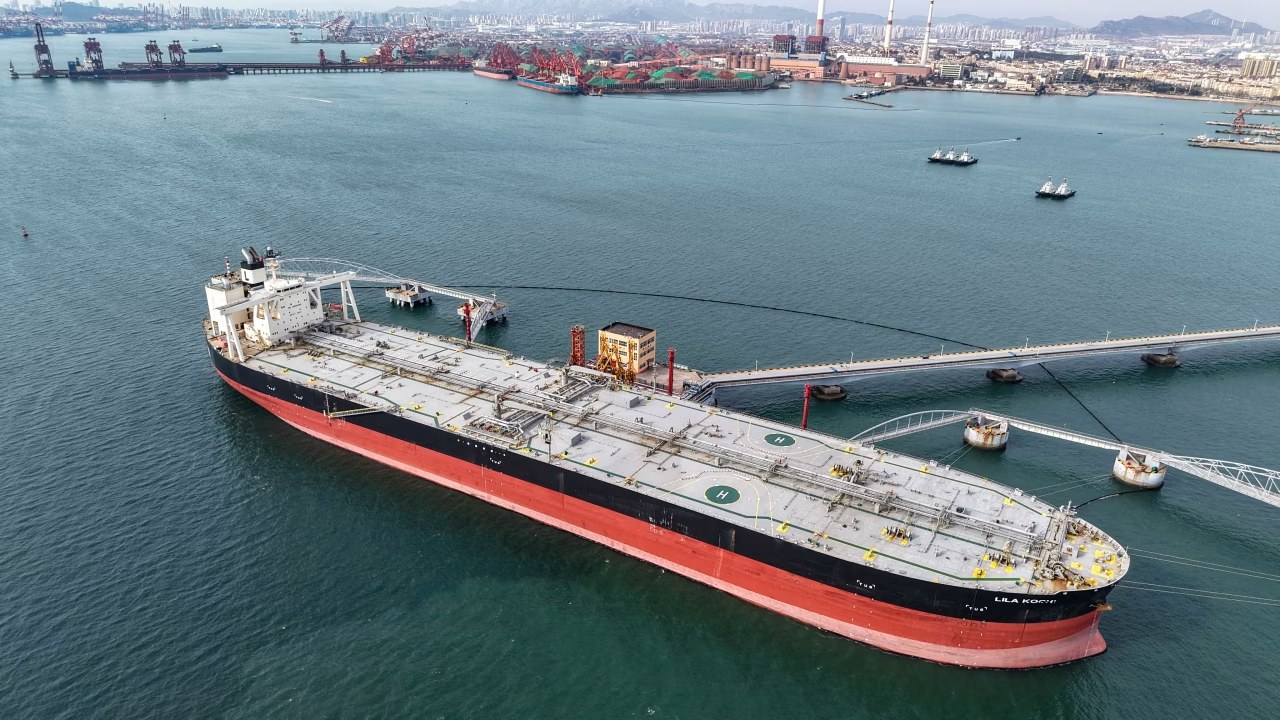
Over 18 million barrels a day—roughly one in every five consumed globally—pass through the 21-mile-wide strait that separates Iran from Oman. When Tehran’s military warned it would treat any tanker as a legitimate target, traders instantly repriced risk.
A single choke-point controls one fifth of world supply
Unlike earlier Middle East flare-ups, this threat materialized after the U.S. and Israel had already struck Iranian nuclear sites and oil depots in Tehran and Alborz province. With physical damage to facilities and the potential loss of the maritime artery, algorithms flashed buy signals within minutes of Sunday evening’s market open.
Shipping trackers report the number of vessels entering the strait has fallen sharply, though precise counts were not disclosed. “As long as shipping is stopped the pain point remains,” Atlantic Council economist Josh Lipsky told reporters.
The strait has no practical alternative: pipelines crossing Saudi Arabia and the United Arab Emirates can divert only a fraction of the flow, and they were already running near capacity before the latest escalation. Traders who had shrugged off earlier missile strikes finally reacted when the maritime choke-point was explicitly targeted.
Energy analysts note that even a partial closure lasting weeks would force refiners in Asia and Europe to draw down already-tight inventories, amplifying price volatility. The weekend spike therefore reflected not only headline fear but also the market’s thin buffer against any disruption at this critical bottleneck.
Refiners from South Korea to Poland began scrambling for replacement barrels, bidding up prices for similar-grade crude from Nigeria and the North Sea. The differential between Brent and Dubai-linked sour grades widened to its largest gap since 2022, illustrating how the market is pricing in a prolonged outage.
Insurance underwriters, meanwhile, have slapped temporary surcharges on voyages transiting the strait, effectively doubling freight rates from Asia to Europe. Shipbrokers say at least half-a-dozen very-large-crude-carriers have already rerouted around the Cape of Good Hope, adding 18 days to delivery times and tightening prompt supplies.
From $92 to $119.50: anatomy of a 30% spree
Friday’s New York close of about $92 felt calm; a week of prior strikes had lifted crude only modestly. But by Sunday evening electronic platforms were awash with stop-buy orders. Contracts touched $119.50, just 50 cents shy of the symbolic $120 level last seen in 2013.
Algorithms chased headlines faster than humans could blink
Fund managers said model-driven funds interpreted Iran’s shipping ban, Israeli strikes on storage tanks and the appointment of Ayatollah Khamenei’s son as new leader as a triad of escalation cues. Positioning data show leveraged bets on higher prices hit their highest level since the Ukraine war began.
Yet the rally lacked physical reality: U.S. inventories remain ample and Saudi Arabia has 2 million barrels a day of spare capacity. The mismatch primed the market for a reversal once a diplomatic headline emerged.
Brokers described a textbook short-squeeze: commodity-index funds that had trimmed energy exposure the previous week were forced to rebuild positions at any price, while retail traders piled into bullish exchange-traded products. Volume on the midnight-to-dawn session was triple the norm, underscoring how thin liquidity amplified the move.
By dawn Monday, European refiners began booking spot cargoes from West Africa and the North Sea, signaling that physical players saw the spike as overdone. Their selling pressure, combined with Trump’s televised comments, set the stage for the dramatic unwind that followed.
Options markets tell the same story: at-the-money volatility on one-week Brent contracts surged to 65%, a level last exceeded during the 2020 pandemic collapse. Margin desks raised requirements twice overnight, forcing leveraged longs to liquidate and accelerating the drop back toward $90.
Retail platforms also played a role: trading apps saw record sign-ups for oil-linked exchange-traded notes, many of which automatically roll front-month exposure. When the June contract briefly hit $119.50, the buying surge triggered circuit-breakers on one major brokerage, locking investors into positions that were underwater minutes later.
Is the war ‘very complete’ or ‘nowhere near over’?
President Trump’s first televised comment—”I think the war is very complete, pretty much”—hit newswires around 11 a.m. Eastern. Within minutes oil slid below $100 and the S&P 500 energy index flipped green. By late afternoon he reversed tone, telling reporters, “We haven’t won enough. We go forward… to achieve ultimate victory.”
Markets now parse every presidential adverb
Traders say the administration’s erratic messaging has replaced weekly inventory data as the fastest price driver. “Markets have grown accustomed to Trump’s erratic decision making,” one newsletter noted, yet the speed of Sunday’s spike-and-drop shows algorithms still key off presidential verbs in real time.
The White House offered no clarification on what “very complete” means for troop levels, sanctions relief or Hormuz escort missions, leaving futures to gyrate on each fresh cable-tv clip.
Inside dealing rooms, voice brokers now run CNN on mute so algorithms can scan the closed-caption feed for keywords like “complete,” “victory” or “cease-fire.” A single misinterpreted adjective can trigger millions of barrels worth of electronic trades within seconds, a dynamic that has turned energy futures into a proxy for geopolitical linguistics.
Administration officials, speaking anonymously, said the president’s intent was to signal that major combat operations against Iran’s nuclear sites had achieved their objectives, not to promise an imminent truce. Until clearer guidance emerges, traders say headline volatility will remain the norm rather than the exception.
Democratic lawmakers seized on the mixed signals, demanding a formal war-powers briefing. Meanwhile, G7 envoys scheduled an emergency session in Brussels, but diplomats privately concede that any collective response will hinge on whether Washington commits to keeping the strait open with naval escorts—a step the White House has so far declined to endorse publicly.
What comes next for energy consumers?
Despite Monday’s retreat, crude is still up roughly 20% since last week and retail gasoline prices lag the move by several days. Analysts warn American motorists could soon pay the steepest pump prices since 2022 if the strait stays closed and refining margins tighten.
Storage, spare capacity and diplomacy will decide the trend
U.S. commercial crude stocks stand 4% above their five-year average, giving refiners a cushion. Yet the Strategic Petroleum Reserve sits near historic lows after previous sales, limiting Washington’s ability to flood the market again. The G7 finance ministers pledged Monday to “monitor energy shocks closely,” but issued no commitment to coordinated releases.
For now, traders say the key variable is the strait: if escort convoys restart or Iran partially backs down, $90 could hold. If military action disables additional facilities, $120 may prove only a waypoint toward higher prices.
Airlines and freight carriers are already hedging more of their fuel needs for the third quarter, pushing up the cost of protection and embedding the risk premium into tickets and shipping rates. Consumer-facing brands warn that any sustained move above $100 will feed into headline inflation, complicating the Federal Reserve’s next rate decision.
Meanwhile, Asian importers are quietly seeking long-term supply deals with U.S. Gulf exporters, a shift that could structurally raise trans-Atlantic freight rates. If diplomacy stalls and the strait remains shut, the world may be entering an era in which $90 oil is the floor, not the ceiling.
Frequently Asked Questions
Q: Why did oil prices spike 31% in one day?
Brent crude leapt from about $92 Friday to $119.50 Sunday after Iran vowed to attack any vessel using the Strait of Hormuz, a choke-point for 20% of global supply. Weekend headlines of Israeli strikes on Tehran oil sites and the lack of a quick cease-fire amplified panic buying when electronic trading reopened.
Q: What sent prices crashing back down?
President Trump told CBS the war is ‘very complete,’ and the G7 pledged joint action to buffer energy shocks. Algorithmic funds reversed long bets, pushing U.S. futures to a 4.3% daily gain of $94.77, erasing most of the 30% overnight surge.
Q: Is the Strait of Hormuz still closed?
Satellite data show tanker transits through the strait have fallen sharply since Tehran’s threat. As long as shipping remains stopped, traders say the market’s downside is limited despite diplomatic headlines.
Q: How does Trump’s messaging move oil so fast?
Trading algorithms scan live TV captions for keywords like ‘complete’ or ‘victory.’ When Trump told CBS the war is ‘very complete,’ funds interpreted it as a de-escalation signal and unwound long positions within minutes, sending crude from $119.50 to under $100.
Q: Will gasoline prices follow the crude spike?
Retail pumps lag crude by several days. If the strait stays shut and refining margins tighten, U.S. motorists could face the highest gasoline prices since 2022, though ample domestic crude inventories provide a partial cushion.
Sources & References
- Primary SourceThe 24 Hours When Oil Markets Went Wildwsj.com
- Source 1The Wild 24-Hour Rise and Fall of Oil PricesMar 09, 2026bing.com
- Source 2The Wild 24-Hour Rise and Fall of Oil PricesMar 09, 2026bing.com
