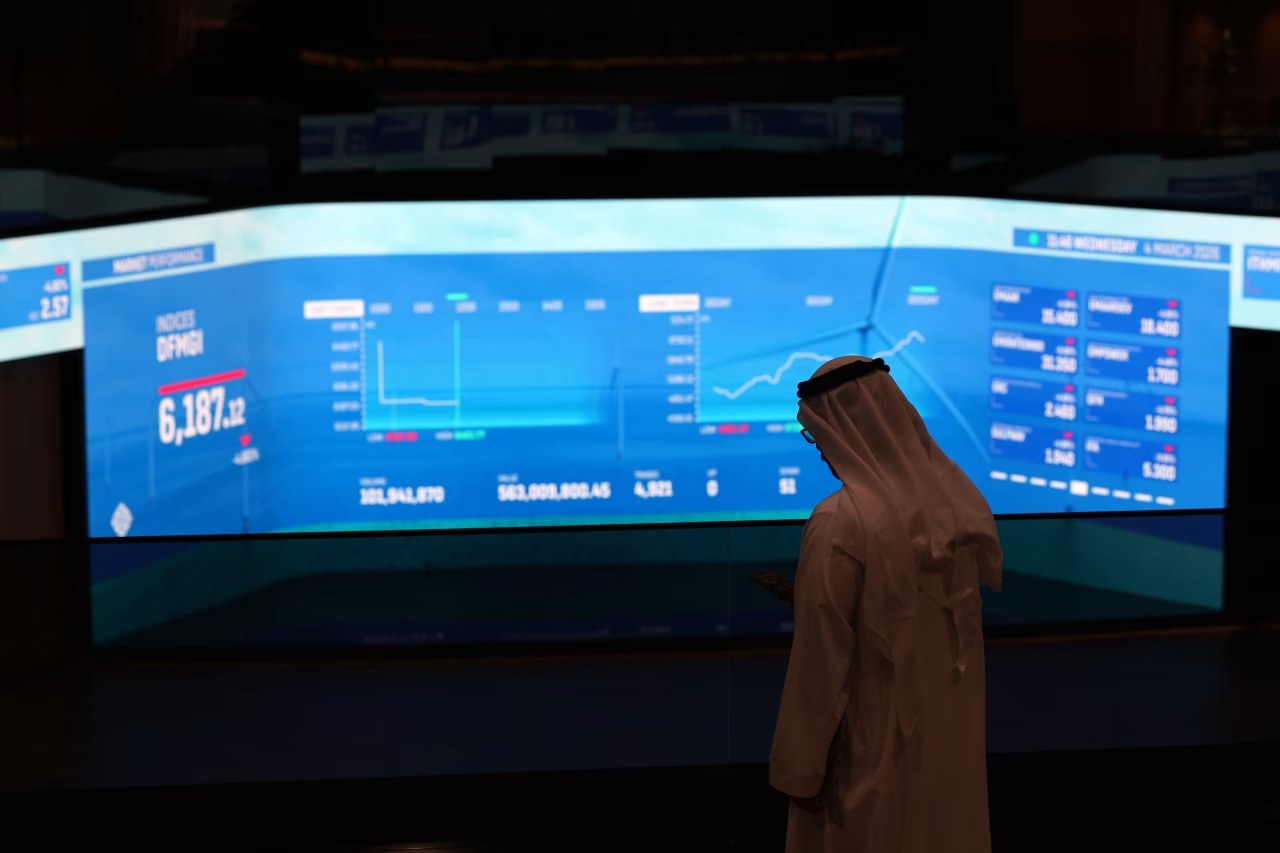
Iran War erases $110B from Gulf bourses in 21 days as Dubai stocks drop 18%
- Dubai’s DFM General Index sinks 18% in 21 sessions; foreign funds withdraw $2.7B
- Israeli defense giants Israel Aerospace and Elbit surge 27% and 24% on wartime orders
- Brent crude spikes to $97.40/bbl, adding $12 conflict premium as tankers reroute
- Qatar Exchange falls 12%, Saudi TASI down 9% as missile threats over the Gulf intensify
Long viewed as islands of stability, Gulf markets confront a new risk paradigm as Iranian missiles reach Dubai airspace
IRAN WAR—For two decades investors treated Dubai and its Gulf neighbors as a ‘safe pocket’ in the world’s most volatile neighborhood—wars raged in Gaza, Lebanon and Syria while glitzy skyscrapers kept rising. That calculus shattered overnight. The Iran War, which has grounded commercial flights, forced tankers to avoid the Strait of Hormuz and put cities such as Dubai and Doha under direct bombardment, is forcing a brutal repricing of regional risk.
In the past 21 trading days the Dubai Financial Market General Index has tumbled 18%, erasing roughly $110 billion in market capitalization, according to exchange data compiled by Bloomberg. International funds have pulled a net $2.7 billion from UAE equities since mid-February, EPFR Global figures show, the fastest outflow since the 2020 pandemic.
Meanwhile Israeli defense contractors are enjoying a wartime boom. Shares of state-owned Israel Aerospace Industries have jumped 27% since 20 February, while drone-maker Elbit Systems is up 24%. Oil investors are also winners: Brent crude surged to $97.40 a barrel on 14 March, its highest close since September 2023, as the market prices in a $12 ‘conflict premium’, Goldman Sachs commodity strategists wrote in a note to clients.
Investor exodus: $110B wiped off Gulf bourses in less than a month
The speed of capital flight has stunned Gulf fund managers. Between 19 February and 14 March the DFM General Index fell in 16 of 21 sessions, pushing price-to-book valuations for UAE banks to 0.9x, a level not seen since the 2016 oil slump. ‘We are seeing forced selling by long-only European pension funds that have a hard 10% stop-loss on single-country ETFs,’ said Fahad Al-Marri, head of equities at Al-Mal Capital in Dubai.
Abu Dhabi’s ADX General Index has declined 11% over the same period, trimming the combined market cap of the UAE’s two main exchanges to $732 billion, down from $842 billion a month ago, according to bourse data. The sell-off accelerated after Iranian missiles struck empty desert 60 kilometers south of Dubai on 3 March, the closest hit yet to the emirate’s population centers.
Kuwait’s SE Price Index is down 8% year-to-date, while the Saudi Stock Exchange (TASI) has fallen 9% since February, underperforming the MSCI Emerging Markets index by 12 percentage points. ‘Gulf equities are trading like emerging-market high-beta plays again, not the defensive oil-rich oasis narrative we sold to clients for years,’ said Sven Kopold, MENA strategist at Deutsche Bank.
Flight-to-cash forces IPO postponements
The risk reset is derailing primary markets. Abu Dhabi National Oil Company (ADNOC) has delayed the $1.5 billion listing of its drilling unit, people familiar with the matter told Reuters, while Dubai’s road-toll operator Salik is reconsidering a planned secondary share sale. Bankers say new mandates will stay on ice until volatility, measured by the implied-volatility index for Saudi stocks, retreats below 20—it hit 34 last week.
Each fresh missile volley tightens liquidity further. Average daily turnover on the DFM has fallen to 163 million dirhams ($44 million), down 38% from the 12-month average, as retail investors from Kuwait and Saudi Arabia pull back. ‘The fear trade is overwhelming fundamentals,’ said Al-Marri, noting that UAE lenders still offer 14% return on equity and 5% dividend yields.
The exodus shows few signs of slowing. EPFR-tracked funds dedicated to MENA equities recorded outflows for a seventh consecutive week, bringing year-to-date redemptions to $4.3 billion—already 70% of 2025’s full-year outflow. Unless a cease-fire emerges, analysts say regional bourses could surrender another 10% in the coming quarter.
Israel defense rally: How wartime spending lifted IAI and Elbit 27% and 24%
While Gulf investors dump risk, Israeli defense contractors are enjoying a liquidity-fuelled boom. Tel Aviv-traded Israel Aerospace Industries (IAI) has soared 27% since 20 February, pushing its market capitalization to 28.6 billion shekels ($7.9 billion). Elbit Systems, which makes 80% of its revenue from defense exports, advanced 24% over the same span, valuing the company at $9.4 billion.
The rally is underpinned by hard cash. On 6 March Prime Minister Benjamin Netanyahu’s government approved a supplemental defense budget of 8.7 billion shekels ($2.4 billion) for 2025, on top of the 75 billion shekels already allocated. About 60% of the new money is earmarked for missile-defense systems such as the Arrow-3 interceptor, built jointly by IAI and Boeing.
Export orders are also accelerating. Germany’s parliament on 9 March signed a 3.5 billion-euro deal to buy Israel’s Arrow-3 interceptors, the largest-ever defense contract between the two countries. ‘The Iran War has shifted global perception of Israeli technology from nice-to-have to must-have,’ said Ronen Bergman, defense analyst at Israel’s Channel 12.
Cybersecurity firms ride dual boom
Non-hardware players are not left out. Check Point Software Technologies, best known for consumer firewalls, has added 11% since February as corporations worldwide increase cyber-defense budgets following Iranian ransomware attacks on Gulf oil ports. Smaller peer CyberArk jumped 18%. The Tel Aviv TA-Defense index, which tracks the nine largest listed defense contractors, has outperformed the benchmark TA-35 by 19 percentage points year-to-date.
Portfolio managers say the rally can persist. ‘Defense spending in Israel is entering a multi-year up-cycle similar to the U.S. after 9/11,’ said Gilad Aharon, fund manager at Clarity Capital. He forecasts IAI revenue will grow 15% annually through 2027, well above the 4% compound rate of the past decade.
Yet valuations are no longer cheap. Elbit now trades at 24x forward earnings, a 40% premium to its five-year average, while IAI fetches 22x. Analysts warn that any cease-fire could trigger a swift 10–15% pullback, but for now the momentum remains with the bulls.
Oil spike: Why Brent crude carries a $12 Iran War premium
Energy markets are repricing faster than equities. Brent crude for May delivery settled at $97.40 a barrel on 14 March, up 19% year-to-date and $12 above the pre-crisis futures curve, according to Goldman Sachs. ‘We attribute the entire backwardation move to geopolitical risk,’ said the bank’s commodity chief Damien Courvalin, noting that physical supply has not yet been disrupted.
Traders cite two chokepoints. Roughly 21 million barrels a day of oil transit the Strait of Hormuz, equating to 21% of global supply. Shipping data compiled by TankerTrackers show that 14 very-large-crude-carriers (VLCCs) have rerouted around the Cape of Good Hope since 1 March, adding 18 days to voyages from the Gulf to Europe.
Insurance costs are also surging. War-risk premiums for VLCCs calling at Iranian or UAE ports have jumped to $2.1 million per voyage from $400,000 in January, according to London insurance broker Howden. ‘Owners are demanding cash upfront or proof of top-tier government guarantees,’ said Howden’s maritime chief Mike Adams.
OPEC+ cushion thinner than 2019
The spike comes at a delicate moment. OPEC+ spare capacity has fallen to 3.4 million barrels a day, or 3.2% of global demand, the lowest since 2019, U.S. Energy Information Administration data show. Saudi Arabia, which holds 2.8 million b/d of idle capacity, has pledged to ramp up only if sanctions, not conflict, remove Iranian barrels.
Goldman now models a $107 average Brent price in a scenario where Hormuz traffic falls 30%. Analysts at Rystad Energy go further, warning of $115 if missile strikes hit Saudi’s Abqaiq processing plant again. ‘The market is one supply disruption away from triple digits,’ said Rystad’s head of oil markets Bjørnar Tonhaugen.
Yet higher prices also invite a U.S. response. The White House on 12 March said it would release up to 60 million barrels from the Strategic Petroleum Reserve if average retail gasoline exceeds $4 a gallon nationally—currently $3.87, according to AAA. For now, though, the bulls remain in control.
Which sectors are safest as Gulf risk surges?
Within the battered Gulf region, not all stocks are equally vulnerable. Defensive sectors—utilities, consumer staples and telecoms—have outperformed the wider Dubai index by 6–8 percentage points since February, data compiled by S&P Global show. Dubai Electricity & Water Authority (DEWA), which enjoys regulated returns, is down only 4% compared with the 18% plunge in the benchmark.
Telecom giant Etisalat, now branded e&, has fallen 7% but trades on a 6.7% dividend yield, luring domestic pension funds. ‘High-yield telecom and utility names are the new flight-to-quality inside the region,’ said Mariam Al-Falasi, portfolio manager at Abu Dhabi Commercial Bank’s asset-management arm.
Conversely, tourism-linked shares are the hardest hit. Dubai’s flagship airline Emirates said on 11 March it would cut 15% of flights to Iran, Iraq and Jordan, wiping out a route network that contributed 8% of pre-tax profit. Shares of airport retailer Dubai Duty Free, though privately held, were marked down 20% in secondary-market trades, brokers say.
Gold and the dollar regain regional allure
Traditional havens are back. In March, UAE gold dealers reported a 35% jump in retail bar and coin sales compared with the monthly average, according to the Dubai Gold & Jewellery Group. The UAE dirham, pegged to the dollar, has seen no volatility, but demand for physical dollars is rising. ‘Clients want stacks of $100 bills in vaults, not bank balances,’ said a private-banker at a European lender in Dubai.
Meanwhile, regional sovereign wealth funds are rotating into global bonds. Norway’s NBIM estimates the Abu Dhabi Investment Authority shifted $7 billion into U.S. Treasuries during the first two weeks of March, accelerating a trend that began in 2025 when oil revenue surged. For Gulf investors, the safest trade may be to leave the neighborhood.
What comes next? Analysts map four Iran War scenarios for markets
With no cease-fire in sight, regional strategists are gaming binary outcomes. In a ‘contained conflict’ baseline—defined as no disruption to Hormuz oil traffic—Goldman sees Brent averaging $92 in 2026, Dubai equities recovering 10% and Israeli defense names adding a further 5%. The probability-weighted outlook assigns a 45% chance to this scenario.
A second scenario, ‘Hormuz disruption-lite’, assumes a 20% drop in tanker traffic for three months. Brent spikes to $107, the Saudi riyal forward points widen 200 basis points and Dubai stocks fall another 12%. Goldman assigns 30% probability.
The tail-risk ‘Blockade’ envisions Iran mining the strait, cutting traffic 60% and sending Brent to $140. Under this case—10% probability—Dubai’s index would plunge 35%, Israeli defense stocks surge 50% and U.S. strategic-reserve releases would fail to cap oil above $100. ‘It would be the 1980s tanker-war replay but with today’s algo-driven markets,’ said Deutsche’s Kopold.
Diplomatic off-ramp could spark violent relief rally
The fourth scenario—a cease-fire within 30 days—carries 15% odds but asymmetric upside. Historical precedent: when the 2020 Abraham Accord was announced, Dubai stocks jumped 13% in a week while Brent slid $6. ‘Markets are positioned for bad news; any truce could trigger a 15–20% short-covering rally in the DFM,’ said Al-Marri.
Until then, fund managers recommend barbell strategies: long Israeli defense and U.S. energy, short high-beta Gulf consumer plays, and overweight cash. ‘Geopolitics is now the top factor in every MENA model,’ said Kopold, noting that 18 months ago ESG rankings dominated client calls. For Gulf markets, the age of innocence is over.
Frequently Asked Questions
Q: How much have Dubai stocks fallen since the Iran War escalated?
The DFM General Index has dropped 18% in 21 trading days, wiping out roughly $110 billion in market cap as missile strikes hit UAE airspace and forced fund managers to cut Gulf allocations.
Q: Which Israeli stocks are rallying on the Iran conflict?
Defense contractors Israel Aerospace Industries and Elbit Systems have surged 27% and 24% respectively, while cyber-security play Check Point added 11% as government contracts accelerate.
Q: Is Brent crude still rising on the Iran War risk premium?
Yes—Brent touched $97.40/bbl on 14 March, up 19% year-to-date, with Goldman Sachs citing a $12 ‘conflict premium’ embedded in futures as tankers avoid the Strait of Hormuz.
