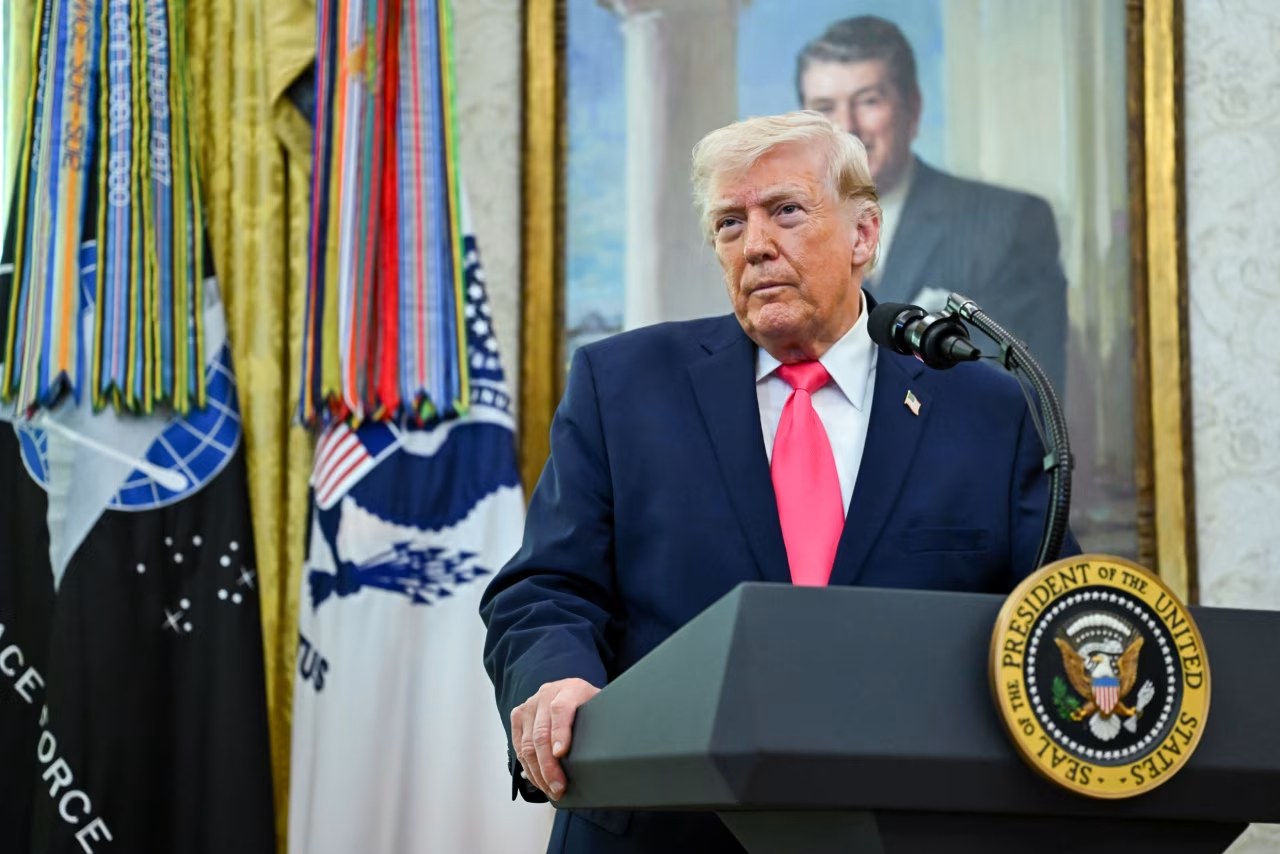
Trump Signs Up 3 Tech Titans to Shape U.S. AI Rules
- Meta CEO Mark Zuckerberg, Oracle chairman Larry Ellison and Nvidia CEO Jensen Huang will sit on the President’s Council of Advisors on Science and Technology.
- David Sacks, White House AI and crypto czar, and former U.S. CTO Michael Kratsios will co-chair the panel.
- The council has no regulatory power but past recommendations have guided everything from Apollo funding to CRISPR oversight.
- Trump’s move signals a pivot toward industry-heavy input on artificial-intelligence governance ahead of the 2026 mid-term policy window.
Silicon Valley’s most powerful executives gain a direct line to the Oval Office on AI regulation, federal procurement and research priorities.
TRUMP—President Donald Trump on March 25 installed three of the technology sector’s most influential leaders—Meta Platforms CEO Mark Zuckerberg, Oracle Executive Chairman Larry Ellison and Nvidia CEO Jensen Huang—onto the President’s Council of Advisors on Science and Technology, a White House statement confirmed.
The council, known inside the Beltway as PCAST, will be co-chaired by David Sacks, the venture capitalist who has emerged as Trump’s AI and crypto policy architect, and Michael Kratsios, who served as U.S. chief technology officer under Trump’s first term. Their mandate: advise the president on how to regulate artificial intelligence, streamline federal tech procurement and maintain American leadership in semiconductors.
While PCAST lacks statutory rule-making authority, its bipartisan alumni network—from former NIH director Francis Collins to ex-Google CEO Eric Schmidt—has historically translated closed-door deliberations into billion-dollar budget lines and landmark legislation. By recruiting Zuckerberg, Ellison and Huang, Trump is betting that industry heavyweights can craft AI guardrails without throttling the very innovation the administration hopes to unleash.
Why Trump Is Handing the AI Pen to Zuckerberg, Ellison and Huang
The appointments vault three executives whose companies control the backbone of modern AI—social-media data, enterprise cloud contracts and the GPUs that train large language models—into the room where federal rules are drafted. Zuckerberg oversees Meta’s family of apps used by 3.2 billion people daily, giving him unrivaled insight into content-moderation algorithms that Washington wants to audit. Ellison’s Oracle holds more than 50 percent of the market for secure-cloud accreditation packages required by the Pentagon and intelligence agencies. Huang’s Nvidia chips power 87 percent of the world’s top 500 supercomputers, making him the gatekeeper of the compute supply chain.
Trump’s selection calculus is rooted in raw market share, according to interviews with three former White House science-policy officials who asked not to be named. By co-opting the CEOs who literally sell the picks and shovels of the AI boom, the administration gains technical fluency while blunting industry resistance to future oversight. The tactic mirrors President Eisenhower’s 1958 decision to name AT&T’s CEO to PCAST at the dawn of the space age, a move that aligned private R&D budgets with federal priorities and seeded the micro-electronics revolution.
Yet the concentration of power also raises conflict-of-interest alarms. Meta is under Federal Trade Commission investigation for alleged monopolistic practices; Oracle faces a Government Accountability Office audit over its $11 billion cloud migration at the Department of Veterans Affairs; and Nvidia is defending itself against French antitrust raids. Consumer-advocacy group Public Knowledge warns that council members could water down privacy or antitrust enforcement under the guise of promoting innovation. The White House counters that all appointees will file standard financial-disclosure forms and recuse themselves from votes that pose a direct financial benefit, a protocol last tightened under President Obama after the 2008 financial crisis.
The council’s first deliverable will be a 90-day report on AI competitiveness, due weeks before the administration’s 2026 budget proposal lands on Capitol Hill. Expect fierce lobbying over export-control thresholds for advanced chips, open-source model disclosure rules and federal procurement preferences for American-made GPUs. The stakes: an estimated $1.3 trillion in global AI infrastructure spending through 2030, according to IDC forecasts. Whatever PCAST recommends this summer will echo in appropriations bills, Defense Authorization language and Commerce Department rule-makings for years to come.
Can David Sacks and Michael Kratsios Keep the Peace?
Co-chairing PCAST is a political tightrope. The council must produce consensus reports that land on the president’s desk without dissenting footnotes, a tradition that dates to President George H.W. Bush’s tenure. David Sacks, co-founder of Yammer and a PayPal mafia veteran, arrives with a libertarian bent forged during his years at Craft Ventures. He has publicly argued that AI regulation should be “as light as possible” to preserve American competitiveness versus China. Michael Kratsios, by contrast, is a technocrat who shepherded the National AI Initiative Act through Congress in 2020 and helped stand up the National AI Research Resource during the Biden era. Their ideological overlap: both view export controls on GPUs as a geopolitical weapon.
People close to the transition say Sacks will focus on private-sector deployment and crypto integration, while Kratsios will manage inter-agency coordination with the National Science Foundation, Department of Energy and Department of Defense. The division of labor is deliberate: Sacks courts venture capital and start-ups; Kratsios translates Silicon Valley lingo into procurement language the Pentagon understands. Past PCAST co-chairs warn that personality clashes can stall reports for months. In 2014, co-chairs John Holdren and Eric Lander disagreed over gene-editing oversight language, delaying a report until the White Office of Science and Technology Policy intervened.
Trump’s staff is betting that Sacks’s fundraising prowess—he donated $1.5 million to the 2024 Trump campaign—and Kratsios’s Senate confirmation experience will smooth partisan rifts. The council’s 21 remaining seats must still be filled, and each new member will need security clearances to discuss sensitive semiconductor supply-chain data. Intelligence officials told the Journal that clearance backlogs currently average 213 days, potentially compressing the council’s first-year agenda. If Sacks and Kratsios can keep the council on a 120-day drafting cycle, their AI competitiveness report could land in time to influence the 2026 appropriations mark-ups, the last major legislative vehicle before the mid-term elections.
The duo’s immediate test: whether to endorse a new Commerce Department rule that would require cloud providers to verify foreign customer identities. Oracle supports the measure; Meta and Nvidia worry it could deter overseas developers from U.S. platforms. The compromise they craft will signal how aggressively the administration intends to weaponize cloud access in its tech cold war with Beijing.
What History Says About Industry-Led Science Councils
Every president since Eisenhower has used PCAST to legitimize policy by wrapping it in lab-coat authority, but Trump’s industry-heavy roster is the most lopsided since Ronald Reagan stacked the council with defense contractors to support the Strategic Defense Initiative. Reagan’s 1983 council recommended doubling federal R&D spending and loosening export controls on satellites—policies that benefited member companies including Boeing and Lockheed but also accelerated commercial micro-electronics. The parallel is not lost on today’s Capitol Hill staffers, who note that Zuckerberg’s Meta spends $38 billion a year on R&D, more than the entire National Science Foundation budget.
The counter-example is President Clinton’s 1993 council, which balanced CEOs with academic Nobel laureates and produced the 1995 National Innovation Report that seeded the modern internet boom while also authorizing antitrust action against Microsoft. That mixed model kept corporate overreach in check, say historians like University of Washington professor Margaret O’Mara, author of “The Code.” The risk of an industry-dominated council is regulatory capture: rules that sound neutral but entrench incumbents. The 1980 Bayh-Dole Act, which let universities patent federally funded research, was drafted after heavy PCAST lobbying by pharmaceutical executives and is now criticized for inflating drug prices.
Trump’s council could swing either way. On export controls, Zuckerberg and Huang have incentives to keep tight lids on chips and open-source models to stifle foreign rivals. On privacy, Meta’s business model depends on targeted ads, creating tension with any federal data-protection standard. Ellison, whose Oracle profits from government contracts, may push for procurement rules that favor American cloud providers over Amazon or Microsoft. The White House insists that the Federal Advisory Committee Act, which requires public comment periods and meeting minutes, will provide transparency. Yet the first council meeting will be held at the Eisenhower Executive Office Building, which can be closed to press under security protocols.
Congressional Democrats plan to counterbalance the council by reviving the Office of Technology Assessment, abolished in 1995, to provide independent analysis. Senator Maria Cantwell has already floated a bill that would give the OTA a $50 million annual budget, roughly half of PCAST’s projected operating cost. Whether Republicans, who control the Senate, will support the measure remains uncertain, but the legislative chess match underscores that PCAST’s recommendations are only the opening gambit in a longer regulatory war.
Will the Council Tilt AI Regulation Toward Deregulation?
The council’s first policy test is already on the docket: a Commerce Department proposal to require cloud providers to verify the identity of foreign users training models above a yet-undefined compute threshold. Meta and Nvidia oppose the rule, arguing it would push overseas developers toward Chinese cloud platforms. Oracle supports it, betting that security-conscious agencies will prefer its domestic data centers. The split illustrates how AI governance is becoming a proxy fight over market access, not just safety.
Trump’s executive order drafting team has circulated a draft that would sunset any new AI model-reporting requirement within five years unless renewed by Congress—a clause that dovetails with Sacks’s libertarian stance. Critics say the sunset clause would create regulatory uncertainty and chill long-term investment in compliance infrastructure. Supporters counter that it prevents bureaucratic overreach and keeps the U.S. ahead of European rivals now finalizing the EU AI Act’s mandatory risk assessments.
Beyond export controls, the council is expected to weigh in on federal procurement standards for generative AI, a market worth $2.4 billion in FY 2025 contracts, according to Deltek estimates. Oracle wants preference for systems that can be audited line-by-line; Meta promotes open-source benchmarks; Nvidia favors performance metrics that favor GPU-rich architectures. The compromise language will likely end up in the Federal Acquisition Regulation, binding every agency from the Pentagon to the Department of Agriculture.
The wildcard is state-level legislation. California’s SB 1047, which would impose liability on large AI model developers, is advancing in Sacramento. A PCAST report that endorses federal pre-emption could undercut such state laws and create a uniform national standard—something big tech lobbyists have sought for years. Consumer groups fear that outcome would set a low regulatory floor, much as the 1996 Telecom Act did for internet platforms. The council’s final report, due 90 days after its first meeting, will be the clearest signal yet of which direction Trump intends to steer the AI debate.
Frequently Asked Questions
Q: What is PCAST and why does it matter for AI?
PCAST is the President’s Council of Advisors on Science and Technology. It has shaped U.S. policy since 1957, from Apollo to CRISPR. Adding Zuckerberg, Ellison and Huang signals AI will be treated as a national-priority issue with direct industry input into regulation, procurement and research funding.
Q: Who will co-chair the council?
David Sacks, the White House AI and crypto czar, and Michael Kratsios, a former U.S. chief technology officer, will co-chair. Both have start-up and venture capital experience, aligning Trump’s deregulatory stance with Silicon Valley’s growth priorities.
Q: Does the council have formal rule-making power?
No. PCAST can only recommend policy. Yet its alumni have gone on to lead federal agencies, and its reports often become blueprints for legislation, making its influence on AI governance far greater than its advisory status suggests.
📰 Related Articles
- Sen. Merkley Demands Probe Into Private Equity’s Grip on Child‑Care Centers
- Pop Mart Profits Surge 350% as Labubu Dolls Drive Global Blind-Box Boom
- Trian and General Catalyst Seal $52-a-Share Janus Henderson Deal After Victory Capital Bows Out
- TransAlta Gains Analyst Upgrade as Alberta Power Prices Rebound
