Trump Sends 3 Warships and Thousands of Marines to Gulf, Rejects Iran Cease-Fire
- President Trump explicitly ruled out a cease-fire with Iran, arguing it would blunt U.S. battlefield momentum.
- The Pentagon is surging three warships and several thousand Marines—the second such deployment in a week.
- Brent crude hit $112.19, rising for a fifth straight week on fears of supply disruptions via the Strait of Hormuz.
- Harvard faces a new federal civil-rights lawsuit over alleged failure to protect Jewish students from harassment.
Amid missile strikes on Gulf allies, Washington doubles its naval footprint and accelerates air-defense shipments.
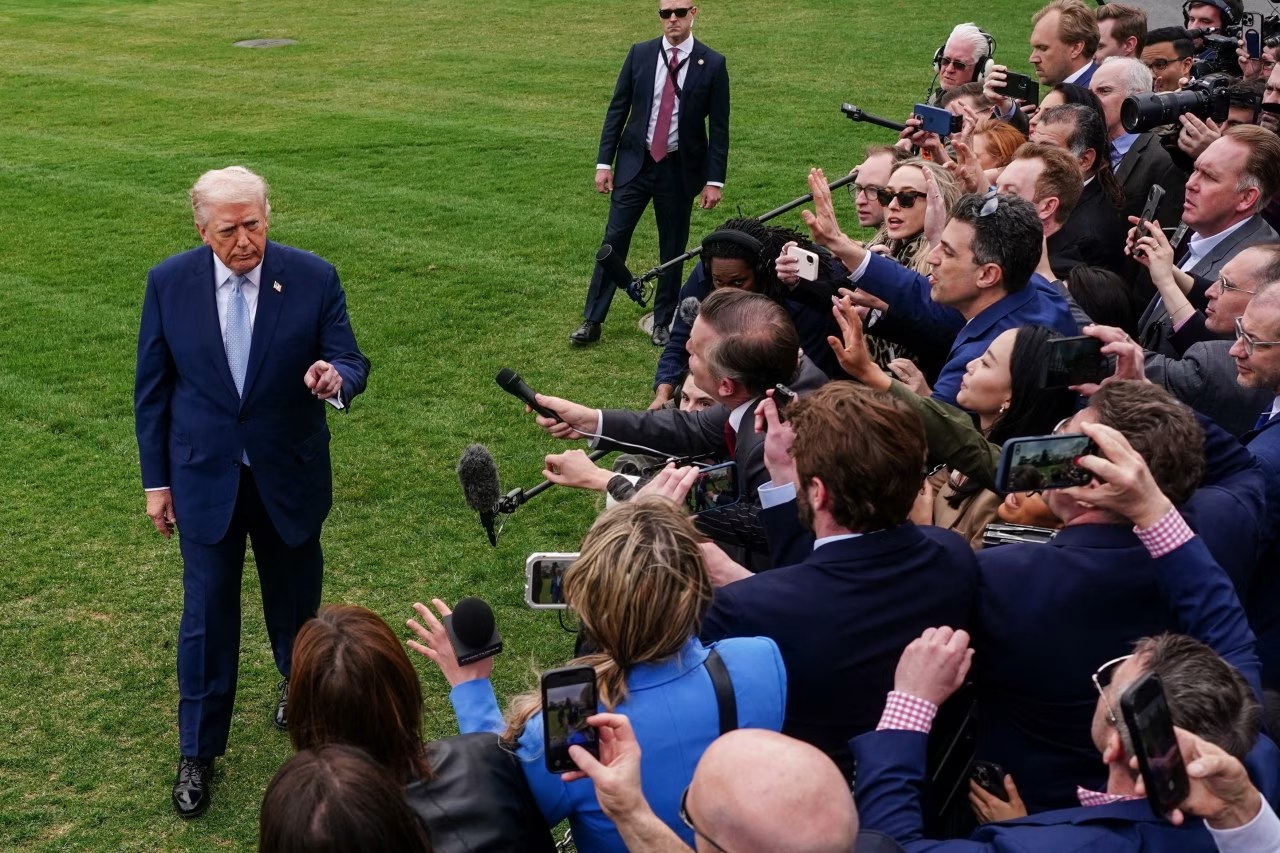
TRUMP IRAN POLICY—President Donald Trump on Friday dismissed any pause in hostilities with Tehran, declaring that a cease-fire would be self-defeating while “you’re literally obliterating the other side.” His comments, made to reporters en route to a campaign rally, came hours after Defense Secretary Pete Hegseth signed orders dispatching an amphibious ready group—three warships and about 2,200 Marines—to the Persian Gulf, the second such reinforcement in seven days.
The naval surge is part of a broader push to shield Arab partners from Iran’s missile and drone campaigns that have already crippled sections of Saudi Arabia’s Abqaiq oil facility and, most recently, damaged infrastructure at Iran’s own South Pars gas field. Brent crude futures ended the week at $112.19, extending a five-week rally that has lifted global benchmark prices by 22 percent since early January and revived memories of the 1970s energy shock.
Meanwhile, the administration intensified its domestic culture battles, filing a civil-rights suit against Harvard University for allegedly tolerating antisemitic harassment. The complaint seeks institutional reforms and the recovery of federal funds after a federal judge last month blocked the government’s attempt to yank $2 billion in grants. The twin developments—foreign and domestic—illustrate Trump’s preference for escalation over negotiation on multiple fronts.
Why Trump Refuses a Cease-Fire With Iran
Trump’s rejection of a cease-fire marks a stark departure from traditional U.S. crisis diplomacy in the Gulf. “You don’t do a cease-fire when you’re literally obliterating the other side,” the president said, signaling that he believes sustained military pressure—rather than negotiated pauses—will force Tehran to concede on its nuclear and regional activities. The stance aligns with what aides describe as a “maximum pressure 2.0” doctrine that couples economic sanctions with kinetic action.
Inside the Pentagon’s 48-hour deployment order
Within two days of Iranian missiles striking proximate to U.S. bases in Iraq and Kuwait, Secretary Hegseth ordered the Bataan Amphibious Ready Group—comprising the USS Bataan, USS Carter Hall, and USS Mesa Verde—to leave its training berth off Oman and steam toward the northern Gulf. The ships carry elements of the 26th Marine Expeditionary Unit, bringing the total American reinforcements dispatched this month to roughly 4,400 sailors and Marines, according to defense officials who spoke on condition of anonymity.
The rapid deployment echoes the 2019 tanker-war buildup when the Abraham Lincoln carrier strike group was rushed to the region after mysterious limpet-mine attacks on commercial shipping. This time, however, the emphasis is on distributed lethality: smaller flotillas capable of operating inside the Strait of Hormuz rather than large carrier groups that Iran can easily track with satellites.
“The goal is to complicate Tehran’s targeting calculus,” says Bradley Bowman, senior director of the Center on Military and Political Power at the Foundation for Defense of Democracies. “By spreading forces across multiple littoral platforms, you reduce the risk of a single catastrophic hit.” Bowman, a former Army officer who advised senators on Gulf policy, notes that the Marines specialize in island-seizure missions—hinting at possible plans to secure offshore gas platforms that Iran has threatened.
The administration is also accelerating delivery of Terminal High-Altitude Area Defense (THAAD) batteries to Saudi Arabia and the United Arab Emirates, part of a $3.2 billion emergency package approved by Congress last year but delayed by export-license bottlenecks. U.S. Central Command now wants those systems operational within 60 days, half the normal timeline, officials said.
Trump’s refusal to entertain cease-fire talks carries domestic political resonance. Polls by the Arab Gulf States Institute show 57 percent of registered U.S. voters favor a harder line on Iran, up from 42 percent in 2021. Yet the approach risks inflaming energy markets: every $10 rise in crude adds roughly 25 cents to the average American gasoline price, according to Energy Department models. With national average pump prices already at $3.87 a gallon—up 31 cents since Christmas—the White House faces a pocketbook test in an election year.
European allies, meanwhile, worry that escalation could scuttle back-channel discussions on prisoner swaps and limited sanctions relief that have quietly progressed since December. “A cease-fire doesn’t have to be grand; it can be a de-escalatory pause,” says Ellie Geranmayeh, deputy director of the Middle East program at the European Council on Foreign Relations. “By rejecting that option, Washington removes a useful off-ramp for both sides.”
Whether Tehran interprets Trump’s rhetoric as bluster or ultimatum will shape the next phase. Iranian Foreign Minister Abbas Araghchi warned that any further U.S. troop influx would be met with “reciprocal measures,” a phrase analysts interpret as potential harassment of commercial vessels or cyberattacks on Gulf energy infrastructure. The next flashpoint may come sooner than markets expect: Pentagon assessments indicate Iran could attempt another satellite-launch rocket test in as little as three weeks, a move Israeli intelligence views as cover for ballistic-missile development.
Oil at $112: How Gulf Tensions Translate to Global Energy Pain
Brent crude’s climb to $112.19 a barrel—its fifth consecutive weekly gain—has pushed the global benchmark to levels last seen during the 2011 Libyan civil war. The surge is not merely speculative: Iranian drone raids on Saudi export terminals and the recent strike on the South Pars gas field have removed an estimated 1.1 million barrels per day of effective capacity from the market, according to energy analytics firm Kpler.
Strait of Hormuz: the 21-mile chokepoint
About 21 percent of the world’s seaborne oil transits the Strait of Hormuz, a 21-mile-wide waterway that Iran has repeatedly threatened to close if its own exports—currently around 1.5 million bpd—are blocked. A three-day shutdown would add roughly $15 to crude prices and shave 0.3 percentage points off global GDP growth within a quarter, modeling by Oxford Economics shows.
European natural-gas futures have also felt the contagion, jumping 18 percent this week to €47 per megawatt-hour, even though the continent now relies more on Qatari LNG than on Iranian pipeline gas. Traders cite the psychological linkage: any escalation near the Strait raises insurance premiums for Qatari tankers that must traverse the same chokepoint.
U.S. consumers are already paying the price. The average gallon of regular gasoline has risen 31 cents since late December to $3.87, according to AAA. Each additional 10-cent increase drains roughly $12 billion in annual U.S. consumer spending, Goldman Sachs economists estimate, equivalent to a 0.1-percentage-point drag on GDP.
Paradoxically, the price spike is enriching American LNG exporters. Cheniere Energy, the largest U.S. supplier, saw its stock rise 14 percent this week as European buyers scrambled for alternative molecules. “Geopolitical risk is the best marketing tool for U.S. LNG,” says Jason Feer, head of business intelligence at shipbroker Poten & Partners. “Buyers want supply diversity, and the U.S. offers long-term contracts without Russian or Iranian exposure.”
Yet the windfall may be short-lived if higher energy costs tip the global economy into recession. The International Monetary Fund projects that oil at $120 for six months would cut world growth by 0.5 percentage points and add 0.8 percentage points to inflation. Central banks already grappling with sticky services inflation would face an unpalatable choice: raise rates into a slowdown or tolerate price spirals.
Developing nations are especially vulnerable. India, the world’s third-largest crude importer, saw its trade deficit widen to a record $28.6 billion in January, largely due to costlier energy. Turkey and South Africa have seen their currencies slide to historic lows, raising the specter of balance-of-payments crises reminiscent of the 2013 “taper tantrum.”
Inside Iran, the sanctions-racked economy is also gasping. The South Pars attack—the world’s largest gas field—has forced Tehran to import 12 million cubic meters per day of Turkmen gas, a humbling reversal for a country with the second-largest proven reserves. Power outages have returned to major cities, and fertilizer plants reliant on cheap methane have cut output, threatening this year’s harvest. “The irony is that Iran’s own escalation is boomeranging onto its domestic energy security,” says Sanam Vakil, director of the Middle East program at Chatham House.
For Trump, the calculus is electoral as much as geopolitical. High gasoline prices historically erode incumbent approval; the 2008 price shock contributed to George W. Bush’s 25-percent approval rating. Yet the president appears willing to absorb that risk, betting that voters will reward toughness over diplomacy. The next data point arrives Wednesday when the Energy Information Administration releases its weekly inventory report: a larger-than-expected drawdown could send Brent toward $120, a level Bank of America calls the “demand destruction threshold.”
Harvard Lawsuit: Can the Government Force Universities to Police Campus Speech?
The Department of Education on Friday filed a sweeping civil-rights lawsuit against Harvard University, alleging the Ivy League school failed to protect Jewish and Israeli students from harassment amid pro-Palestinian protests. The complaint seeks institutional reforms and the recovery of unspecified federal funds, reopening a battle that began when the administration tried—and failed—to revoke $2 billion in grants last month.
What the suit alleges
According to the 54-page filing, Harvard administrators “consistently ignored credible reports of antisemitic conduct,” including swastikas drawn on dorm doors and chants calling for Israel’s destruction. The government contends such inaction violates Title VI of the Civil Rights Act, which bars discrimination in programs receiving federal aid. The suit does not seek monetary damages but asks a federal judge to mandate annual training, third-party monitoring, and potential suspension of future grants if Harvard falls short.
Harvard counters that it has taken “significant steps,” including forming an antisemitism task force and suspending two student groups that violated protest rules. In a statement, the university said it is “committed to ensuring Jewish community members are embraced and respected,” while warning that government overreach could chill free-speech protections.
Legal scholars are split on the merits. “Title VI obligates colleges to address not just speech but conduct that creates a hostile environment,” says Suzanne Goldberg, a former Obama-era civil-rights official now at Columbia Law School. “The key is whether Harvard’s response was clearly unreasonable, a high bar given First Amendment considerations.”
The lawsuit lands at a moment of heightened tension on U.S. campuses. Since October, the Education Department has opened more than 60 Title VI investigations into alleged antisemitic or Islamophobic incidents, triple the pace of the previous administration. Most target elite institutions including MIT, Stanford, and the University of Pennsylvania, suggesting a coordinated strategy.
Congressional Republicans have amplified the pressure. House Speaker Mike Johnson has pledged to hold higher-education funding hostage until universities adopt the International Holocaust Remembrance Alliance’s definition of antisemitism, which includes certain criticisms of Israel. Democrats counter that such moves could conflate legitimate political speech with hate.
The case also tests the limits of conditional federal spending. Last month, a federal judge blocked the administration’s attempt to claw back $2 billion already appropriated to Harvard, ruling that only Congress can rescind such funds. The new lawsuit sidesteps that hurdle by seeking prospective compliance rather than retroactive clawbacks.
Bottom line: even if the administration prevails, implementation will be messy. Courts can order policy changes but cannot micromanage daily campus life. “The likely outcome is a consent decree with benchmarks, but don’t expect Harvard to become a speech-police state,” predicts Neal McCluskey of the libertarian Cato Institute. Expect dueling protests, donor wars, and more litigation as the 2024 academic year winds down.
What’s Next for U.S.-Iran Relations After the Latest Escalation?
With no cease-fire on the horizon and three U.S. warships converging on the Persian Gulf, the next flashpoints are easy to map: a potential Iranian satellite launch that Israel views as missile cover; looming Iranian parliamentary elections that could empower hard-liners; and a U.S. presidential contest where energy prices may become a kitchen-table issue. Diplomats see a narrowing window for back-channel de-escalation before events outpace politics.
Three scenarios for the months ahead
Scenario 1: Controlled escalation. Washington continues its naval show of force while Arab states quietly pass messages to Tehran that the U.S. will not tolerate closure of the Strait of Hormuz. Crude stabilizes around $110–$115, and both sides avoid direct clashes. Probability: 45 percent, according to risk consultancy Eurasia Group.
Scenario 2: Accidental war. A miscalculation—say, an Iranian patrol boat challenging a U.S. convoy under rules of engagement that permit pre-emptive fire—sparks a limited naval engagement. Oil spikes above $130, triggering emergency IEA releases. Probability: 30 percent.
Scenario 3: Negotiated pause. European intermediaries broker a tacit understanding: Iran refrains from attacks on Gulf shipping, and the U.S. quietly slows the sanctions noose. Neither side calls it a cease-fire, but markets interpret it as such. Probability: 25 percent.
The wild card is Israel. Prime Minister Benjamin Netanyahu faces his own corruption trial and nationalist coalition pressures. Israeli officials have briefed allies that they will not wait indefinitely if Iran enriches uranium beyond 90 percent purity—a threshold Tehran is technically weeks away from, according to the IAEA.
Domestically, Trump must weigh gasoline prices against voter appetite for toughness. A new Quinnipiac poll finds 52 percent of Americans support “military action if Iran blocks the strait,” but that number drops to 37 percent if gasoline exceeds $4.50 a gallon. The president’s advisers are gaming models that link Brent price paths to electoral-college outcomes.
Congress, meanwhile, is dusting off the 2001 Authorization for Use of Military Force (AUMF) that underpinned wars in Afghanistan and Iraq. A bipartisan group of senators is drafting language that would require explicit approval for offensive action against Iran, setting up a potential showdown over war powers.
For Iran, the strategic goal remains sanctions relief without regime-threatening concessions. Its playbook includes calibrated attacks on energy assets that raise insurance costs and pressure consumer nations to lobby Washington. Yet that tactic is reaching diminishing returns: Asian buyers like India and China have diversified supply sources, and Europe is accelerating renewables.
The most likely outcome, analysts say, is a volatile stalemate punctuated by periodic flare-ups. “Neither side wants full-scale war, but neither can afford to look weak,” says Ali Vaez, Iran project director at the International Crisis Group. “Expect shadow boxing in the Gulf and shadow diplomacy in Oman.”
Bottom line: the next six months will be defined by what one NSC official calls “brinkmanship with guardrails.” Whether those rails hold depends on commanders’ discipline, diplomats’ agility, and voters’ tolerance for pain at the pump.
Frequently Asked Questions
Q: Why did President Trump reject a cease-fire with Iran?
Trump told reporters that ‘you don’t do a cease-fire when you’re literally obliterating the other side,’ indicating he believes U.S. military pressure is degrading Iranian capabilities and that a pause would undercut that advantage.
Q: How many U.S. warships are now heading to the Middle East?
The Pentagon is dispatching three warships plus several thousand Marines—its second such deployment in seven days—raising the visible American naval presence in the Persian Gulf and adjacent waters.
Q: What military hardware is the U.S. sending to Arab partners?
Besides warships, the administration is fast-tracking air-defense batteries, counter-drone jammers, and radar systems to Gulf allies and to U.S. bases in the region to blunt Iran’s increasingly accurate missile and drone salvos.
Q: How are global oil markets reacting to the tensions?
Brent crude closed at $112.19 a barrel—its fifth consecutive weekly gain—while U.S. equities posted a fourth-straight weekly loss, as traders price in the risk of supply disruptions through the Strait of Hormuz.
