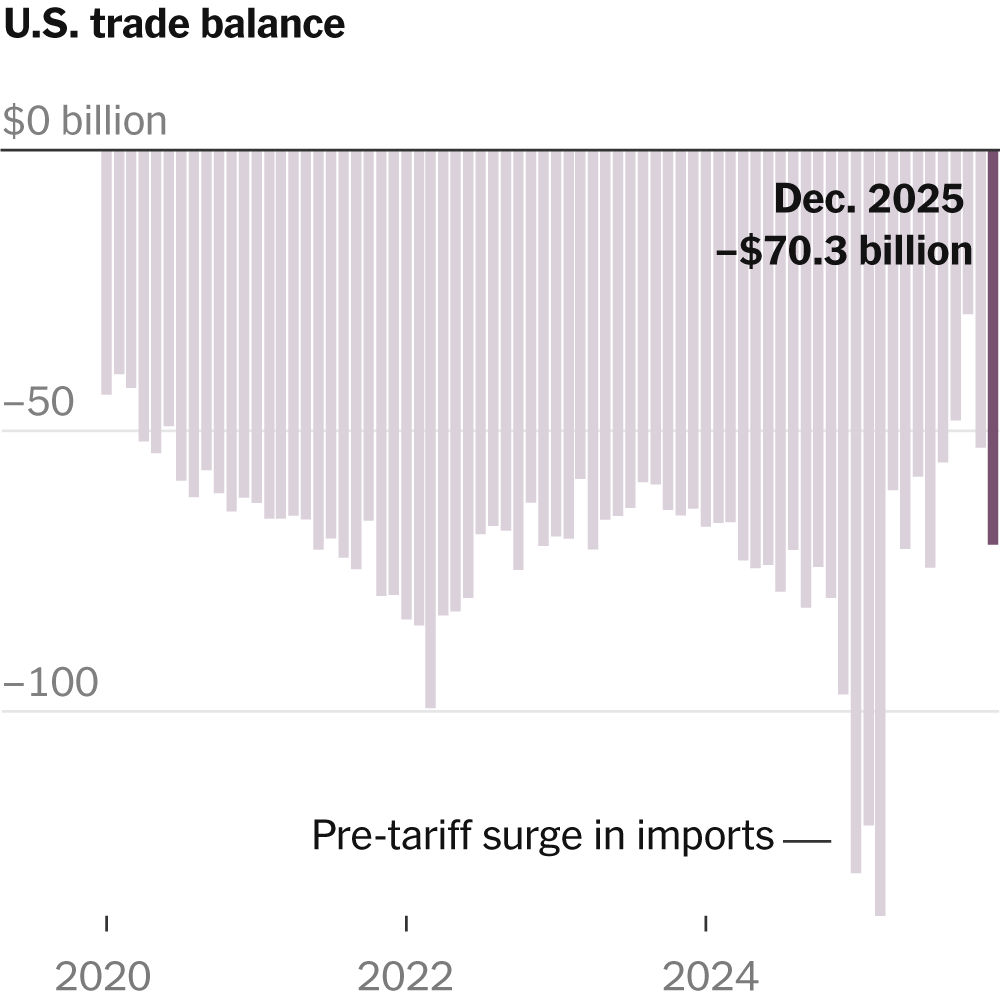
U.S. TRADE DEFICIT—The U.S. trade deficit narrowed in 2025, according to data released by the Census Bureau, as the country saw a significant expansion in its trade surplus in services, despite the trade deficit in goods reaching a record high. The shift reflects the ongoing impact of tariffs imposed by the Trump administration, which have continued to reshape global trade patterns.
The Market Trigger
Trade Deficit Overview
The U.S. trade deficit, which is the difference between the value of imports and exports, narrowed in 2025. This shift was primarily driven by an increase in the trade surplus in services, such as tourism and financial services.
According to the Census Bureau, the overall trade deficit with the world narrowed, indicating that the value of exports exceeded the value of imports in the services sector. However, the trade deficit in goods was the highest on record, highlighting the complexity of the current trade landscape.
Impact of Tariffs
The tariffs imposed by the Trump administration have played a significant role in reshaping global trade patterns. The tariffs, which were initially intended to protect U.S. industries, have had far-reaching consequences, including retaliatory measures from other countries.
As a result, U.S. imports grew in 2025, despite the tariffs, as companies adapted to the new trade environment. However, the increase in imports was not uniform, with some sectors experiencing significant growth while others declined.
Market Mechanics
Trade Surplus in Services
The expansion in the trade surplus in services was a key factor in the narrowing of the overall trade deficit. The services sector, which includes industries such as finance, tourism, and telecommunications, has been a significant contributor to U.S. exports.
The growth in the services sector can be attributed to various factors, including the increase in international travel and the demand for U.S. financial services. Additionally, the strong dollar has made U.S. services more competitive in the global market.
Trade Deficit in Goods
Despite the growth in the services sector, the trade deficit in goods reached a record high in 2025. The deficit in goods is a result of the imbalance between U.S. imports and exports of physical goods, such as electronics, automobiles, and agricultural products.
The high trade deficit in goods has raised concerns about the impact of tariffs on U.S. industries and the potential for retaliatory measures from other countries. However, the data also suggests that U.S. companies have adapted to the new trade environment, with some sectors experiencing significant growth in exports.
Macro Backdrop
Global Trade Environment
The current global trade environment is characterized by uncertainty and volatility. The ongoing trade tensions between the U.S. and other countries have resulted in a significant shift in global trade patterns.
The tariffs imposed by the Trump administration have had a far-reaching impact, with many countries imposing retaliatory measures. The resulting trade wars have disrupted global supply chains and have had a significant impact on U.S. industries.
Economic Implications
The narrowing of the U.S. trade deficit has significant economic implications. A reduced trade deficit can lead to an increase in domestic economic activity, as well as an improvement in the country’s balance of payments.
However, the record-high trade deficit in goods raises concerns about the impact of tariffs on U.S. industries. The data suggests that U.S. companies have adapted to the new trade environment, but the long-term effects of the tariffs remain uncertain.
Risk & Volatility Layer
Risk and Volatility
The U.S. trade deficit has significant implications for the country’s economy and industries. The narrowing of the trade deficit can lead to an increase in domestic economic activity, but the record-high trade deficit in goods raises concerns about the impact of tariffs.
The volatility in the global trade environment has resulted in significant uncertainty for U.S. companies, with many struggling to adapt to the new trade landscape. The ongoing trade tensions between the U.S. and other countries have disrupted global supply chains, leading to increased costs and reduced competitiveness for U.S. industries.
Future Outlook
The future outlook for the U.S. trade deficit is uncertain, with many factors contributing to the country’s trade position. The ongoing trade tensions, as well as the impact of the tariffs, will continue to shape the global trade environment.
However, the data suggests that U.S. companies have adapted to the new trade environment, with some sectors experiencing significant growth in exports. The expansion in the trade surplus in services is a positive indicator for the U.S. economy, and the country’s ability to adapt to the changing global trade landscape will be crucial in determining its future trade position.
