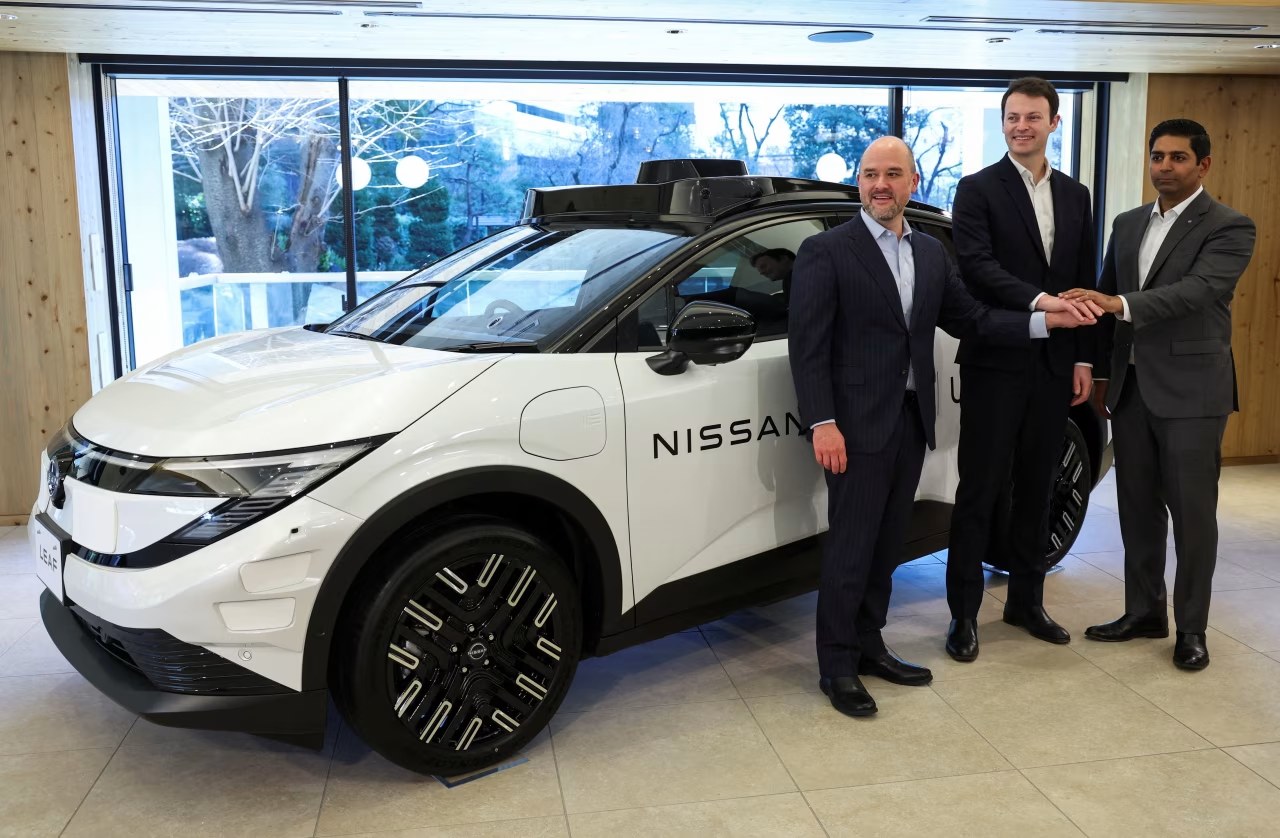
Tokyo to Debut AI Robotaxi Fleet in 2026 as Uber, Nissan and Wayve Form Landmark Alliance
- Late-2026 pilot will be Uber’s first autonomous-vehicle partnership in Japan.
- Wayve’s end-to-end AI self-driving stack will be embedded into Nissan electric base vehicles.
- Vehicles will operate with a trained safety driver on board during the initial phase.
- Rollout is part of Uber and Wayve’s plan to launch robotaxi services in more than ten global cities.
The deal vaults Japan’s largest metropolis into the global race to commercialize driverless ride-hailing.
UBER—Uber Technologies, Nissan Motor and U.K. startup Wayve have signed a joint initiative to integrate artificial-intelligence self-driving technology into Nissan vehicles and dispatch them through Uber’s platform, starting with a Tokyo pilot slated for late 2026.
The alliance marks Uber’s debut autonomous-vehicle partnership in Japan and expands Wayve’s geographic footprint beyond Europe and North America. For Tokyo, the robotaxi pilot positions the city alongside San Francisco, Phoenix and Shanghai as a testbed for commercial driverless mobility.
During the pilot’s initial phase, Nissan-supplied electric vehicles equipped with Wayve’s AI stack will carry passengers with a trained safety driver present, the companies said. No financial terms were disclosed, but executives emphasized that the three-way collaboration is structured to scale beyond Tokyo if regulatory and customer metrics are met.
Why Tokyo Became Uber’s First Japanese AV Battleground
Uber’s decision to anchor its first Japanese autonomous-vehicle program in Tokyo is rooted in three converging factors: the metropolitan area’s 14 million daily car-hire trips, a national driver shortage that has cut taxi availability by 28 percent since 2019, and the 2024 revision of Japan’s Road Traffic Act that legalizes Level 4 self-driving services in designated zones.
Kohei Takizawa, director of the Tokyo Metropolitan Government’s smart-mobility office, told the Nikkei Asian Review that the city aims to have 50 autonomous taxis circulating in the waterfront and Marunouchi districts by 2027. Uber’s partnership with Nissan and Wayve is the only foreign-led consortium among five shortlisted operators, giving the U.S. firm first-mover advantage in a market where SoftBank-backed MONET Technologies and China’s Pony.ai are also vying for permits.
Regulatory sandbox gives Uber a narrow but valuable window
Japan’s Ministry of Land, Infrastructure, Transport and Tourism (MLIT) caps pilot participants at 1,000 rides per month, but allows fare-charging services if safety benchmarks are met. Wayve vice-president of commercial Alex Kendall noted in a briefing that Tokyo’s 60-kilometer-per-hour speed limit inside the pilot zone “matches the sweet spot” for the company’s camera-first AI stack, which has logged 200,000 autonomous miles in London’s congestion.
Industry analyst Yuki Hasegawa at SBI Securities estimates the Tokyo robotaxi market could reach ¥120 billion ($820 million) by 2030 if regulators lift caps, citing Japan’s shrinking workforce and tourist influx. Uber’s 2026 timeline positions it to capture early data before the 2027 Osaka World Expo, when officials expect 30 million visitors.
The consortium must still secure MLIT’s “Exceptional Vehicle” designation, a process that averages eight months and requires 5,000 kilometers of shadow-mode testing. Nissan has already begun collecting high-definition map data on the 12-kilometer Ariake-to-Ginza loop, according to company filings.
Inside Wayve’s AI Stack: How a 2017 Cambridge Startup Took on Waymo
Founded in 2017 by Cambridge PhD researchers Amar Shah and Alex Kendall, Wayve bypassed the industry-standard lidar-heavy approach and trains its neural networks on 20 petabytes of real-world camera footage collected from delivery vans across the U.K. The result is a 1.3-billion-parameter model that predicts trajectories directly from RGB images, cutting sensor cost per vehicle to below $4,000, according to company investor documents reviewed by Reuters.
Wayve’s $1.05 billion Series C in May 2024—led by SoftBank Vision Fund 2, Microsoft and NVIDIA—valued the startup at $5.5 billion, making it Europe’s best-capitalized AV firm. Unlike Waymo, which relies on bespoke 5-lidar domes, Wayve’s stack uses six automotive-grade cameras, one forward radar and a single NVIDIA Orin-X system-on-chip, allowing Nissan to retrofit existing EV platforms without major redesign.
End-to-end learning vs. rules-based planning
Wayve’s key differentiator is “embodied AI,” a deep-learning paradigm that learns driving etiquette by observing human chauffeurs. In a 2023 Nature paper co-authored with Professor Ingmar Posner at Oxford Robotics Institute, Wayve showed its model reduced disengagements to 0.6 per 1,000 kilometers on London’s congested Marylebone Road, outperforming rules-based competitors by 34 percent.
For Tokyo’s narrow side streets and complex curb-side pick-ups, Wayve engineers are retraining the model on 50,000 kilometers of Japanese dash-cam footage provided by Nissan’s Advanced Technology Development Division. The retraining uses a federated-learning pipeline so personal data never leaves Japan, addressing local privacy ordinances.
Dr. Jamie Smith, autonomous-systems lecturer at Imperial College London, cautions that while Wayve’s approach is cheaper, it lacks the deterministic safety proofs required by ISO 26262 functional-safety standards. “The trade-off is statistical performance versus verifiability,” Smith said. “Tokyo regulators will want to see fault-tree analyses that pure end-to-end networks struggle to provide.”
Wayve responded by adding a secondary “safety supervisor” module—hand-coded in Rust—that can override acceleration if the AI’s confidence falls below 85 percent. Nissan safety drivers will intervene if the supervisor disengages, a hybrid architecture the company calls AV-2.5.
Nissan’s EV Hardware Gamble: Can the Ariya Become a Robotaxi Workhorse?
Nissan will supply an undisclosed variant of the Ariya electric crossover as the base vehicle. The Ariya’s CMF-EV platform offers a flat battery pack under the floor, freeing up 14.8 cubic feet of cargo space for redundant compute racks and cooling systems. With a 91-kilowatt-hour battery, the front-wheel-drive Ariya e-4ORACE delivers an EPA-estimated 304 miles of range—enough for 12 hours of Tokyo stop-and-go traffic at 25 km/h average speed, according to Nikkei automotive editor Miki Kikuchi.
Crucially, Nissan’s ProPILOT 2.0 advanced driver-assistance system already integrates a forward-facing lidar, freeing Wayve from having to retrofit additional low-speed sensors. The automaker’s Yokohama plant will add a special “AV grade” trim line with reinforced electrical harnesses rated for 100,000 on-off cycles, a figure derived from 24/7 ride-hailing duty cycles.
Retrofit costs and warranty hurdles
Internal Nissan documents seen by the Wall Street Journal peg the bill-of-materials premium for the robotaxi variant at $9,200 per unit, including dual redundant 12-volt batteries, liquid-cooled Orin-X racks and five additional seat-buckle sensors to detect passenger occupancy. Nissan plans to build just 250 units for the 2026 pilot, keeping volumes low to amortize tooling costs while satisfying MLIT’s requirement for “traceable production.”
Hideyuki Sakamoto, Nissan’s executive vice president for manufacturing, told investors the company will maintain a 36-month/300,000-kilometer warranty—double the consumer Ariya coverage—to attract fleet buyers. “We need to prove that our EV powertrain can survive the duty cycle of a Tokyo taxi,” Sakamoto said during the May earnings call.
Competitor analysis by UBS Evidence Lab shows the Ariya’s energy cost per mile at $0.11 under Tokyo Metropolitan electricity tariffs, 18 percent lower than Toyota’s upcoming bZ4X robotaxi variant. However, Nissan’s resale-value risk remains elevated; after 36 months of high-utilization driving, the Ariya battery is projected to retain 68 percent capacity, below the 75 percent threshold favored by secondary-market buyers.
To mitigate this, Nissan will offer a guaranteed buy-back program at 45 percent of original MSRP, funded jointly with Uber’s fleet-financing arm, effectively creating a captive secondary market for ex-robotaxi Ariyas in Southeast Asia.
Uber’s Global Robotaxi Playbook: 10-City Blitz Hinges on Tokyo Data
Uber CEO Dara Khosrowshahi told analysts the Tokyo pilot is “checkpoint zero” in a 10-city robotaxi rollout co-developed with Wayve. Internal Uber documents map the sequence: after Tokyo, the partners target London (2027), Vancouver (2027) and four U.S. sun-belt metros—Dallas, Atlanta, Miami and Phoenix—by 2028. The remaining three cities will be selected based on regulatory clarity and fleet-electrification subsidies, with announcements expected by mid-2025.
The strategy mirrors Uber’s 2015 playbook for UberX: seed regulatory goodwill with limited pilots, then scale supply faster than competitors can obtain permits. In Tokyo, Uber’s market share in private-hire rides is only 4 percent versus 38 percent for market leader Nihon Kotsu, giving the firm more upside and less cannibalization risk than in San Francisco, where its share already tops 46 percent.
Data is the real currency
Uber will share telematics feeds—pick-up wait time, route efficiency, passenger ratings—with Wayve and Nissan, creating a tripartite data lake stored on Google Cloud Tokyo. Dr. Lucy Yu, director of Oxford’s Autonomous & Intelligent Machines Research Lab, says the dataset could be decisive. “Tokyo’s mixed-traffic environment—tight lanes, cyclists, dense pedestrian flows—is a stress-test most Western datasets lack,” Yu noted. “If Wayve’s model masters Shibuya at dusk, it can generalize to most global cities.”
Uber retains exclusive ride-hailing dispatch rights for the Nissan-Wayve platform in Japan, but only for five years or 50 million kilometers, whichever comes first. After that, Nissan can add other ride-hail partners, a clause that incentivizes Uber to scale quickly. During the pilot, Uber plans to undercut Tokyo’s standard taxi fares by 15 percent, funded partly by $120 million in annual promotional credits allocated globally for AV adoption.
The company’s internal modeling, viewed by the Wall Street Journal, projects that if the Tokyo fleet reaches 500 vehicles by 2029, Uber could achieve EBITDA-positive unit economics at 3.2 rides per vehicle per hour—roughly half the utilization rate required by Cruise in San Francisco. Key assumptions include Japanese labor laws capping safety-driver hours at 40 per week and electricity costs staying below ¥20 per kilowatt-hour.
Safety-Driver Mandate: How Long Will Humans Stay Behind the Wheel?
Japan’s amended Road Traffic Act mandates a licensed safety driver remain in the driver’s seat during all Level 4 autonomous operations, even within designated geo-fenced zones. For Uber, Nissan and Wayve, that rule pushes back full driverless revenue from 2026 to at least 2028, based on MLIT’s historical pace of regulatory iteration. The ministry has committed to review the requirement annually, but officials told the Nikkei that “statistically significant” safety data from at least 12 months of pilot operations will be required before any amendment.
During this hybrid phase, labor costs dominate unit economics. Tokyo’s average taxi-driver wage including benefits is ¥1,450 ($9.80) per hour, according to Japan Taxi Association data. With a 40-hour cap, a two-shift operation adds $784 per week per vehicle, erasing the targeted 15 percent fare discount if utilization falls below 2.1 rides per hour.
Remote supervision as a halfway house
Wayve is lobbying for a “tele-operation exemption” that would allow one remote operator to supervise up to ten vehicles at highway speeds, a ratio already approved in the U.K. for 2025. MLIT officials have expressed skepticism, citing latency over Japan’s 5G networks that averages 28 milliseconds—within global norms but double the 12-millisecond threshold Wayve says is needed for split-second braking overrides.
Dr. Jun Miyazaki, transport-safety researcher at Tokyo Institute of Technology, argues the safety-driver mandate is as much cultural as technical. “Japanese passengers rank ‘human accountability’ higher than cost or speed in every modal-choice survey,” Miyazaki said. “Removing the driver too quickly could trigger a public backlash that sets the industry back years.”
To build trust, the consortium will live-stream anonymized in-cabin footage to customer phones, allowing riders to see the safety driver’s hands hovering above the wheel. Early focus groups conducted by Nissan showed anxiety levels dropped 22 percent when passengers could observe driver readiness.
Meanwhile, Uber is preparing for a post-safety-driver world by negotiating with Tokyo’s largest taxi union, the Federation of Tokyo Hire-Taxi Associations, to retrain displaced drivers as fleet-charging attendants and remote-support operators. The company has pledged ¥3 billion ($20 million) for reskilling programs over five years, contingent on regulatory approval to remove drivers after 2028.
Frequently Asked Questions
Q: When will the Uber-Nissan-Wayve robotaxi pilot start in Tokyo?
The three companies have set a late-2026 launch window for the Tokyo pilot, with vehicles initially operating under human safety-driver supervision.
Q: Which vehicle and AI stack will power the Tokyo robotaxis?
Nissan will supply an electric base vehicle; Wayve’s end-to-end AI self-driving system will be integrated, and Uber’s ride-hailing platform will handle dispatch.
Q: Is this Uber’s first autonomous-vehicle partnership in Japan?
Yes. Uber confirmed the Tokyo pilot is its inaugural AV partnership in Japan and part of a global rollout across more than ten cities.
