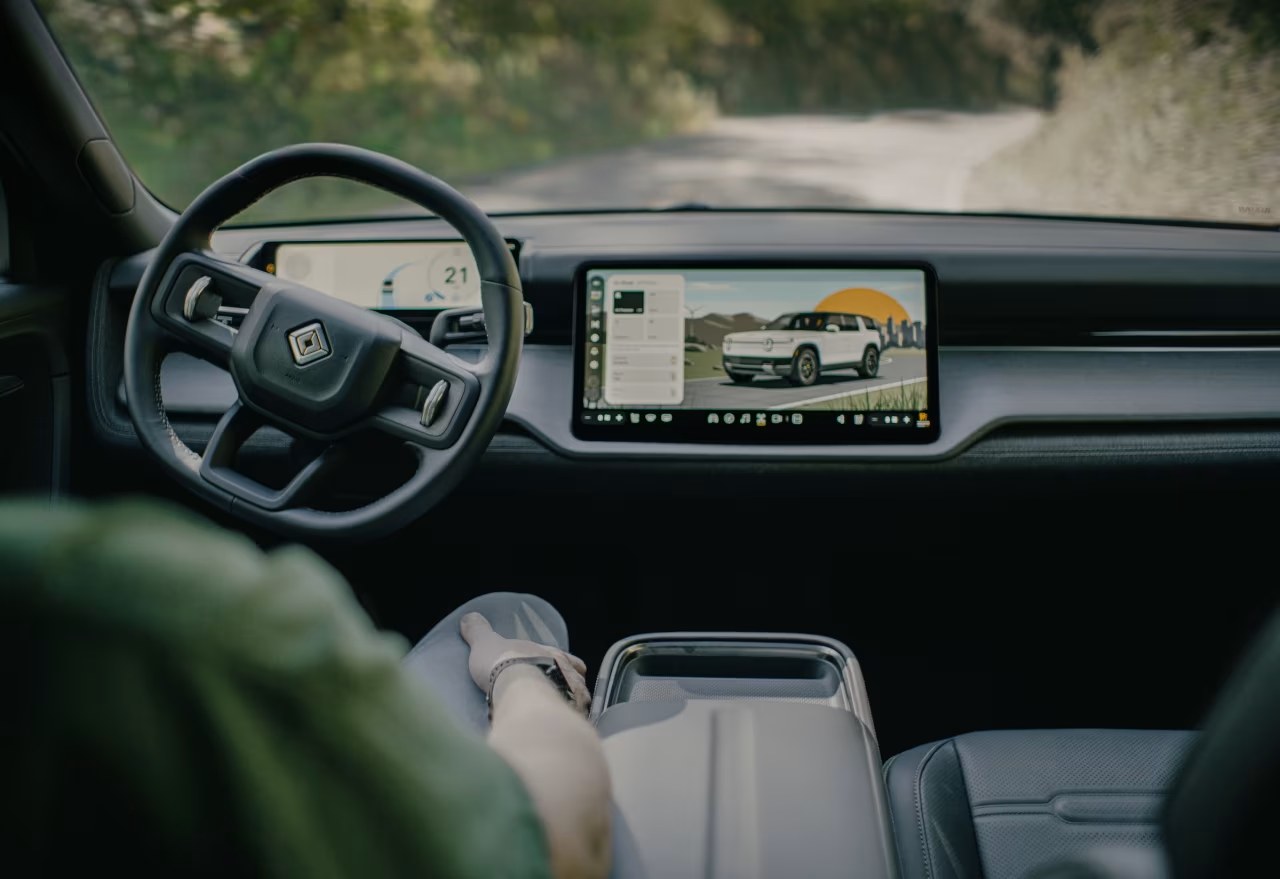
Uber Pours $1.25 Billion Into Rivian for 10,000 Autonomous R2 SUVs
- Uber commits up to $1.25 billion to Rivian for 10,000 self-driving R2 SUVs.
- Deployment starts in San Francisco and Miami, expanding to 25 cities by 2031.
- Rivian gains critical capital and a ready-made customer for its robotaxi ambitions.
- Uber secures a dedicated supply of electric autonomous vehicles to reduce driver costs.
The ride-hailing giant bets big on a startup still proving it can master driverless tech.
UBER—Uber Technologies is staking as much as $1.25 billion on Rivian Automotive’s ability to crack the hardest problem in mobility: a safe, scalable, fully autonomous vehicle. The companies unveiled a sweeping partnership Thursday that will put 10,000 driverless versions of Rivian’s upcoming R2 SUV on Uber’s network, beginning in San Francisco and Miami before a targeted rollout to as many as 25 cities across the U.S., Canada and Europe by the end of 2031.
For Uber, the deal offers a path to slash its largest cost—human drivers—while locking in a zero-emission fleet. For Rivian, it delivers a guaranteed customer and a fresh injection of capital at a moment when investors have grown wary of cash-burning EV startups. Yet the agreement also places enormous technical risk on Rivian, whose executives have acknowledged that achieving true autonomous capability remains “a big technological leap.”
Wall Street signaled caution: Rivian shares slipped 1.83 % in after-hours trading, while Uber dipped 1.45 %. Analysts say the market is weighing whether Rivian can deliver a fully autonomous R2 on Uber’s timeline without the deep pockets or data advantages that rivals such as Waymo, Cruise and Tesla have accumulated over years of real-world testing.
Why Uber Is Paying Rivian Now
Uber’s decision to commit up to $1.25 billion before a single autonomous R2 rolls off the line underscores the strategic urgency inside the company’s San Francisco headquarters. Despite generating $37.2 billion in revenue last year, Uber still pays drivers roughly 75 cents of every dollar in ride-hailing gross bookings, according to its latest 10-K filing. Eliminating that slice would instantly flip Uber’s ride-hailing EBITDA margin from high single digits to north of 40 %, a shift that could add billions in annual profit.
“Uber needs a captive, electric, autonomous supply chain,” said Asad Hussain, mobility analyst at PitchBook. “They’ve learned from the Waymo One model that owning the fleet is capital intensive, so anchoring on a partner like Rivian lets them lock in volume without taking manufacturing risk.” The structure resembles airline purchase agreements: Uber will provide non-dilutive prepayments and revenue guarantees, while Rivian retains ownership of the vehicles, booking them as assets on its balance sheet.
The cash infusion arrives as Rivian burns through roughly $3 billion a year developing its R2 platform, a midsize SUV aimed at the $45,000 price band. With cash and short-term investments falling from $17.1 billion at the end of 2022 to an estimated $9.2 billion by March 2024, according to consensus analyst estimates, the company needs external funding to avoid a dilutive equity raise before R2 production starts in 2026.
Autonomous R2s as a Service
Under the term sheet, Uber will pay Rivian an undisclosed per-mile usage fee once the vehicles are deployed. Internal Uber modeling projects that the all-in cost of an autonomous mile on the R2 will fall below $0.50 by 2028, compared with roughly $1.10 today for a human-driven electric mile, according to a person familiar with the forecasts. If Rivian hits those targets, Uber’s effective payback period on the $1.25 billion outlay would be under four years, faster than any prior capital project in the company’s 15-year history.
Can Rivian Outrun Waymo, Cruise and Tesla?
Rivian’s autonomous push lands late in a field already crowded with well-capitalized incumbents. Waymo operates 700 fully driverless Jaguar I-PACE vehicles in Phoenix and San Francisco, completing more than 150,000 paid rides per week. Cruise, owned by General Motors, has run a 400-vehicle fleet in Phoenix, Dallas and Houston since 2023, logging 1 million autonomous miles last quarter alone. Tesla, meanwhile, claims its “unsupervised” Full Self-Driving software will be ready for ride-hail deployment in Austin and Los Angeles by late 2024, leveraging a data advantage of more than 5 billion real-world miles collected from its customer fleet.
Rivian’s current autonomous test fleet: zero vehicles. The company has relied on a 120-employee Advanced Driver Assistance Systems (ADAS) team housed in Palo Alto, developing what it calls “Highway Autonomy” features for consumer R1S and R1T pickups. Those systems max out at Level 2+, requiring constant driver attention. Moving to Level 4—no human needed in defined geographic areas—demands new sensor suites, redundant compute stacks, machine-learning infrastructure and, most critically, billions of labeled miles to train neural networks.
“The gap between Level 2+ and Level 4 is not incremental; it’s exponential,” said Dr. Raj Rajkumar, director of the Connected and Autonomous Vehicles Lab at Carnegie Mellon University. “Rivian needs to build a perception pipeline, prediction algorithms and a safety-validation culture almost from scratch, then scale it in under 36 months to meet Uber’s 2027 commercial launch target. That timeline is aggressive even for companies that have been at this for a decade.”
Hardware Headroom in the R2
Rivian executives told investors the R2 skateboard chassis was architected from day one to support redundant steering, braking and power systems—key for driverless operation. The vehicle will ship with a roof-mounted sensor pod housing Luminar lidar, 11 cameras and five radars, hardware that adds an estimated $8,000 to bill-of-materials cost but can be software-locked for consumer versions. Uber will receive the first production units configured in “robotaxi spec,” including a stripped interior with easy-clean vinyl seats and a plexiglass partition, according to two suppliers briefed on the program.
Regulatory Red Tape in San Francisco and Miami
Even if Rivian perfects the hardware and software, it must still navigate two of the most complex regulatory environments in the United States. California’s Department of Motor Vehicles currently authorizes 56 companies to test autonomous vehicles, but only Waymo and Cruise hold permits for fully driverless passenger service. Each new entrant must submit a 200-page safety case, complete 1,000 miles of driverless testing and post a $5 million surety bond. Rivian has not yet applied, according to DMV spokesperson Anita Gore.
Florida’s framework is lighter—Miami-Dade County requires only proof of $5 million in liability insurance and a local fleet-management partner—but city commissioners have grown wary after a 2023 Cruise collision with a fire truck. “We welcome innovation, but we’re not rubber-stamping any more permits until we see federal standards,” said Miami City Commissioner Manolo Reyes during a March hearing. Uber lobbyists have already met with Reyes’ office three times this year, according to city lobbying records.
Europe adds another layer. The European Union’s upcoming Autonomous Vehicle Approval Regulation, slated for 2025, will require manufacturers to demonstrate fail-safe systems in 14 traffic scenarios, from highway pile-ups to pedestrian jaywalking. The United Kingdom, where Uber has 5.5 million monthly users, mandates that autonomous vehicles obtain a separate Single European Vehicle Type Approval, a process that typically takes 18 months.
Insurance Bottleneck
Commercial insurers remain cautious. Allstate, State Farm and Berkshire Hathaway’s GEICO have all excluded autonomous vehicle liability from standard ride-hail policies, forcing operators to turn to specialty underwriters like Swiss Re or Munich Re. Rates currently run 25 to 40 cents per autonomous mile—well above Uber’s target. “Until actuaries have loss data spanning multiple years, premiums will stay elevated,” said Cathy Seifert, insurance analyst at CFRA Research.
What Happens If Rivian Misses the 2027 Deadline?
The term sheet includes stiff penalties. If Rivian fails to deliver Level 4-capable R2s by June 30, 2027, Uber can claw back 35 % of its capital contributions—roughly $440 million—plus accrued interest at SOFR plus 400 basis points, according to a person who reviewed the draft. Miss the 2031 fleet-size target of 10,000 vehicles and Uber gains the right to source up to 30 % of its autonomous demand from competitors, diluting Rivian’s guaranteed revenue stream.
Rivian’s own risk disclosures underscore the uncertainty. In its 2023 annual report, the company listed “development of autonomous vehicle technology” as a risk factor, noting that “delays or cost overruns could materially impact our business.” The R2 program is already running six months behind its original internal timeline, largely due to supplier constraints on Luminar’s Iris lidar, two people familiar said.
Market analysts have penciled in only a 50 % probability that Rivian hits the 2027 commercial launch. “If they slip, Uber still holds the capital leverage to pivot quickly to an alternate OEM,” said Chris McNally, global auto analyst at Evercore ISI. “But Rivian doesn’t have that luxury—they need Uber’s cash and Uber’s miles to train their algorithms.”
Escalator Clauses
The contract also includes performance escalators: for every month beyond June 2027 that Rivian remains non-compliant, Uber’s revenue-share percentage increases by 1.2 basis points, effectively reducing Rivian’s take rate from 68 % to as low as 52 % over two years. Conversely, if Rivian exceeds safety benchmarks—measured by disengagements per 1,000 miles below 0.2—it can reclaim 2 basis points of revenue share for each qualifying quarter.
The Bottom Line: Disruption or Distraction?
The Uber-Rivian pact is either a masterstroke that vaults both companies ahead of legacy automakers or a $1.25 billion gamble on an unproven startup’s ability to solve one of tech’s hardest problems in three years. The upside is clear: if Rivian delivers, Uber could chop 60 cents off the cost of every mile it drives, unlocking an estimated $7 billion in annual profit while meeting its 2030 zero-emission pledge. Rivian would gain a $5 billion revenue backlog and priceless real-world data, catapulting it from EV laggard to autonomy leader.
Yet history counsels caution. Apple spent a decade and an estimated $10 billion before canceling its Titan car project in 2024. Amazon-backed Zoox has burned through $3.2 billion since 2014 and still operates only a 30-vehicle shuttle in Las Vegas. Even deep-pocketed Ford and Volkswagen shuttered their $7 billion Argo AI joint venture in 2022, citing the yawning gap between Level 2 and Level 4 capability.
“The auto industry systematically underestimates the difficulty of full autonomy,” said Bryant Walker Smith, a law professor at the University of South Carolina who specializes in self-driving regulation. “Money buys hardware, but it doesn’t buy time for the subtle, messy, edge-case learning that only millions of real miles can provide.”
Investor Takeaway
Short sellers have increased their Rivian wagers to 12.6 % of the free float, the highest since its 2021 IPO, according to S3 Partners data. Options markets imply a 42 % swing in either direction around the next earnings call, reflecting binary sentiment. For Uber, the exposure is more manageable: the $1.25 billion represents just 6 % of its 2024 capital-expenditure budget, and the clawback条款 limit downside. Still, every quarter of delay tightens the noose on Rivian’s cash runway and, by extension, its credibility.
What is certain is that Thursday’s announcement redraws battle lines in the global race to monetize robotaxis. Instead of going it alone, Uber has chosen to outsource hardware risk while locking in supply. Rivian, for its part, has traded autonomy—both technological and corporate—for a lifeline. Whether that swap proves visionary or fatal will be decided on the streets of San Francisco and Miami long before 2031.
Frequently Asked Questions
Q: How much is Uber investing in Rivian’s robotaxis?
Uber will invest up to $1.25 billion to deploy 10,000 fully autonomous Rivian R2 SUVs, forming the backbone of its future driverless fleet.
Q: Which cities will get the Rivian robotaxis first?
San Francisco and Miami are the initial launch cities, with plans to expand to as many as 25 cities across the U.S., Canada, and Europe by 2031.
Q: Is Rivian ready for fully autonomous driving?
Rivian is still developing the technology; analysts note that delivering a fully autonomous vehicle remains a major technological leap for the company.
