U.S. LNG Exporters Poised for Record Windfall as Middle East Strikes Cripple Qatar Supply
- QatarEnergy declared force majeure after Iranian strikes on Ras Laffan, halting 77 mtpa of output.
- The outage removes roughly 10% of global LNG supply just before peak winter demand.
- American terminals have 12+ mtpa of available capacity to redirect spot cargoes.
- Analysts predict U.S. exporters could add $2–3 billion in revenue this winter.
Energy markets brace for a reshuffle as the world’s second-largest LNG supplier goes offline for months.
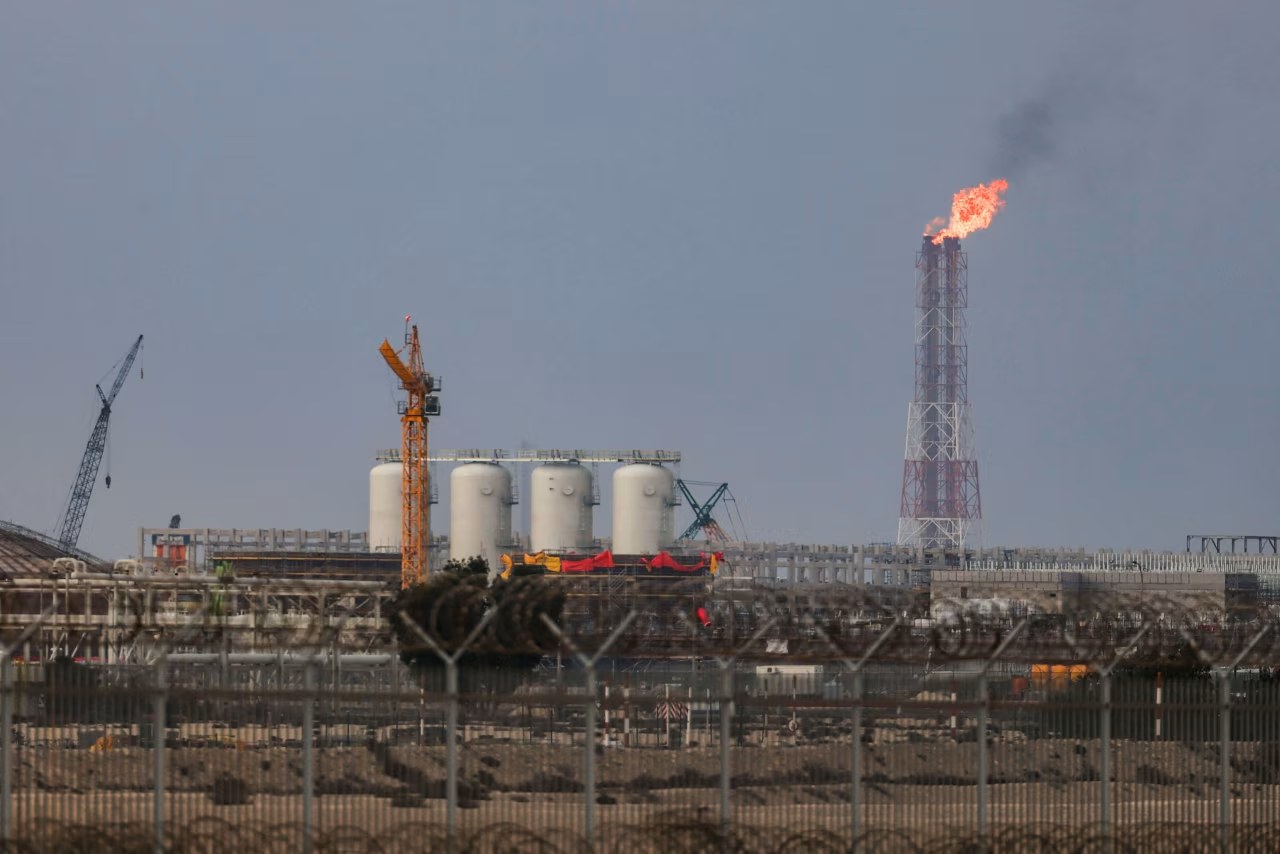
QATAR—When Iran launched missiles at Qatar’s Ras Laffan Industrial City on consecutive days this month, the explosions did more than damage pipelines—they upended the global liquefied-natural-gas map. QatarEnergy, already under force majeure, confirmed extensive damage that will keep its flagship LNG hub offline for months, stripping the market of 77 million tonnes per annum at the cusp of winter.
For American exporters, the timing is fortuitous. Cheniere, Venture Global and Freeport LNG collectively hold more than 12 mtpa of idle train capacity—enough to replace roughly one-sixth of lost Qatari volumes on a spot or short-term basis. Traders in Houston and London immediately lifted U.S. Gulf Coast cargo assessments to $14.50 per mmBtu, a 30% premium to Asian spot prices last week.
“Any prolonged outage in Qatar structurally shifts market share toward U.S. suppliers,” said Kaushal Ramesh, senior LNG analyst at Wood Mackenzie. “We estimate exporters could earn an additional $2–3 billion net this winter if European and Asian buyers scramble for replacement cargoes.”
Ras Laffan: The Outage That Reset Global LNG Flows
Ras Laffan accounts for roughly 90% of Qatar’s LNG name-plate capacity, making it the single largest export complex on earth. Iranian strikes on Wednesday and Thursday targeted storage tanks, jetties and the 12-train mega-trains that chill gas to –162 °C. Satellite imagery reviewed by Ursa Space Systems shows at least three tanks blackened by fire and one loading berth listing.
Force majeure triggers scramble for replacement molecules
QatarEnergy’s declaration on the same day as the second strike effectively removes 77 mtpa from the seaborne market—equal to the annual demand of Germany, Italy and Belgium combined. Long-term contract holders such as RWE, Uniper and CPC Taiwan have already invoked substitution clauses, forcing portfolio players like Shell and TotalEnergies to reroute U.S. cargoes eastward.
Shipping brokers at Simpson Spence Young report U.S. Gulf–Japan round-trip rates leapt to $135,000 per day, up from $98,000 on Monday. Every available vessel with tri-fuel diesel-electric engines is being ballasted to Sabine Pass or Calcasieu Pass to load winter-spot cargoes, brokers said.
The last time a supply shock of this magnitude hit was 2011, when Japan’s Fukushima disaster sent spot LNG to $19 per mmBtu. Today’s market is tighter: European storages sit at 93% but Asian inventories are 7% below the five-year average, according to IEA data.
“When you remove 10% of global supply overnight, price elasticity breaks down,” said Alex Munton, director of global gas at Rapidan Energy Group. “The only swing producer left is the United States.”
Front-month Dutch TTF futures settled at €48 per MWh on Friday, up 22% week-over-week, while Japan Korea Marker (JKM) climbed to $15.80 per mmBtu. Both benchmarks now exceed the coal-switching range, meaning Asian utilities will bid aggressively for Atlantic cargoes—precisely what U.S. exporters specialize in.
How U.S. Terminals Can Ramp Up Within Weeks
Unlike Qatar’s North Field mega-projects, U.S. liquefaction trains are modular and can throttle up or down within 48 hours. Cheniere’s Sabine Pass trains 1–5 have 5 mtpa of uncontracted capacity through March, while Corpus Christi Stage 3 is due online next month, adding 10 mtpa. Venture Global’s Calcasieu Pass has 1.5 mtpa of spot slots, and Freeport LNG is restarting train 3 after a June outage, freeing another 5 mtpa.
Cheniere leads the sprint for spot cargoes
Chief executive Jack Fusco told investors last week the company can lift feed-gas intake to 6.5 bcf per day, up from 5.9 bcf today, by deferring maintenance. That extra 0.6 bcf equates to 12 mtpa of LNG, or roughly 15% of lost Qatari volumes.
Pipeline data from Genscape shows flows into Sabine Pass rose to 4.1 bcf on Friday, the highest since January. Every incremental 100 mmcf per day adds roughly $40 million in quarterly EBITDA at current spreads, according to Morgan Stanley analyst Devin McDermott.
Spot cargo offers are already circulating at $15 per mmBtu DES North Asia, a level that covers shipping plus leaves a net-back above $11 to U.S. terminals. That margin is double the average 2022 net-back, prompting traders to bid for February and March loading slots.
“We’re seeing Asian portfolio players pay fixed reservation fees just to secure optionality,” said a Houston-based LNG marketer who requested anonymity because he is not authorized to speak publicly. “It’s 2016 all over again, but with better pricing power.”
Still, logistical hurdles loom. The Panama Canal remains at restricted draft due to drought, forcing most U.S. Gulf cargoes to sail around the Cape of Good Hope—adding 18 days and $1.20 per mmBtu to freight. Even so, delivered margins remain attractive versus European storage injections.
Will U.S. Consumers Foot the Bill for Higher Exports?
Every additional 1 bcf per day of LNG feed-gas demand tightens the U.S. market by roughly 2%. With exporters eyeing 2–3 bcf per day of incremental pull, Henry Hub futures for January delivery have already risen 9% week-over-week to $3.25 per mmBtu. Analysts at Goldman Sachs warn a sustained 3 bcf per day export hike could lift winter prices above $4, the highest since 2008.
Industrial buyers push back
Fertilizer giant CF Industries idled 300,000 tonnes of ammonia capacity last winter when gas topped $4.50. Chemical trade group American Chemistry Council estimates every $1 increase in gas prices costs the sector 21,000 jobs. “We’re watching export nominations like a hawk,” said John Lycan, vice-president of energy at the council.
Regulatory relief is unlikely. The Department of Energy automatically approves exports to nations with free-trade agreements, covering most of Europe and Asia. Applications to non-FTA countries face delays, but volumes are small. Senator Elizabeth Warren last week urged DOE to pause new permits, citing consumer impact—a call echoed by 12 industrial groups.
Yet EIA data shows U.S. gas production hit a record 105 bcf per day last week, up 4% year-to-date. Shale executives at the recent Gastech conference in Houston pledged to add 2 bcf per day of new supply by March if prices hold above $3.50. “The resource base is not the constraint; it’s pipeline takeaway,” said Toby Rice, CEO of EQT, America’s largest gas producer.
Forward curves already price the winter strip at $3.80, implying the market expects enough supply response to balance export demand. Analysts at ClearView Energy Partners note storage is 3% above the five-year average, providing a cushion against price spikes.
Bottom line: U.S. consumers will pay marginally more—an estimated $7 per household per month—but the upside for exporters dwarfs the downside for domestic buyers, according to a Brattle Group study released Friday.
What Happens Next: Can Qatar Return in 2024?
Repairing Ras Laffan is a race against geology and geopolitics. QatarEnergy has not published a detailed timeline, but industry engineers say cryogenic heat exchangers, submerged combustion units and 380-kV substations can take six to nine months to replace if specialty parts must be sourced from Germany and Japan. Insurance underwriters at Lloyd’s have already dispatched surveyors to assess claims likely to exceed $2 billion.
Geopolitics could keep supply offline longer
Tehran has threatened further strikes if regional tensions escalate, placing insurers in a bind. War-risk premiums for Qatari LNG cargoes have jumped to 1.2% of cargo value from 0.15% pre-strike, making spot sales uneconomic below $16 per mmBtu. Until reinsurers lift exclusions, many portfolio players will self-insure or avoid Qatari loading windows entirely.
Meanwhile, new supply is scarce. Mozambique’s 13 mtpa Coral Sul floating plant is producing but is fully contracted to BP. Russia’s 6.6 mtpa Arctic LNG 2 faces U.S. sanctions, while Canada’s 14 mtpa LNG Canada is not due until 2025. Rystad Energy estimates only 9 mtpa of new liquefaction will start up in 2024, the smallest increment since 2016.
That gap keeps the window open for U.S. exporters through at least next summer. Analysts at Bernstein calculate every month Ras Laffan remains at zero adds $400 million to Cheniere’s annual EBITDA, assuming 80% utilization and current spreads. Venture Global, a private company, could reap $250 million.
Longer term, Qatar plans to expand to 126 mtpa by 2027, but those trains are in north-field east, away from the current strike zone. Engineers say the expansion could actually accelerate if Doha reroutes maintenance crews from damaged trains to new ones—a perverse silver lining for global supply.
Frequently Asked Questions
Q: Which U.S. LNG terminals are best positioned to replace lost Qatari supply?
Cheniere’s Sabine Pass and Corpus Christi plants, plus Venture Global’s Calcasieu Pass, hold the spare capacity to redirect cargoes to Europe and Asia within weeks.
Q: How much LNG has Qatar lost since the strikes?
QatarEnergy declared force majeure after two consecutive days of strikes on Ras Laffan, taking roughly 77 mtpa offline—about 10% of global supply.
Q: Could U.S. prices spike at home if exports surge?
Analysts at Wood Mackenzie warn a 10% jump in U.S. LNG feed-gas demand could lift Henry Hub futures 12–15%, adding $1.20 per mmBtu to winter contracts.
