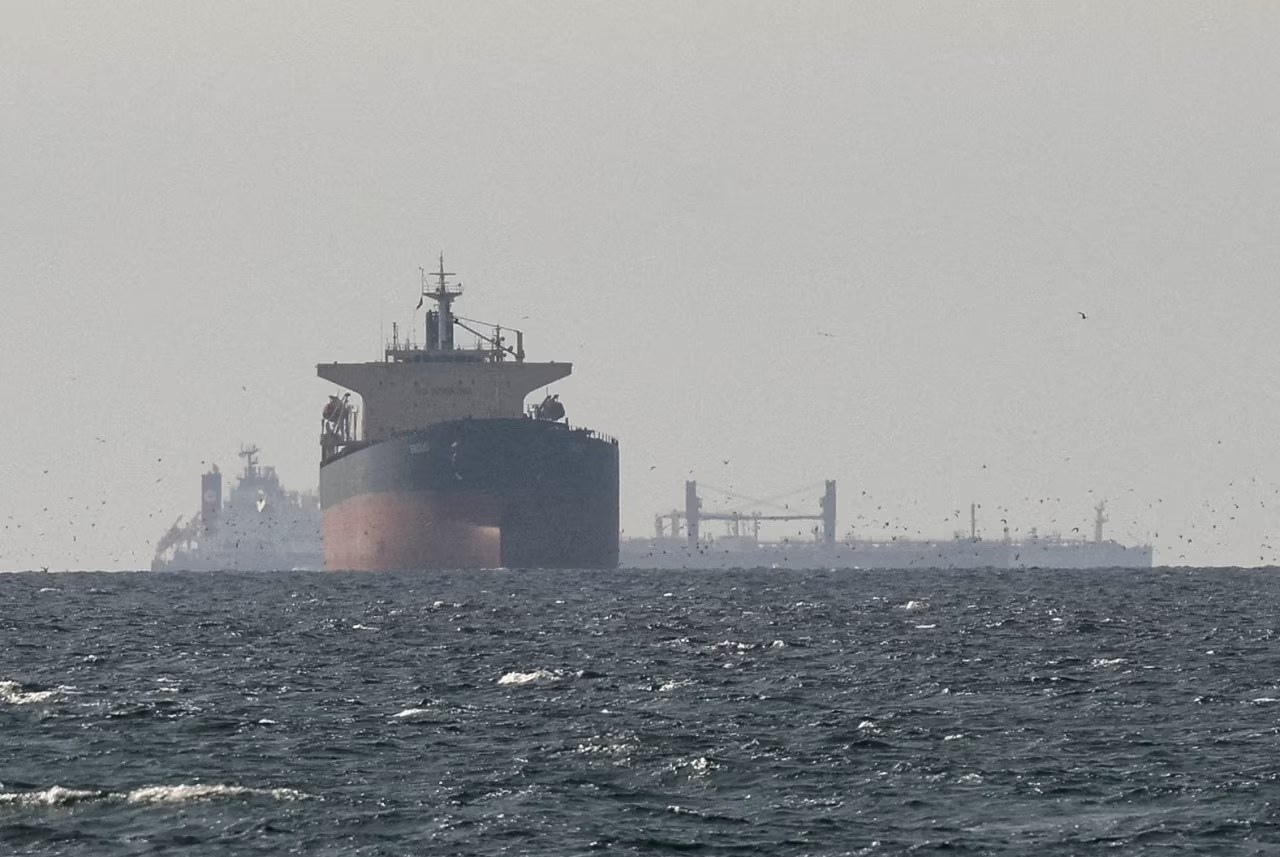
Brent Crude Slides to $102 After Brief $105 Spike, Fueling Stock Futures Rally
- Brent hovered at $102, down from a $105 high earlier Monday.
- WTI slipped after breaching the $100 barrier.
- U.S. stock futures jumped as Hormuz‑related supply worries eased.
- President Trump urged allies to protect trade through the Strait of Hormuz.
Oil’s volatile dance with geopolitics continues to dictate market sentiment.
BRENT CRUDE—Monday’s opening saw U.S. equity futures climb, buoyed by a retreat in Brent crude from a fleeting $105 peak to around $102 a barrel. The dip came as diplomatic overtures aimed at reopening the Strait of Hormuz gained traction, reducing the premium investors had been demanding for perceived supply risk.
While Brent’s retreat was modest, the broader market response was pronounced. Futures on the S&P 500, Dow Jones and Nasdaq all posted gains, reflecting a collective sigh of relief that the world’s most critical oil chokepoint appeared less threatened.
At the same time, WTI crude, the North American benchmark, slipped after briefly breaking the $100 per barrel threshold, underscoring how tightly linked global oil pricing remains to geopolitical flashpoints.
Why Hormuz Remains the World’s Oil Pressure Valve
The Strait of Hormuz, a 21‑mile-wide waterway between Oman and Iran, channels roughly 20% of global petroleum shipments. Historical episodes—from the 1980s Iran‑Iraq war to the 2019 tanker attacks—show that even the hint of disruption can inflate oil prices by several dollars per barrel. According to the Wikipedia entry on the Strait, its narrowness and proximity to regional flashpoints make it uniquely vulnerable.
Historical precedent shapes today’s pricing
When the United Nations imposed sanctions on Iran in 2012, Brent spiked above $115, illustrating how political risk translates directly into market risk. Analysts at Bloomberg note that each time the Strait’s security is questioned, Brent typically rallies 2‑4% before settling as the situation clarifies.
In the current episode, President Trump’s public pressure—”Trump has sought to pressure countries to help protect trade through the Strait of Hormuz,” as reported by Reuters—served as a market catalyst. Traders interpreted the statement as a signal that the United States would intervene if the flow were threatened, reducing the risk premium.
The implication for investors is clear: any credible move to secure Hormuz can quickly reverse oil‑price gains, benefitting broader equity markets that had been under the shadow of supply‑side uncertainty.
Looking ahead, the durability of this risk‑off sentiment will depend on whether diplomatic channels remain open and whether any new incidents arise. Should tensions flare again, Brent could retest the $105 level, reigniting volatility across commodities and equities alike.
How Brent’s $102 Level Reshapes Energy‑Sector Futures
Energy equities are acutely sensitive to Brent’s price swings. When Brent hovered near $102 on Monday, the S&P 500 Energy Index rose 1.2%, outpacing the broader market’s 0.5% gain. This divergence underscores the sector’s reliance on real‑time oil pricing.
Case study: ExxonMobil’s intraday performance
ExxonMobil (XOM) shares climbed $1.45, or 2.3%, after the price pullback, reflecting investor optimism that lower input costs would improve profit margins. In contrast, smaller independent producers, which often lack hedging depth, saw more modest gains, highlighting the nuanced impact across the energy spectrum.
Industry analysts at Reuters, citing the Brent dip, warned that while short‑term gains are evident, “the market remains jittery; any resurgence above $105 could reverse today’s rally.” Their perspective aligns with historical patterns where Brent’s breach of the $105 threshold has repeatedly triggered risk‑off moves in equity markets.
The broader implication is that traders are now pricing in a narrower Brent range of $100‑$105 for the next two weeks, a band that could stabilize energy stocks if upheld. However, the presence of lingering geopolitical risk means that a single incident could widen the band dramatically.
Future market participants should monitor not only Brent’s price but also forward curves for WTI and the volume of oil‑tankers transiting Hormuz, as these metrics provide early warning of supply‑side stress.
Stat Card – Brent’s Current Trading Level
Brent’s price point serves as the market’s barometer for geopolitical risk. At the close of Monday’s early session, the benchmark settled at $102 per barrel, a 2.9% decline from its brief $105 high earlier that morning.
Why $102 matters
Analysts at Bloomberg note that $102 sits just above the $100 psychological barrier that often separates bullish from bearish sentiment in oil‑dependent economies. The figure also aligns with the average Brent price over the previous ten trading days, suggesting a short‑term equilibrium.
Investors should interpret the $102 level as a pivot point: a sustained move above $105 could reignite concerns over Hormuz, while a slide toward $95 would signal deeper demand weakness or renewed supply fears.
Given the current trajectory, the market appears to be testing the resilience of $102 as a support level. Any breach—upward or downward—will likely be amplified by media coverage of Hormuz‑related developments.
Looking forward, the next price test will likely come from the upcoming OPEC+ production meeting, where any indication of output cuts could push Brent back toward $105.
What the $102 Brent Figure Means for Global Trade Flows
Oil’s price directly influences shipping costs, freight rates, and ultimately the price of goods worldwide. At $102 per barrel, the cost of transporting a standard 100‑barrel cargo through the Strait of Hormuz is estimated at $1,200, according to industry calculators.
Implication for exporters and importers
For Asian manufacturers, a $3‑per‑barrel drop from $105 to $102 translates into roughly $0.30 per barrel in freight savings—a modest yet significant margin for high‑volume shippers. Conversely, oil‑exporting nations like Saudi Arabia see a marginal dip in revenue, though the broader economic impact is cushioned by diversified export baskets.
Trade analysts at Reuters point out that “the marginal price decline eases pressure on emerging‑market import bills, which have been strained by higher energy costs over the past year.” This observation underscores how even small oil‑price movements can ripple through global supply chains.
In the longer term, sustained Brent prices near $102 could encourage a modest uptick in oil‑intensive commodities such as plastics and chemicals, potentially boosting industrial output in Europe and North America.
Future trade forecasts will need to incorporate the dual variables of Hormuz security and Brent’s price band, as any shift in either could re‑price shipping contracts and alter competitive dynamics across sectors.
Will Brent Break $105 Again? A Look at Price Momentum
Technical analysts often watch the $105 level as a key resistance point for Brent. A line chart of the past ten trading days shows Brent peaking at $105 on Monday, then retreating to $102, forming a classic “failed breakout.”
Chart analysis
The line_chart below plots Brent’s daily closing prices over the last ten sessions. The brief breach above $105 followed by a pullback suggests that market participants are still testing the strength of Hormuz‑related risk premiums.
Experts at Bloomberg argue that “if geopolitical tensions re‑intensify, we could see another push past $105 within weeks, especially if OPEC+ signals tighter supply.” Their view is supported by historical volatility spikes whenever the Strait’s security is questioned.
For traders, the current pattern implies a potential “range‑bound” environment, where price oscillates between $100 and $105 until a decisive catalyst—be it a diplomatic breakthrough or a new incident—breaks the stalemate.
Investors should therefore keep a close eye on news flow from the Gulf, OPEC+ statements, and inventory data from the U.S. Energy Information Administration, all of which can provide early signals of a renewed upward thrust.
Should Brent breach $105 with strong volume, the next logical target could be $110, a level last seen during the 2022 supply‑concern rally, setting the stage for renewed market volatility.
Frequently Asked Questions
Q: Why did Brent crude drop from $105 to $102 on Monday?
Brent fell to $102 after a brief surge past $105 as news of renewed diplomatic efforts to reopen the Strait of Hormuz eased supply‑risk fears, prompting traders to trim the rally.
Q: How do tensions in the Strait of Hormuz affect U.S. stock markets?
The Strait is a key oil chokepoint; any disruption can spike oil prices, which in turn lifts energy stocks and drags broader indices. When flow looks secure, markets often open higher on reduced risk premiums.
Q: What role did President Trump play in the recent Hormuz situation?
According to Reuters, President Trump pressured regional partners to safeguard trade routes through the Strait, a move aimed at stabilising oil supplies and supporting market confidence.
📰 Related Articles
- Public Storage Buys National Storage Affiliates for $5.7B in Largest-Ever U.S. Self-Storage Merger
- Oil Futures Surge as U.S. Threatens Iran’s Strait of Hormuz Oil Supply
- Piers Morgan Redefines ‘Good TV’ in the Digital Age: From Fox to YouTube Independence
- Tony Hsieh’s $500‑Million Estate Sparks Ghost‑Signed Will Controversy
