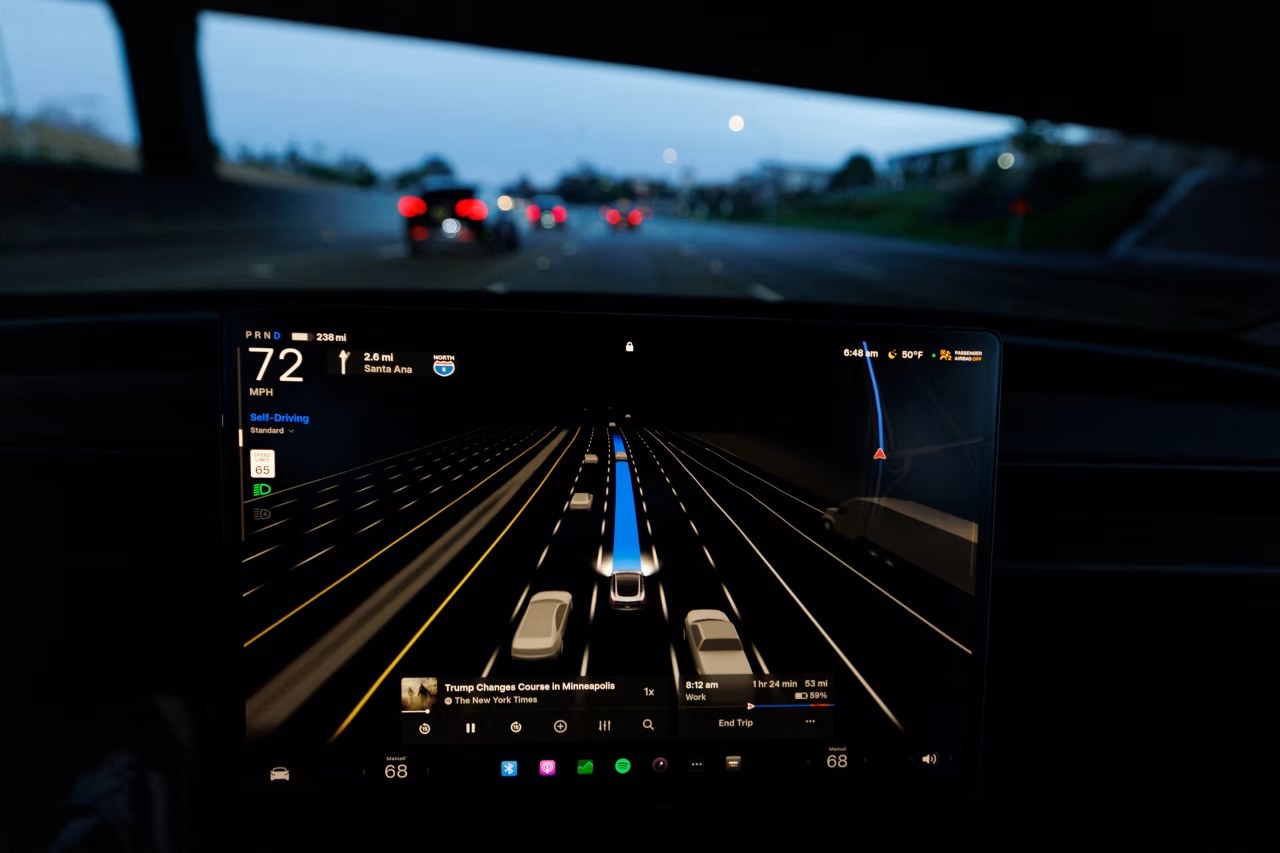
18 Crashes in Fog and Snow Trigger Expanded Tesla Full Self-Driving Probe Covering 2.4 Million Cars
- NHTSA escalated its Tesla Full Self-Driving investigation after 18 crashes in low-visibility conditions since 2021.
- The probe now covers 2.4 million Teslas equipped with FSD (Supervised) software released from 2019 onward.
- Federal investigators cite concern that the system fails when lane markings disappear under snow, water or fog.
- Tesla markets the $15,000 option as “capable of delivering full autonomy” yet requires constant driver oversight.
Regulators tighten the screws on Tesla’s boldest—and most lucrative—technology bet.
TESLA—Federal safety regulators have widened their investigation into Tesla’s automated-driving technology after a string of crashes exposed potential weaknesses in poor-visibility conditions. The National Highway Traffic Safety Administration (NHTSA) said Thursday it is escalating a probe that began as a limited review into Tesla’s Full Self-Driving (Supervised) system.
The upgraded investigation now covers roughly 2.4 million Tesla vehicles and focuses on whether the software can safely navigate when road markings are obscured by fog, heavy rain or snow. NHTSA has documented at least 18 incidents since 2021 in which Teslas operating with FSD struck stationary objects or veered off the road in such conditions.
For Tesla, the stakes are enormous. The Austin automaker charges up to $15,000 for FSD software it describes as “designed to provide autonomous driving,” yet the company simultaneously tells drivers they must keep hands on the wheel and eyes on the road. Any forced recall could dent both Tesla’s autonomous-vehicle narrative and a revenue stream analysts value at more than $10 billion in future cash flow.
From Limited Review to Engineering Analysis: How NHTSA Scales Up a Safety Probe
NHTSA’s Office of Defects Investigation (ODI) opened its initial assessment of Tesla’s Full Self-Driving software in 2021 after receiving 12 crash reports involving fog or standing water. At that stage, the probe covered 830,000 vehicles and carried the bureaucratic label “Preliminary Evaluation.” The agency can keep that status for up to 120 days while requesting data and meeting with automaker engineers.
Thursday’s upgrade converts the case to an “Engineering Analysis,” the final step before the agency can issue a recall request. Sam Abuelsamid, principal analyst at Guidehouse Insights, notes that once NHTSA reaches this stage, about 80 percent of probes end in a recall. “The bar is now much higher for Tesla,” Abuelsamid said. “They must prove the system is not defective rather than regulators proving it is.”
Between the two phases, investigators amassed 140 GB of data from Tesla, including 4,000 crash videos recorded by the cars’ own cameras. Engineers compared FSD’s behavior in 125 controlled tests on closed tracks and found that, when lane stripes were masked by salt residue or snow, the software frequently “disengaged lateral control,” according to NHTSA documents.
The agency also revealed that Tesla pushed an over-the-air software update in October that was supposed to improve low-visibility performance. Yet eight additional crashes occurred after the update, including a Model Y that struck a fire truck parked on a fog-shrouded interstate in Northern California. No injuries were reported in that incident, but firefighters on scene told investigators the Tesla did not brake or attempt evasive steering.
Regulators now want to know whether Tesla’s neural-network training data includes enough images of snowy or fog-covered roads. Internal emails released by NHTSA show Tesla engineers discussing a “winter data gap” as early as 2020. “We have 5 million miles of dry-pavement clips but only 300,000 miles from snow events,” one engineer wrote in a message dated 12 February 2020.
Consumer-advocacy group Center for Auto Safety applauded the escalation. Executive director Michael Brooks said, “Tesla has been beta-testing unfinished software on public roads for years. NHTSA is finally signaling that the public is not a testing lab.” Brooks urged the agency to require Tesla to disable FSD until a final safety recall is completed if a defect is confirmed.
What happens next
NHTSA has 180 days to complete the Engineering Analysis, though complex cases often take longer. If regulators conclude an “unreasonable risk” exists, they can demand a recall that would force Tesla to either update the software or limit where FSD can operate. Tesla can contest the finding in court, but history shows automakers usually settle.
Why Snow, Fog and Standing Water Expose a Blind Spot in Tesla’s Neural Network
Tesla’s Full Self-Driving package relies primarily on optical cameras and neural-network processing to interpret the roadway, a deliberate choice by Chief Executive Elon Musk to avoid costly lidar sensors used by competitors such as Waymo and Cruise. Yet cameras struggle when precipitation, glare or road-spray obscure lane markings, creating what engineers call a “perception vacuum.”
Phil Koopman, co-founder of Edge Case Research and a safety professor at Carnegie Mellon University, explains that neural networks are only as good as the data on which they are trained. “If Tesla’s training set under-represents snow-packed roads, the model will output low-confidence predictions and may cede control abruptly,” Koopman said. He noted that human drivers unconsciously use multiple redundant cues—tire tracks in snow, reflectors on guardrails, even the feel of rumble strips—to stay centered when paint is invisible.
NHTSA test data released Thursday show FSD disengaged steering assistance in 42 percent of runs when lane lines were artificially concealed with salt film. In 18 percent of those disengagements, the vehicle drifted more than 0.7 meters laterally within three seconds, enough to cross into an adjacent lane. No comparable failures occurred in identical tests on dry pavement.
Tesla’s own safety reports acknowledge the gap. The company told regulators it has collected 200 million miles of FSD driving data but only 7 million miles in precipitation, and conceded that “performance degradation is expected” on unmarked or snow-covered roads. Tesla advises drivers to disable FSD in such conditions, yet the system’s geofencing does not automatically restrict activation when weather deteriorates.
Competitors take a different path. Ford’s BlueCruise and GM’s Super Cruise combine cameras with high-resolution maps and infrared sensors to maintain lane discipline when paint disappears. Waymo’s fleet operates primarily in sunny Phoenix and San Francisco where snow is rare, but the Alphabet unit pre-maps every mile and uses lidar to create a real-time 3-D point cloud, reducing reliance on visible stripes.
Autonomy analysts say Tesla’s camera-only approach is cheaper but riskier. “They’re trading dollars for safety margin,” said Mike Ramsey, an automotive-tech analyst at Gartner. “When weather variability exceeds the training distribution, the system fails catastrophically rather than gracefully.” Ramsey estimates Tesla saves roughly $1,000 per vehicle by omitting lidar, a figure that scales to $2.4 billion across the 2.4 million vehicles now under investigation.
The legal exposure
Plaintiffs’ attorneys are already citing NHTSA data in pending civil suits. A class action filed in Santa Clara County Superior Court alleges Tesla engaged in “deceptive marketing” by advertising FSD as capable of “driving autonomously” while withholding that the system “cannot safely operate in common weather conditions.” Tesla has moved to compel arbitration, citing its purchase agreement, but a judge denied the motion for vehicles bought before 2022.
Can Tesla Fix Full Self-Driving With Another Over-the-Air Update?
Tesla has built its brand on rapid, smartphone-style software updates that promise to make cars safer while you sleep. Yet NHTSA’s expanded probe raises a thorny question: can a camera-only system ever handle white-out conditions without new hardware?
Inside Tesla, engineers have floated several fixes. One proposal, outlined in internal documents submitted to regulators, would fuse camera images with crowd-sourced road friction data collected from other Teslas. Another would use tire-slip sensors to estimate lane position when paint is hidden, a technique similar to rally-car navigation. Neither feature has reached consumers.
Over-the-air updates must also pass regulatory muster. If NHTSA deems FSD defective, any remedy must be “objectively measurable,” according to former NHTSA senior counsel Paul Hales. “Tesla can’t just say ‘we improved the neural net.’ They need to demonstrate a statistically significant reduction in crash rate under controlled conditions,” Hales said.
History offers mixed lessons. In 2021 Tesla recalled 54,000 vehicles to disable a “rolling stop” function that allowed cars to creep through stop signs at 2 mph. A simple code push satisfied regulators. But in 2023, NHTSA rejected Tesla’s proposed software tweak for phantom braking, forcing the company to replace a faulty forward-facing radar—hardware—in 1.1 million vehicles.
Analysts say a hardware recall would be financially painful. Tesla no longer installs radar on new cars, so retrofitting 2.4 million radar-less vehicles could cost $2,000 each, or $4.8 billion total, according to Guidehouse Insights. Even a partial retrofit limited to 500,000 vehicles in snowy states would approach $1 billion, erasing roughly 18 percent of Tesla’s projected 2024 free cash flow.
Tesla’s letter to NHTSA insists that “incremental software releases” will close the weather-performance gap. The company points to version 12.5, released to employees last month, which adds synthetic snow images during training. Yet regulators want real-world validation: Tesla must submit dash-cam video from 100,000 miles of winter driving before NHTSA will consider closing the investigation.
Investor implications
Morgan Stanley analyst Adam Jonas warned clients that “regulatory overhang could freeze FSD price increases,” a key pillar of Tesla’s margin expansion story. Tesla raised FSD pricing from $8,000 in 2020 to $15,000 today, contributing roughly $1.5 billion in high-margin revenue last year. A protracted recall could delay further hikes and depress take-rate, Jonas wrote.
What the Widening Probe Means for Tesla’s Autonomy Valuation
Wall Street values Tesla less like a carmaker and more like a tech platform, assigning a $600 billion-plus market cap largely on the promise that millions of FSD-equipped vehicles will eventually generate recurring software revenue. Any regulatory setback that slows deployment threatens that narrative—and the premium valuation attached to it.
ARK Invest, one of Tesla’s most vocal bulls, models a $2,000 per-share bull-case scenario predicated on FSD reaching full autonomy by 2026. Analyst Tasha Keeney told clients Thursday that “heightened NHTSA scrutiny could delay commercial robotaxi launch by 12–18 months,” trimming her price target by $300 to $1,700. Even so, ARK remains overweight the stock.
Bears see a bigger reckoning. Gordon Johnson, managing director at GLJ Research, argues Tesla’s “autonomy premium” is built on regulatory arbitrage that is now collapsing. “Tesla has sold consumers a beta product, collected billions in cash, and let the public underwrite its R&D,” Johnson said. He values FSD revenue at zero under a scenario where NHTSA mandates hardware retrofits and caps pricing until safety is proven.
Options markets signaled immediate concern. Tesla’s one-month implied volatility spiked 28 percent after the probe widened, the largest jump since last October when third-quarter deliveries missed estimates. Put-call skew tilted toward puts, indicating traders are hedging downside risk ahead of NHTSA’s final ruling.
Retail investors on Reddit’s r/teslainvestors largely shrugged off the news, calling it “regulatory theater,” yet institutional holders trimmed exposure. Form 13F filings show Vanguard Group reduced its Tesla stake by 2.1 million shares in the first quarter, while State Street cut 1.3 million shares. Neither firm cited the NHTSA probe specifically, but both flagged “regulatory uncertainty” in client notes.
Credit markets are also watching. Moody’s rates Tesla Baa3, the lowest investment grade. In a March note, the agency warned that “ongoing safety investigations could pressure governance scores and heighten litigation risk,” though it maintained a stable outlook citing Tesla’s $23 billion cash pile.
Long-term autonomy race
Even if Tesla resolves the weather-detection issue, competitors are moving fast. Mercedes-Benz received California approval last year to sell Level 3 “Drive Pilot” that works at up to 40 mph in heavy traffic, while Waymo operates fully driverless taxis in Phoenix and San Francisco. Tesla’s advantage—millions of customer-owned data collectors—erodes if regulators limit where FSD can operate.
Frequently Asked Questions
Q: What exactly is NHTSA investigating in Tesla’s Full Self-Driving system?
NHTSA is probing whether Tesla’s Full Self-Driving (Supervised) software can detect and react safely when road markings vanish in fog, snow or standing water. The probe now covers 2.4 million vehicles after 18 crashes in poor-visibility conditions since 2021.
Q: How many vehicles are affected by the expanded Tesla FSD probe?
The probe covers every Tesla equipped with FSD (Supervised) software—2.4 million Model 3, Model Y, Model S and Model X vehicles produced from 2019 onward.
Q: Could NHTSA force Tesla to recall Full Self-Driving?
Yes. If NHTSA’s Office of Defects Investigation finds an unreasonable safety risk, it can compel an immediate recall that might disable or restrict FSD features, cutting into Tesla’s $15,000-per-vehicle FSD revenue stream.
