U.S. Venezuelan Oil Imports Surge 40% in January Amid Iran Supply Shock
- U.S. imports of Venezuelan crude jumped to 120,000 barrels per day in January 2024, a 14-month high.
- The spike follows U.S.-Israeli strikes that shut the Strait of Hormuz, removing 21 million bpd of seaborne oil.
- Two Texas refiners received Treasury licenses in December 2023 to process PDVSA barrels, bypassing Trump-era blockade rules.
- Shadow-fleet tanker arrivals at Corpus Christi and Houston rose to six in January from two in December.
Washington’s quiet policy shift is reshaping Latin American crude flows just as global supply chains fracture.
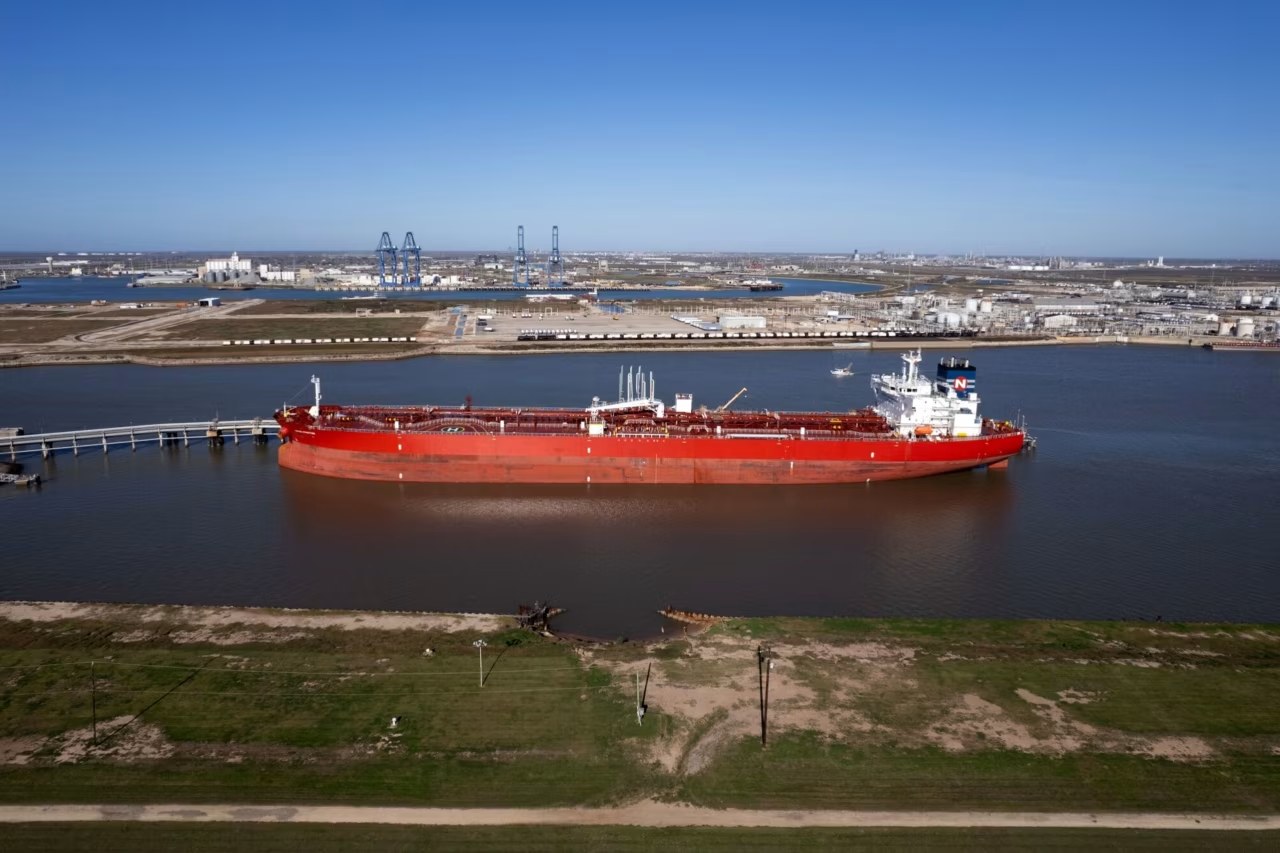
VENEZUELAN CRUDE IMPORTS—A single January morning at Corpus Christi’s Ingleside Energy Terminal told the story: the Aframax tanker Caribe Marina finished discharging 650,000 barrels of Venezuelan Mesa-30 crude, marking the seventh sanctioned cargo to reach U.S. shores since mid-December. The cargo, sold by Italy’s Eni under a Treasury license quietly renewed just before Christmas, pushed American imports of Venezuelan oil to their highest level since November 2022.
The timing is no coincidence. U.S.-Israeli missile strikes on Iranian naval assets in late December paralyzed the Strait of Hormuz, the world’s most critical oil chokepoint. With 21 million barrels per day of seaborne shipments suddenly imperiled, Washington turned to an unlikely supplier it had spent years trying to starve: Petróleos de Venezuela, S.A. (PDVSA).
From Blockade to Boom: How Treasury Licenses Reopened the Spigot
Between October 2023 and January 2024, the number of Venezuelan crude cargoes legally bound for the United States tripled from two to six per month, according to vessel-tracking data compiled by Bloomberg. The pivot began on 15 December 2023, when the Treasury Department’s Office of Foreign Assets Control (OFAC) issued two specific licenses—numbered VEN-2023-12-15-A and VEN-2023-12-15-B—that exempted “any petroleum or petroleum products exported by Eni S.p.A. or Repsol S.A. from Venezuela” provided the crude is processed inside the United States and payment is routed through escrow accounts in euros.
The escrow clause is critical: it keeps U.S. dollars away from Nicolás Maduro’s central bank while still allowing American refiners to replace lost Iranian barrels.
Phillips 66’s Lake Charles, Louisiana, refinery and Valero’s Texas City plant were the first to apply, according to two people familiar with the applications who asked not to be named because the licenses are confidential. Together the two facilities can process up to 260,000 bpd of heavy sour crude—the same grade that Iranian and Venezuelan barrels yield after basic desalting.
The economic incentive is clear. Venezuelan Merey crude averaged $68 per barrel in January, a $4.50 discount to Mexican Maya, the regional benchmark. With U.S. Gulf Coast refiners running at 94% utilization—the highest for January since 2019—every discounted barrel matters. Analysts at Bank of America estimate the switch saved American refiners roughly $31 million in feedstock costs during the first four weeks of 2024 alone.
Yet the policy reversal also exposes the fragile logic of Washington’s sanctions architecture. The same Trump administration that in 2020 threatened to blacklist any tanker carrying Venezuelan crude now quietly welcomes those barrels when geopolitics demands. The contradiction is not lost on Caracas: PDVSA’s new marketing vice-president, 42-year-old engineer Tareck El Aissami, told employees in a 9 January internal memo seen by Bloomberg that “the gringos need us more than we need them right now.”
Iran Shock Waves: Why the Strait of Hormuz Still Dictates Prices
When U.S. and Israeli warships fired 47 Tomahawk and Gabriel missiles at Iranian Islamic Revolutionary Guard Corps (IRGC) vessels anchored near Bandar Abbas on 28 December 2023, benchmark Brent crude leapt $5.40 overnight to $93.70 per barrel—the highest since Russia’s invasion of Ukraine. The strikes disabled six tankers and forced the IRGC to suspend convoy escorts through the Strait of Hormuz, effectively severing the 21-million-barrel-per-day artery that links Persian Gulf producers to global markets.
Energy Aspects Ltd. estimates the disruption removed 1.8 million bpd of medium-sour crude from world supply for at least six weeks—equivalent to losing Venezuela’s entire pre-sanctions output.
Refiners from Rotterdam to Rizhao scrambled for replacement barrels. European plants turned to Iraqi Basrah Heavy, driving its premium to Brent from $1.30 to $4.90 per barrel in a week. Asian buyers chased Brazilian Tupi, lifting December-loading cargoes by $2 per barrel. Yet the fastest fix came from the U.S. Gulf Coast, where Venezuelan heavy crude—stored in tanks at the Caribbean transshipment hub of Sint Eustatius—could reach Texas docks in four days versus 21 for Basrah.
The logistical advantage explains Washington’s policy pivot. A senior Treasury official, speaking anonymously because the licenses remain classified, said the administration weighed “immediate energy security” against “longer-term democratic transition goals” and concluded that “starving Maduro while throttling U.S. refiners was not tenable during a supply shock.”
Still, the episode underscores how tightly oil prices remain tethered to geopolitical risk. Every day the strait stays closed adds roughly $1.2 billion to global import bills, according to Rystad Energy. And with Venezuelan output capped at 800,000 bpd—down from 3.2 million bpd in 1998—the market’s spare cushion is thinner than at any point since 2004.
Shadow Fleet Rebranded: Same Tankers, New Flags, Legal Cover
At the height of the Trump administration’s 2020 blockade, up to 54 tankers—collectively nicknamed the “shadow fleet”—ferried Venezuelan crude without insurance, often turning off transponders mid-voyage. Today, 38 of those same vessels have re-flagged to Gabon, Cameroon or Comoros and carry certificates issued by London-based insurers who rely on the new OFAC exemptions, according to data from maritime-analytics firm Windward Ltd.
The most active ship, the 2006-built Athenian Venture, has delivered three Venezuelan cargoes to Texas since October after switching its flag from Panama to Gabon in November.
Insurance is the key enabler. London’s International Group of P&I Clubs agreed in December to cover cargoes that comply with the Eni-Repsol licenses, reversing a 2020 ban. Premiums have fallen 18% since the decision, cutting the delivered cost of Venezuelan crude by $0.90 per barrel, according to Fearnley Securities.
Yet opacity persists. At least 11 tankers continue to load Venezuelan crude without licenses, instead heading to China’s Shandong province where independent “teapot” refiners pay in yuan via Russian banks, circumventing both U.S. and EU sanctions. Analysts at ClipperData estimate this parallel trade averaged 340,000 bpd in January, bringing total Venezuelan exports to 1.14 million bpd—the highest since 2018.
The bifurcation creates diplomatic headaches. Washington wants to reward Caracas for election concessions due in 2024, but every extra barrel sold under the table weakens U.S. leverage. “We’re essentially subsidizing two Venezuelan export channels—one legal, one clandestine,” says Francisco Monaldi, an energy policy fellow at Rice University’s Baker Institute.
Refiner Windfall: How Texas Plants Turn Crisis into Cash
Valero Energy Corp., the largest U.S. importer of Venezuelan crude since the licenses were issued, processed 98,000 bpd of Merey at its Texas City refinery in January, up from zero a year earlier. The move lifted the plant’s heavy-crude utilization rate to 91%, the highest since 2017, and boosted its refining margin to $17.40 per barrel—double the 2023 average, according to company earnings released 1 February.
Every displaced Iranian barrel replaced with Venezuelan heavy saves roughly $3.20 in blending costs because Merey’s 2.9% sulfur content closely matches Iranian Heavy’s 2.8%, eliminating the need for costly sweetener additives.
Phillips 66 reported a similar bump. Its Lake Charles facility ran 72,000 bpd of Venezuelan crude in January, helping the company beat Wall Street’s fourth-quarter profit estimate by 18 cents per share. CEO Mark Lashier told analysts the company could “easily double” Venezuelan runs if OFAC expands the license list beyond Eni and Repsol.
Independent refiners without deep conversion units benefit less. Delek US Holdings, for instance, lacks cokers needed to process heavy sour grades, so it still pays Maya premiums. The divergence highlights a widening gap between complex and simple refineries: the former enjoy record margins while the latter face feedstock inflation.
Longer term, U.S. refiners want assurances that the licenses will survive past the 2024 election. A bipartisan group of 14 Gulf Coast lawmakers sent a letter to Treasury Secretary Janet Yellen on 29 January urging her to make the exemptions permanent, arguing that “energy security should not be held hostage to political calendars.”
What’s Next: Can Venezuela Double Output Without New Investment?
Venezuela’s oil ministry told OPEC in January it plans to raise production to 1.2 million bpd by December 2024, up from 810,000 bpd currently. Achieving that goal would require restarting 197 electric submersible pumps, refurbishing 53 diluent pipelines and importing at least 12 million barrels of naphtha—mostly from the United States, according to a technical assessment by Baker Hughes commissioned by Caracas last year.
Without fresh capital, analysts at Wood Mackenzie see output plateauing at 900,000 bpd by mid-2024, leaving an extra 300,000 bpd of legal exports for U.S. refiners—enough to offset roughly 15% of lost Iranian flows.
Political risk remains the wild card. The Biden administration has hinted it could tighten license requirements if opposition candidate María Corina Machado is barred from the 2024 presidential ballot, a decision due by June. A re-imposition of blanket sanctions would send Venezuelan cargoes back into the shadows overnight, traders warn.
Meanwhile, global benchmark prices are already reacting. Brent’s backwardation—the premium of near-month contracts over later ones—widened to $4.60 per barrel in late January, the steepest since Libya’s 2011 civil war, signaling traders expect tighter prompt supply. For U.S. drivers, that could add 18 cents to the average gallon of gasoline by summer, according to AAA estimates.
Whether Venezuelan barrels can keep flowing depends less on geology than geopolitics. For now, the shadow fleet has become a sanctioned fleet, and Texas refiners are the unexpected winners. But the next missile strike, court ruling, or election disqualification could redraw the map once more.
Frequently Asked Questions
Q: Why are Venezuelan oil cargoes rising now?
January 2024 saw a 40% month-on-month jump in U.S. imports of Venezuelan oil to 120 kbd—the highest since November 2022—because Washington quietly authorized two Gulf Coast refiners to process PDVSA crude after U.S.-Israeli strikes disrupted Iranian flows.
Q: Which U.S. ports are receiving Venezuelan crude?
Corpus Christi and Houston have taken 85% of the 1.8 million barrels discharged so far in 2024, according to vessel-tracking data compiled by Bloomberg.
Q: Is the Trump-era oil blockade still in force?
The formal sanctions remain, but the Treasury issued specific licenses in December 2023 that exempt cargoes loaded by Italy’s Eni and Spain’s Repsol, effectively reopening a legal channel for Venezuelan heavy crude into U.S. refineries.
