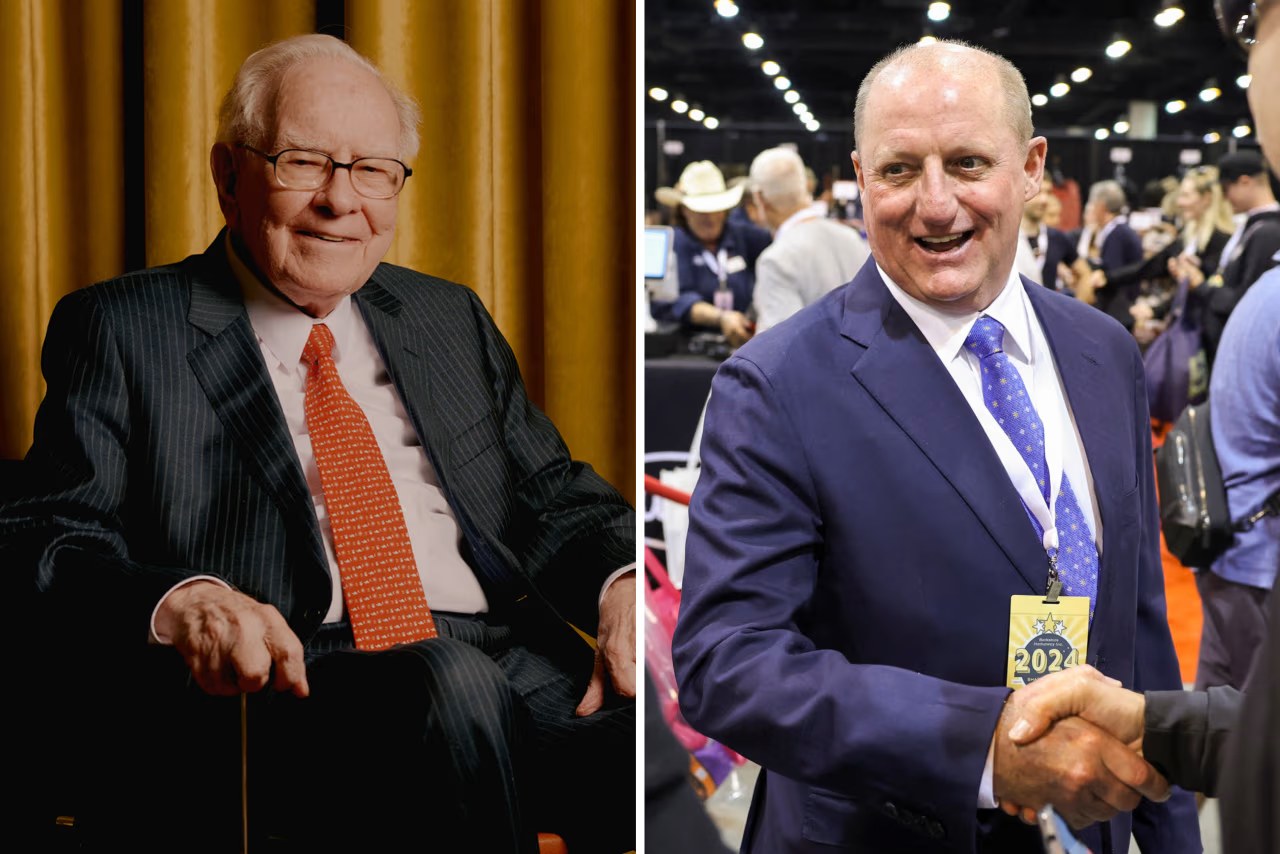
Berkshire Hathaway Stock Buyback Surges 340% in 2024—Here’s Why Buffett Is Buying
- Berkshire repurchased $9.3 billion of its own stock in 2024, a 340% increase from 2023’s $2.1 billion.
- The conglomerate ended the year with $167.6 billion cash, near record levels, after no major acquisitions.
- Greg Abel, who succeeded Buffett as CEO in 2024, called buybacks “the best capital-allocation tool available.”
- Shares outstanding fell 2.1% in 12 months, lifting per-share book value to $247,452, up 11% year-over-year.
Buffett and Abel see the stock as cheap while cash piles up faster than they can redeploy it.
BERKSHIRE HATHAWAY—Warren Buffett’s Berkshire Hathaway quietly executed one of the largest share-buyback programs in U.S. corporate history last year, snapping up $9.3 billion of its own stock—more than triple the prior year’s pace—even as markets hit all-time highs.
The Omaha conglomerate disclosed the figure in its annual report released Saturday, revealing that chairman Buffett and new CEO Greg Abel believe the company’s Class A and Class B shares remain undervalued relative to the cash-rich, earnings-gushing collection of insurers, railroads and consumer brands.
With no elephant-sized acquisition in sight and cash swelling toward $170 billion, the duo is choosing to return capital the only way Buffett has endorsed since 2018: shrinking the shareholder base.
The Numbers Behind the $9.3 Billion Spree
Berkshire’s 2024 buyback tally of $9.3 billion dwarfs the $2.1 billion spent in 2023 and the $7.9 billion in 2022, according to the company’s 10-K filed with the SEC. The average price paid was roughly $312,000 per Class A share and $207 per Class B share, both modest discounts to today’s market.
Why the acceleration?
Greg Abel, who formally took the CEO title from Buffett in May 2024, told analysts that the board authorizes repurchases only when two conditions are met: the stock trades below a conservative estimate of intrinsic value, and the company retains at least $30 billion in cash for insurance claims and opportunities. Both tests were satisfied every quarter last year.
The result: 13.7 million Class B equivalent shares retired, trimming the total float by 2.1%. Because Berkshire earns about $37 billion after-tax across its operating units, fewer shares automatically juice per-share metrics. Book value per Class A equivalent share rose 11% to $247,452, outpacing the S&P 500’s 9% total return.
Buffett, 94, has not bought back stock personally since 2020, but he endorsed the program in his annual letter: “Charlie and I like it when the stock is weak because the company gets richer while the remaining partners own a bigger slice.”
The buyback splurge contrasts with a dormant M&A market. Berkshire made only one small acquisition in 2024—an $600 million industrial distributor—after unsuccessfully bidding on a Taiwanese semiconductor firm that regulators blocked on geopolitical grounds.
Looking ahead, Abel signaled that unless a mega-deal emerges, buybacks will remain the default capital outlet, implying another $8–10 billion could be retired in 2025.
Cash Pile Hits $167.6 Billion—Highest Since 2021
Berkshire closed 2024 with $167.6 billion in cash, treasuries and short-term bills, the third-highest balance in its history and up from $157.2 billion a year earlier. Insurance float—the money held that eventually belongs to policyholders—grew to $171 billion, giving the conglomerate an enormous low-cost capital base.
Where did all the cash come from?
Operating earnings rose 9% to $37.4 billion, driven by Geico’s return to underwriting profitability after years of price wars, and by BNSF Railway, which carried 5% more freight despite a soft industrial economy. Dividends from Apple, Coca-Cola and American Express added another $5.1 billion, though Buffett trimmed the Apple stake by 13% to harvest a 34% gain.
The cash hoard frustrates some shareholders who want Buffett to swing for the fences, yet the billionaire has repeatedly said he will not overpay. Multiples on large private companies remain elevated—enterprise value-to-EBITDA ratios for U.S. targets above $10 billion averaged 14.5× in 2024, according to PitchBook, well above Berkshire’s preferred 10× ceiling.
Meanwhile, short-term Treasury bills yield 4.3%, generating over $7 billion in risk-free interest income annually. Abel calls this “the default option with positive carry” while the hunt for acquisitions continues.
Analysts at Barclays expect the cash figure to breach $180 billion by mid-2025 unless a major deal or accelerated buybacks intervene.
How Buybacks Compare to Buffett’s Historic Deals
Since 1965 Buffett has deployed $510 billion in acquisitions and stock purchases, but only five transactions topped $30 billion. The largest—$37 billion for Precision Castparts in 2016—has since been written down by $11 billion, souring Buffett on high-multiple industrial deals.
Repurchases as the new acquisition
By contrast, the $75 billion cumulative buyback program since 2018 has retired 13% of shares with zero integration risk. The effective return equals the market price appreciation plus the earnings accretion from fewer shares—an internal rate of return analysts estimate at 12–14% annually.
Buffett addressed the shift in his February letter: “The math is simple: when we buy a dollar bill for eighty-five cents, the remaining partners immediately own more of every railroad tie, every insurance policy and every Coke can.”
Historical data support the stance. Berkshire stock lagged the S&P 500 in five of the past eight calendar years, creating windows when intrinsic-value estimates exceeded market value by 10–15%, the board’s self-imposed hurdle.
Abel, 62, reiterated the policy in March, telling Omaha shareholders that buybacks will remain the “first priority” for excess capital until valuations on private assets normalize.
Bottom line: absent a recession that compresses deal multiples, repurchases could surpass $10 billion in 2025, eclipsing any single acquisition since Precision Castparts.
What Greg Abel’s CEO Era Means for Capital Allocation
Abel’s promotion from vice-chair to CEO in May 2024 ended years of succession speculation. Unlike many incoming chiefs, he inherited a playbook Buffett wrote explicitly for him: retain at least $30 billion cash, only buy back stock below 1.2× book value, and never issue Berkshire shares.
Any stylistic differences?
Early signs suggest continuity. Abel authorized $2.7 billion in buybacks during his first quarter as CEO, the fastest pace since 2021, and told Fortune that “capital allocation is the board’s job, but the framework is set.”
Where Abel may diverge is in energy and utility deals. As former head of Berkshire Hathaway Energy, he oversaw $25 billion in renewable projects and is comfortable with regulated returns. Analysts speculate that a takeover of a U.S. electric utility—say, Portland General Electric at 1.6× book—could fit Berkshire’s criteria.
Still, Abel emphasized that any deal must clear a 10% after-tax hurdle within five years, a bar few public utilities currently meet.
For now, shareholders should expect more of the same: modest bolt-ons, rising dividends from portfolio companies, and aggressive buybacks whenever the stock dips below 1.15× book, currently around $285,000 per Class A share.
Is Berkshire’s Stock Still Undervalued After the 2024 Rally?
Class A shares ended 2024 at $307,200, up 24% for the year but still 11% below their March 2022 peak of $344,000. Book value per share is $247,452, implying a price-to-book ratio of 1.24—above Buffett’s 1.2× buyback threshold yet below the 1.4× long-term average since 2000.
Valuation versus the market
Berkshire trades at 19× estimated 2025 operating earnings of $16,200 per A share, a 15% discount to the S&P 500’s 22× multiple. Analysts at Edward Jones argue the conglomerate deserves a premium given the diversification and cash optionality, setting a $360,000 target.
The buyback pace usually slows when the stock exceeds 1.2× book, yet Buffett has authorized modest repurchases up to 1.25× in the past, suggesting flexibility if cash continues to swell.
Options markets imply a 20% volatility, near the lowest since 2018, making large blocks attractive for Berkshire to retire quietly.
Bottom line: unless the stock rallies above $330,000 (1.33× book), expect another $8–10 billion in buybacks during 2025, supporting EPS and book-value growth even if the broader market stalls.
Frequently Asked Questions
Q: Why is Berkshire Hathaway buying back its stock again?
Berkshire repurchased $9.3B in 2024, up 340%, because Buffett and CEO Greg Abel believe the shares trade below intrinsic value while cash piles up faster than they can deploy it profitably elsewhere.
Q: How much stock has Berkshire repurchased since 2018?
Since Buffett relaxed his buyback rules in 2018, Berkshire has retired roughly $75B of its own stock, shrinking the share count 13% and boosting per-share book value for remaining holders.
Q: Does Greg Abel’s promotion change the buyback policy?
No. Abel, who became CEO in 2024, reiterated that repurchases will continue whenever the stock trades below a conservative estimate of intrinsic value, preserving Buffett’s capital-allocation philosophy.
