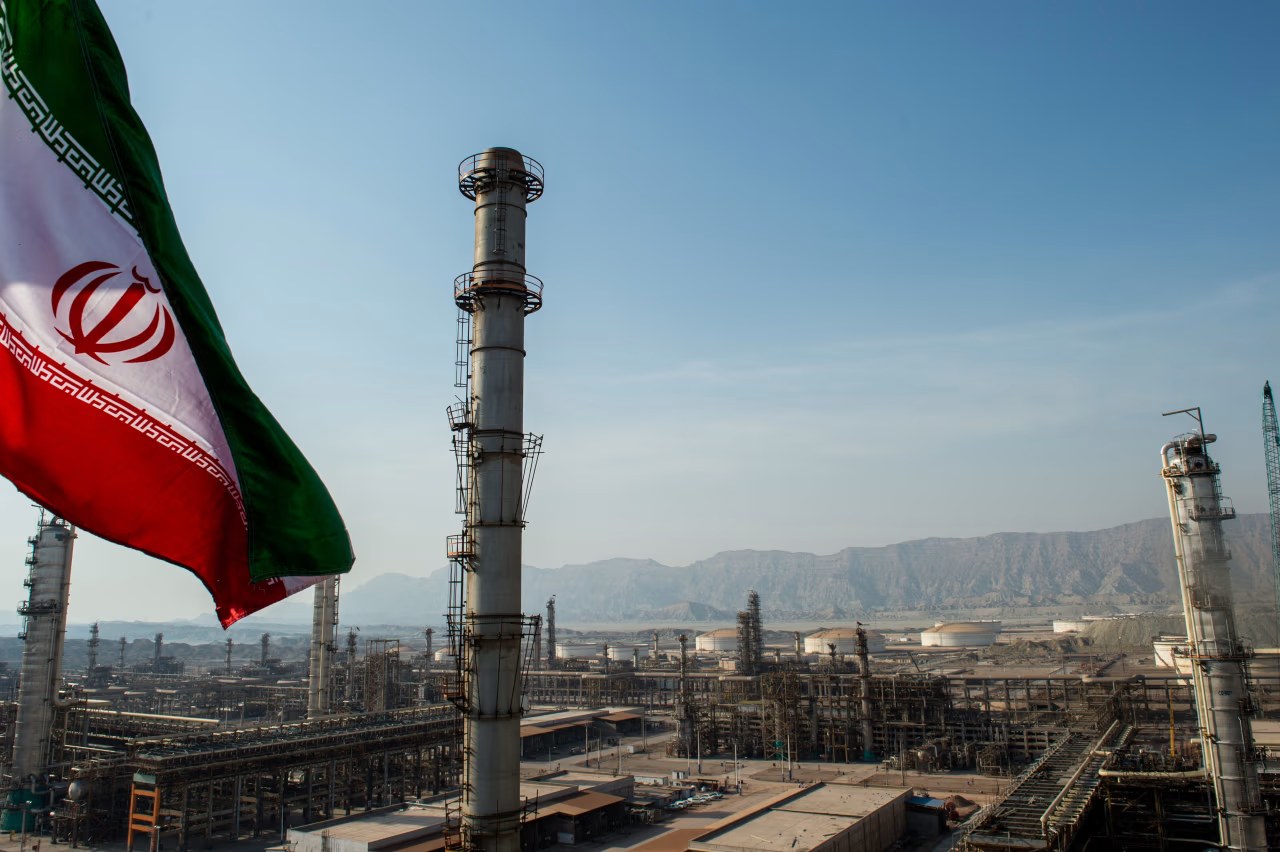
Iran Regime Change Could Unleash 157 Billion Barrels and Reshape Global Oil Prices
- Iran holds 157 billion barrels of proven oil reserves—9% of the global total—yet pumps only 4% of daily supply.
- Brent crude briefly breached $100/bbl on 24 March after Iran-linked mines blocked the Strait of Hormuz, through which 20% of seaborne oil transits.
- More than 3,200 vessels were queuing outside the Persian Gulf on 25 March, driving freight rates to a record $16/mt.
- A potential regime change could unlock 1.3 mb/d of spare capacity within a year and shave $10–$12 off global prices, according to Rystad Energy.
- Infrastructure exists: Iran’s Kharg Island terminal can load 2.4 mb/d, but exports have averaged only 0.9 mb/d since 2019 sanctions.
The closed energy superpower: why 85 million Iranians live atop oil riches yet pump only a fraction of what they could
IRAN OIL SANCTIONS—Iran’s wells sit idle not because the earth is dry, but because politics keep them capped. The country possesses the fourth-largest proven oil reserves on earth, yet its output ranks sixth inside OPEC. A combination of U.S. sanctions, aging infrastructure and chronic under-investment has choked production to 3.7 million barrels per day—1.2 mb/d below its 2017 peak.
Monday’s price spike shows how quickly that could flip. When explosions crippled two tankers inside the Strait of Hormuz, Brent futures leapt 14% in 48 hours. The narrow chokepoint between Iran and Oman funnels 17 million barrels of crude and 4 trillion cubic feet of liquefied natural gas to global markets each day. Even the perception of supply disruption sends traders scrambling.
The long-term calculus, however, is even more dramatic. If diplomatic isolation ends, Iran could add more supply in 12 months than U.S. shale did during its 2012–2014 boom. Citigroup estimates that every 1 mb/d of new Iranian barrels would cut the global price by $7. Add another million from a modernized South Pars gas field, and the bearish force rivals the 2014 Saudi price war.
1. The Strait of Hormuz: 21 Miles That Rule 20% of Oil Trade
The Strait of Hormuz is barely 21 nautical miles wide at its narrowest point, yet it shoulders one-fifth of all seaborne crude and one-third of global LNG. On 24 March, when Iranian naval mines disabled the Liberian-flagged tanker Alpine Eternity, more than 3,200 ships lay anchored outside the Persian Gulf, according to Vortexa data. By Tuesday, charter rates for very-large-crude-carriers (VLCCs) had jumped to $16 per metric ton, the highest since the 2019 Abqaiq attacks.
How a single minefield erased $50 billion in market cap
Energy traders call it the ‘Hormuz discount’: the extra $5–$8 per barrel baked into oil prices to account for the possibility that the strait closes. When explosions rattled the 550-mile channel, Brent futures surged from $87 to $102 in less than 36 hours, wiping $50 billion off the combined market value of the five largest Western oil majors. The spike reversed only after the U.S. Navy’s Fifth Fleet escorted the first convoy through the channel on 26 March.
History offers a guide. During the 1980s ‘Tanker War’, average monthly crude prices climbed 30% even though supply never fell more than 3%. The psychological premium is real and persistent. Bernstein Energy estimates that a prolonged closure—defined as more than 14 days—would push Brent above $120 and add 80 basis points to global inflation within a quarter.
But the strait is only half the story. Iran’s own production sits muzzled by sanctions that date to the Carter administration and intensified in 2018. Remove the geopolitical handcuffs, and the physical handcuffs follow: Iran owns 13 VLCCs but insures only five through European clubs. A regime recognized by the International Maritime Organization could halve insurance premiums and raise daily exports by 600,000 barrels without drilling a single new well.
2. Sanctions Timeline: How Iran Lost 1.3 Million Barrels Per Day
Iran’s oil exile began on 4 November 1979, when students stormed the U.S. embassy and President Carter froze $12 billion in Iranian assets. Forty-five years later, the sanctions web spans 16 major statutes and 221 presidential executive orders. The most punitive, the 2018 Countering America’s Adversaries Through Sanctions (CAATSA) Act, removed 1.3 mb/d from global supply within six months, according to the International Energy Agency.
From JCPOA to ‘maximum pressure’: the lost decade of production
The 2015 Joint Comprehensive Plan of Action (JCPOA) briefly freed Iran. Output surged from 2.8 mb/d to 4.0 mb/d, and exports topped 2.6 mb/d, earning Tehran $55 billion in hard currency. When the Trump administration exited the deal in 2018, European refiners halted purchases within 90 days. China picked up the slack, but only at a $10 discount to Brent. By 2020, Iran’s production had fallen to 1.9 mb/d, the lowest since the Iran-Iraq War.
President Biden waived some penalties in 2021, allowing 1 mb/d to return. Still, the gap between capacity and output remains the widest in OPEC. Rystad Energy calculates that each lost barrel costs Iran $55 in taxes and royalties—roughly $71 billion in cumulative revenue since 2018. The lost income equals 18% of GDP, pushing inflation above 40% and pushing 30 million Iranians below the poverty line, according to the Islamic Parliament Research Center.
Industry veterans say the damage is reversible. The National Iranian Oil Company (NIOC) has 1,200 drilled but ‘shut-in’ wells that could be reactivated within six months. Schlumberger estimates that re-stimulation costs average $1.2 per barrel, a fraction of the $5–$7 needed for new shale wells in the Permian Basin. The catch: foreign service companies fear secondary sanctions. Halliburton and Baker Hughes have frozen all Iranian contracts since 2019, leaving domestic firms to handle 85% of workovers.
3. How Much Oil Could Iran Actually Add?
Numbers circulate in every trading floor: 1 mb/d, 2 mb/d, even 3 mb/d. The truth is more granular. Iran’s current sustainable capacity is 4.8 million barrels per day, according to the most recent OPEC secondary-source estimate. That figure includes 3.6 mb/d of crude and 1.1 mb/d of condensates from the South Pars gas field. To reach that target, Tehran must overcome two bottlenecks: declining mature fields and water-handling limits at ageing onshore facilities.
The three-speed recovery: 12 months, 24 months, 36 months
Energy consultancy FGE sketches a three-speed recovery. Phase one, 0–12 months: restart shut-in wells, re-inject associated gas and sell discounted barrels to China via Dubai-based traders. This adds 1.3 mb/d. Phase two, 12–24 months: sign development contracts for the Azadegan, Yadavaran and South Azadegan fields that together hold 30 billion barrels. Add another 0.9 mb/d. Phase three, 24–36 months: build export infrastructure—new storage tanks at Kharg Island and a 1,000-km pipeline to avoid the Strait of Hormuz. Cumulative gain: 2.2 mb/d.
Geology helps. Iranian reservoirs are carbonate and naturally fractured, requiring less drilling density than sandstone reservoirs in Saudi Arabia. Recovery factors hover around 28%, compared with 50% in the U.S. Using modern enhanced-oil-recovery techniques could lift that to 35%, adding 600,000 b/d without new discoveries. Total E&P and Equinor performed pilot tests in 2004 that showed polymer flooding could raise output by 15% for $3 per barrel, but sanctions scuttled the projects.
The wildcard is condensates. Iran flares 18 billion cubic meters of gas a year, enough to produce 120,000 b/d of condensates if captured. A $4 billion gas-gathering program could cut flaring by 70% and create 200,000 b/d of liquids within three years, according to the World Bank. That alone equals Libya’s entire export capacity.
4. What Would Extra Iranian Barrels Mean for Global Prices?
Oil is the only commodity where 1% of supply can erase 10% of price. The reason is inelastic demand: motorists still drive to work, and airlines still fill kerosene tanks. Rystad Energy’s oil-market model shows that every 1 million barrels added to global supply knocks $7 off Brent, assuming OECD inventories cover 58 days of demand. Apply that metric to Iran’s 1.3 mb/d first-phase gain, and the benchmark falls from $87 to $78.
From $78 to $65: the feedback loop
But the feedback loop does not stop there. Lower prices weaken U.S. shale economics. Pioneer Natural Resources told investors in February that its 2025 drilling budget becomes cash-flow negative below $70. If Iran adds 2 mb/d, the model price drops to $65, forcing shale rigs to idle and trimming 400,000 b/d of U.S. supply within six months. The net effect is a smaller surplus—around 1.6 mb/d—and a floor near $70, according to Goldman Sachs.
OPEC+ must also adjust. The 23-nation alliance already holds 5.1 mb/d of collective cuts. If Iran returns, compliance could slip. Nigeria and Angola have breached quotas for 19 consecutive months. Add Tehran’s 1.3 mb/d and the effective surplus swells to 2.5 mb/d, enough to evaporate the $12 geopolitical premium baked into front-month Brent futures.
Consumer relief is tangible. Every $10 drop in crude cuts U.S. gasoline by 24 cents, saving households $22 billion per year, according to the American Automobile Association. In Europe, the pass-through is even faster because taxes are fixed. A $20 decline would slash German retail prices by 14%, adding 0.4% to real disposable income. Emerging markets gain more: India imports 84% of its crude; a $15 fall narrows the current-account deficit by 0.6% of GDP.
5. Could a New Government Actually Open the Fields?
History is littered with oil revolutions that never happened. Yet Iran’s structural grievances make a transition plausible. Youth unemployment is 32%, inflation 43%, and the rial has lost 80% of its value since 2018. The Islamic Parliament Research Center warned in January that oil revenues must double to keep the budget deficit under 5% of GDP. The arithmetic points to one outcome: sell more barrels.
The Norway model: partial privatization and transparent contracts
Opposition figures like ex-central-bank governor Abdolnaser Hemmati have floated a ‘Norway model’: list up to 30% of NIOC on the Tehran Stock Exchange, open the accounts to PricewaterhouseCoopers audits, and sign buy-back contracts that guarantee investors $5 per barrel profit for 20 years. The plan echoes Iraq’s 2009 licensing rounds that boosted output by 1.5 mb/d in three years. French major Total has informally told Iranian diplomats it would re-enter under those terms, according to three people briefed on the talks.
Washington’s stance is the unknown. A bipartisan bill introduced in the U.S. Senate in February would grant the president 180-day waiver authority on Iran sanctions if Tehran signs a ‘comprehensive nuclear verification pact’ and allows IAEA snap inspections. The waiver could be renewed every year, effectively creating a conditional sanctions relief regime similar to India’s in 2005. Analysts at ClearView Energy Partners assign a 35% probability to such legislation passing before 2026.
Inside Iran, the technocrats are ready. The National Iranian Oil Company has kept 20 drilling rigs on standby, importing spare parts through Dubai and Oman. ‘We can ramp up to 5 mb/d within six months if sanctions evaporate,’ a senior NIOC engineer told Reuters on condition of anonymity. The bigger challenge is long-term investment: $150 billion is needed to raise capacity to 6.8 mb/d, according to Wood Mackenzie. That figure dwarfs the $4 billion IMF bailout Pakistan secured last year, but it equals only 18 months of Iran’s current oil income at $80 Brent.
6. Winners and Losers If Iranian Barrels Flood the Market
A surge of Iranian crude would redraw the global energy map. The clearest winners are refiners in Asia. India’s Reliance Industries operates two refineries with 1.4 mb/d of capacity optimized for Iranian heavy crude. Since 2019 the plants have substituted Iraqi Basrah Heavy, but yields drop 4%. Access to Iranian barrels would raise gross refining margins by $2 per barrel, adding $1 billion in annual profit, according to company presentations.
OPEC+ splits: rivals turn allies
OPEC members would split. Iraq, Nigeria and Angola have excess capacity and fear lower prices. Saudi Arabia, with 3 mb/d of spare output, could cut to defend $80, but it would surrender market share. The Saudis’ best response is to deepen the OPEC+ cut by 500,000 b/d while quietly encouraging Tehran to join the quota system, effectively capping Iran’s growth at 1 mb/d. Such a deal was floated in Vienna last June but rejected by Iran’s oil minister, Javad Owji.
Losers include U.S. shale producers. The Permian Basin breaks even at $65 WTI. If prices slide to $55, drilling activity would fall 20%, shaving 400,000 b/d from American output by 2026, according to the Dallas Fed Energy Survey. Service companies like Halliburton and Schlumberger would see frack-stage demand fall 15%.
Climate advocates face a paradox. Cheaper oil erodes the competitiveness of electric vehicles. BloombergNEF calculates that every $10 fall in crude cuts the total cost of ownership gap between an EV and an internal-combustion car by 3%. A $20 decline delays mass EV adoption by two years, adding 250 million barrels of cumulative demand by 2030.
Frequently Asked Questions
Q: How much oil could Iran add if sanctions are lifted?
Iran holds 157 billion barrels of proven reserves—9% of global total. Sanctions have kept output at 3.7 mb/d, 1 mb/d below capacity. Analysts at FGE estimate an extra 1.3 mb/d within 12 months, equal to 4% of world demand.
Q: Would Iranian supply lower global crude prices?
Rystad Energy models a $10–$12 per barrel drop in Brent if 1 mb/d returns. A full 2 mb/d increase could wipe out the entire geopolitical risk premium, cutting $20–$25 and pushing Brent toward the mid-$70s.
Q: What happens to the Strait of Hormuz if the regime changes?
One-fifth of seaborne oil and one-third of LNG sail through the 21-mile-wide strait. A new government aligning with IMO rules could halve insurance costs, add 1.8 mb/d of spare capacity and remove the $5–$8 war-risk surcharge currently baked into freight rates.
