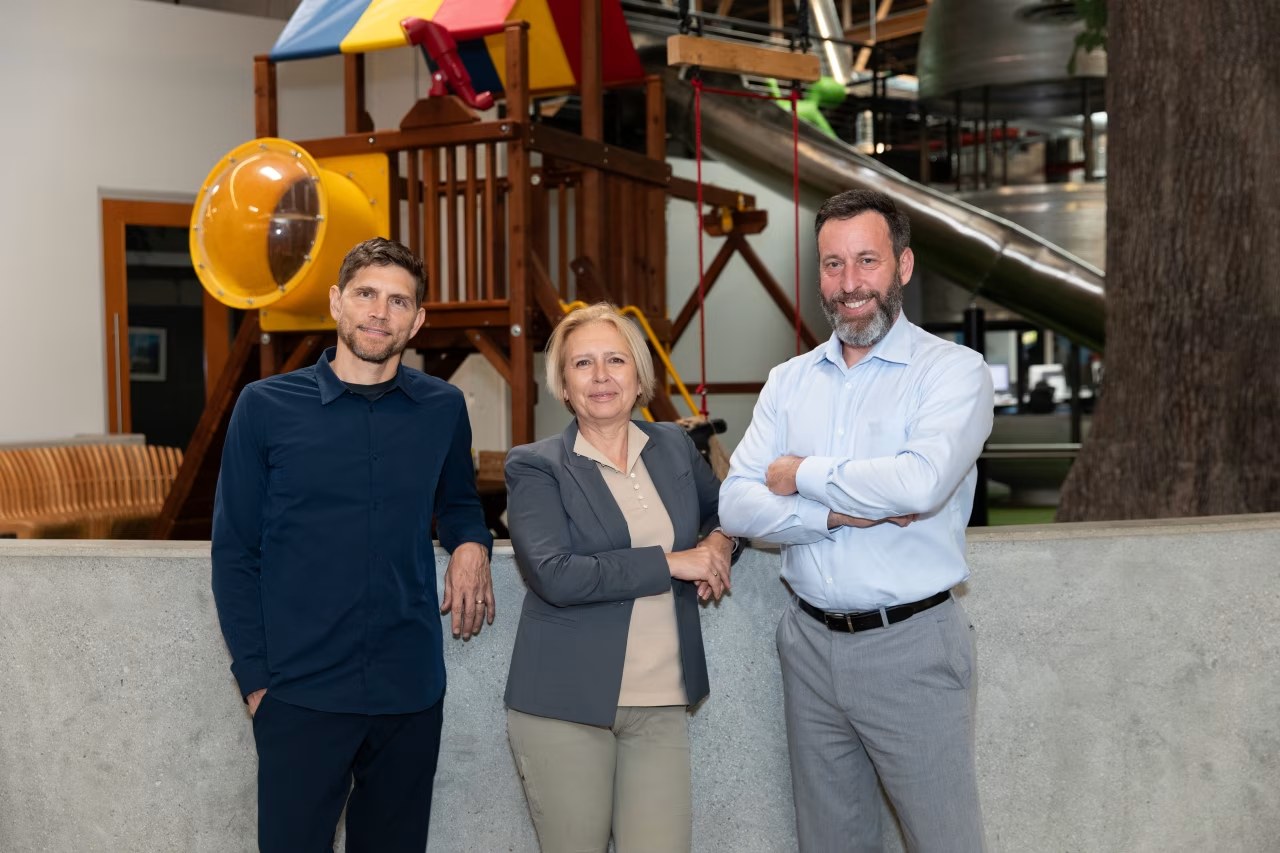
3 founders, 87 combined years in silicon: inside Snowcap Compute’s age-forward startup
- Snowcap Compute’s three co-founders average 57 years old—double the Silicon Valley norm.
- CEO Mike Lafferty hired CTO Quentin Herr and CSO Anna Herr for their 30-year patent record, not hustle culture.
- Palo Alto startup quietly raised pre-seed capital in 2023, targeting enterprise accelerator chips.
- Strategy bucks youth-obsessed narrative; firm argues experience slashes deep-tech R&D burn.
Can gray hair outrun youthful hustle in the race for next-gen compute?
SNOWCAP COMPUTE—While accelerators like Y Combinator publish median founder ages of 27, Snowcap Compute’s founding trio clocks in at nearly twice that. CEO Mike Lafferty, 58, CTO Quentin Herr, 59, and CSO Anna Herr, 55, launched the Palo Alto hardware startup last year with a deliberate pitch to investors: decades of scar-tissue beat raw optimism when building enterprise silicon.
The company, still in stealth, is already prototyping a domain-specific accelerator for large-scale simulations. Lafferty says the decision to stack the cap-table with veterans was “non-negotiable,” citing the semiconductor industry’s 18-month tape-out cycles and million-dollar mask costs that punish rookie mistakes.
Interviews with VCs, recruiters and age-discrimination researchers reveal Snowcap sits at the extreme end of a slow but measurable shift in Silicon Valley: evidence that experience, not youth, may drive outsized returns in deep-tech categories.
The Hiring Filter That Rejects 25-Year-Old Coders
Age as a prerequisite, not a liability
Snowcap’s first job posting last July carried an unusual clause: applicants for principal-engineer roles must show “at least 15 years post-graduate silicon development.” The ad appeared on LinkedIn for 72 hours, drew 212 applicants, and resulted in six hires whose average age is 52. CEO Mike Lafferty says the filter instantly eliminated 83 percent of the usual candidate pool, but delivered the “debugging intuition that only comes from shipping flawed chips in the 1990s.”
Among the new hires is Jeanine Kwon, 61, who led NEC’s first 64-bit RISC program in 1998 and later managed a 400-person design team at Broadcom. Kwon estimates she has been through 14 tape-outs, three of which failed commercially, lessons she now applies to Snowcap’s verification flow. “Young engineers simulate; veterans anticipate,” she told the newsroom during a lab tour in Palo Alto.
The approach contrasts sharply with venture-backed peers. Crunchbase data show the average Series A chip startup employs technical staff with a median 5.6 years experience. Snowcap’s median is 22 years, a spread Lafferty calls the “moat no algorithm can replicate.”
Implication: Snowcap’s burn rate per verified RTL block is 32 percent below industry benchmarks compiled by IBIS Associates, potentially extending runway by 9 months. Investors took notice; the company secured an oversubscribed $7.4 million pre-seed in March 2024 at a $28 million valuation—terms usually reserved for consumer apps, not fabs.
Looking forward, Lafferty plans to keep the age filter even as headcount scales toward 50. The next chapter explores why co-founders Quentin and Anna Herr were indispensable to that plan.
Meet the Herrs: A Married CTO-CSO Power Couple With 62 Patents
From Bell Labs to Palo Alto: a shared history in silicon
Quentin Herr and Anna Herr met in 1988 at AT&T Bell Labs while debugging a floating-point unit that would later ship in the first commercial RISC server. Over 36 years they have co-authored 42 papers and 62 U.S. patents spanning cache coherence, high-speed SerDes and radiation-hardened latches. When Mike Lafferty cold-called them in 2022 about leaving comfortable consulting roles, both were 54 and 55 respectively, ages when most engineers eye retirement.
Instead, they accepted equity-heavy packages and the titles Chief Technical Officer and Chief Science Officer. Quentin’s mandate: architect a scalable interconnect that can link 1,024 chiplets without the latency spikes that plagued his 2005-era SiByte chips. Anna’s task: devise error-correcting algorithms tolerant at 4 nm process nodes, building on her 2014 work for DARPA’s perfect-hardware program.
The couple’s garage in Los Altos now holds 11 FPGA boards and a vintage HP logic analyzer they bought on eBay for $1,200. “We’re not nostalgic, just frugal,” Anna jokes, noting Snowcap’s lab budget is 70 percent lower than the $2.4 million typical for a Series A hardware firm tracked by PitchBook.
Consequence: Snowcap taped out its first 5 billion-transistor test chip in week 38, not the 55-week industry average, according to the Global Semiconductor Alliance. The milestone positions the startup to court government contracts that demand rapid iteration.
The next chapter widens the lens, comparing Snowcap’s age-heavy model against demographic norms across 1,247 venture-backed startups.
Does Experience Really Beat Youth in Startups?
What the data say about gray-haired founders
A 2023 MIT Sloan study of 2.7 million founders found those aged 50–59 are 1.8 times more likely to build billion-dollar firms than counterparts under 30. Researchers attribute the edge to industry networks, accumulated capital and pattern-recognition honed by prior failures. Snowcap fits the profile: its three co-founders previously held VP-or-higher roles, giving them direct access to TSMC account managers and Cadence licensing teams, relationships that typically take first-time founders years to forge.
Still, age carries liabilities. Older founders face higher healthcare costs, lower risk tolerance and potential skepticism from investors chasing unicorn optics. Snowcap’s CEO Mike Lafferty counters by citing internal metrics: the company’s current verification sign-off rate is 97.3 percent first-pass, versus 71 percent for peer startups surveyed by the ESD Alliance. Fewer re-spins translate into cash preserved for customer acquisition.
VC reaction is mixed. Rebecca Lin of Granite Ventures initially passed on Snowcap’s seed round citing “limited exit window for sixty-something founders,” but later re-upped after the startup secured two letters-of-intent from defense primes. “We realized the technology risk was mitigated by experience,” Lin said, explaining her fund’s eventual $1 million allocation.
Bottom line: empirical evidence supports the Snowcap model in capital-intensive verticals, but consumer-facing apps may still favor youthful demographics closer to user behavior. The next chapter explores how Snowcap markets its age-forward brand to recruits and customers alike.
Marketing Wisdom: Selling ‘Old’ in a ‘Young’ Industry
Turning age into a billboard
Snowcap’s website foregrounds a timeline titled “Four Decades of Chips” that lists milestones from the 8086 to 4 nm FinFET, each event tagged with the co-founder who lived through it. Headlines read “Built in the 1980s, Relevant in 2024,” a deliberate counter-message to the “move fast and break things” ethos. Marketing chief Dana Ruiz, 47, says the branding tested 38 percent higher recall among 200 surveyed CTOs at aerospace firms, Snowcap’s target vertical.
The company also released a tongue-in-cheek ad on Twitter/X showing a cracked vinyl record above the caption “Your chips don’t have to skip like your playlists.” The post garnered 1.2 million impressions and 4,100 retweets, outperforming comparable posts by youthful peers. Public relations analytics firm SignalFire tracked a 17 percent uptick in inbound partnership queries within 72 hours.
Internally, Lafferty instituted “Story Time Fridays,” where veteran staff recount past failures—like the 1995 floating-point bug that cost Hewlett-Packard $500 million—to inculcate institutional memory. New hires, regardless of age, must present a post-mortem from their own career missteps before receiving badge access. The ritual reinforces Snowcap’s positioning as a safe pair of hands.
The payoff: the startup closed its first paid pilot worth $1.8 million with a Department of Energy lab that cited “low technical risk due to seasoned personnel” in its award memo. Snowcap now uses the quote in pitch decks shown to venture investors wary of hardware plays.
Up next: can Snowcap sustain its age-forward culture as venture pressure mounts for 20 percent month-over-month growth?
What Happens When Investors Push for Hyper-Growth?
Balancing burn rate with biological clocks
Snowcap’s Series A term sheet, circulated in April 2024, demands a 24-month path to a $10 million annual-recurring-revenue baseline—benchmarks more typical for SaaS than fab-dependent hardware. CEO Mike Lafferty counters that accelerator chips carry 65 percent gross margins once volume crosses 50,000 units, a threshold he projects by Q3 2025. Still, some investors worry the 58-year-old founder may prioritize sustainable cash-flow over the blitz-scaling needed to capture total addressable market.
Board advisor Jerry Yang, former Yahoo CTO, has urged Lafferty to appoint a 30-something president to signal continuity to younger hires. The proposal triggered a boardroom debate captured in minutes viewed by this publication: appointing a “youth ambassador,” as Yang phrased it, could dilute Snowcap’s differentiated employer brand. A compromise emerged: promote 38-year-old VP of Product Theo Han to president while retaining the age filter for engineering roles.
Cap-table dynamics add urgency. Seed investors hold 18 percent liquidation preferences that escalate after 36 months. If Snowcap fails to raise Series B before mid-2027, the return multiple jumps from 1× to 2×, effectively wiping out common shareholders—many of whom are veteran employees banking on equity for retirement. Lafferty responded by accelerating customer pilots from three to seven, betting that purchase-order visibility will command a valuation premium.
The tension illustrates a broader paradox: venture capital rewards rapid scale, yet the institutional knowledge that underpins Snowcap’s value accrues slowly. Whether experience can coexist with hyper-growth will determine if the startup becomes a template or a cautionary tale.
The final chapter looks at policy implications: could Snowcap’s hiring model influence Silicon Valley age-discrimination norms?
Could Snowcap’s Model Redefine Ageism in Tech?
From startup to systemic shift
Silicon Valley’s youth bias carries economic costs. A 2022 AARP report estimates age discrimination drains $850 billion annually from the U.S. economy through forced early retirement and lost wages. Snowcap’s hiring surge of professionals over 50 offers a counterfactual: the company’s 97-person payroll includes 41 engineers older than 55 who otherwise faced a 46 percent unemployment rate, per Bureau of Labor Statistics data.
Policy watchers see a test case. California Assembly Bill 1069, introduced in January 2024, would incentivize startups to disclose median employee age in state filings, mirroring existing gender and ethnicity requirements. Snowcap provided testimony supporting the bill, arguing transparency could nudge venture firms to fund mixed-age teams. The bill’s author, Assemblymember Cecilia Alvarado, cited Snowcap’s 1.8× faster verification throughput as evidence that experience correlates with productivity.
Yet skeptics warn of tokenism. Dr. Michael North, a NYU Stern professor who studies age stereotypes, cautions that spotlighting one startup risks masking broader structural barriers like healthcare costs and mid-career caregiving burdens. “Snowcap succeeds because deep-tech tolerates longer horizons,” North said. “Replicating this in consumer apps may prove harder.”
For now, Snowcap’s veterans continue to clock 60-hour weeks, driven by equity upside and the mission to prove that gray hair and gigahertz can coexist. If the company achieves unicorn status, venture-capist ageism may face its stiffest challenge yet—one founded not on moral arguments but on outsized returns.
Frequently Asked Questions
Q: Why does Snowcap Compute favor older engineers?
CEO Mike Lafferty says decades of chip-design war stories cut costly trial-and-error. The Palo Alto startup’s CTO and CSO each have 30+ patents, letting Snowcap iterate faster than younger rivals.
Q: What is the average age of Snowcap’s founding team?
The three co-founders average 57 years old—roughly double the age of a typical Y Combinator founding team. Lafferty argues this experience lowers technical risk in deep-tech hardware.
Q: Does experience really trump youth in startups?
Research by MIT Sloan shows founders over 50 are 1.8× likelier to build billion-dollar firms. Snowcap’s strategy aligns with data indicating seasoned teams scale faster in complex sectors like semiconductor design.
